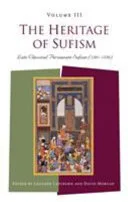
The Heritage of Sufism
 84
84

The Heritage of Sufism
Leonard Lewisohn's *The Heritage of Sufism* is a monumental undertaking, offering a chronological sweep that few other studies achieve. Its principal strength lies in its sheer scope, demonstrating the deep integration of Sufi thought into the fabric of Persianate societies from its early centuries through to the colonial period. The work particularly excels in illustrating the intellectual diversity within Sufism itself, moving beyond monolithic interpretations. A minor limitation, perhaps inherent in such a broad survey, is that some individual figures or schools receive less detailed attention than a specialist might desire. However, Lewisohn's exploration of the Khwajagan movement in Central Asia, connecting early figures to later developments, provides a particularly illuminating thread. This is an indispensable reference for serious students of Islamic mysticism, offering a solid foundation for further research. It is a scholarly achievement that grounds mystical aspiration in historical reality.
📝 Description
84
### A Vast Chronology of Sufi Thought This work presents an expansive survey of Sufism, charting its evolution across centuries and diverse geographical regions. It meticulously details the movement's intellectual currents and historical trajectory, underscoring its pervasive influence.
### Understanding Sufism's Role in Persianate Culture Lewisohn's study highlights how Sufism became deeply interwoven with Persianate cultures across Iran, Central Asia, and India. The book demonstrates the spiritual and intellectual underpinnings Sufism provided to these societies.
### Intellectual Diversity and Historical Scope The volume distinguishes itself through its chronological breadth and intellectual variety, showcasing a wide array of Sufi thinkers and traditions. It maps the development from early asceticism to later philosophical schools.
### The Centrality of Sufism *The Heritage of Sufism* argues compellingly for the foundational role of Sufism in shaping the cultural and spiritual landscape of the Persianate world. It moves beyond mere hagiography to offer a critical historical analysis.
💡 Why Read This Book?
• Gain a comprehensive understanding of Sufism's historical trajectory, particularly its development within Persianate cultures from the early Islamic centuries up to the modern era. • Explore the intellectual diversity within Sufism itself, moving beyond simplistic categorizations to appreciate the range of thinkers and practices covered, such as the philosophical contributions of figures like Ruzbihan Baqli. • Grasp the specific societal impact of Sufism in regions like Iran, Central Asia, and India, understanding its role in shaping cultural and spiritual life as detailed in the book's extensive historical account.
⭐ Reader Reviews
Honest opinions from readers who have explored this book.
❓ Frequently Asked Questions
What is the chronological scope of *The Heritage of Sufism*?
The book covers a vast chronological span, beginning with the early ascetic movements in Islam and tracing the development of Sufism through many centuries, providing a comprehensive historical overview.
In which geographical regions does the book focus on Sufism's influence?
The study emphasizes Sufism's central role in Persianate culture, specifically detailing its impact in Iran, Central Asia, and the Indian subcontinent.
Who is the author of *The Heritage of Sufism*?
The author is Leonard Lewisohn, whose original publication date for this comprehensive study was December 1, 1999.
What distinguishes this study from other works on Sufism?
Its unique strengths lie in its chronological breadth, intellectual diversity, and historical scope, demonstrating Sufism's foundational role in Persianate societies.
Does the book cover early Sufi masters?
Yes, the work explores the evolution from early asceticism, covering various stages and figures in the development of Sufi thought and practice across different eras.
Is *The Heritage of Sufism* suitable for beginners?
While comprehensive, its scholarly depth makes it particularly valuable for those seeking an in-depth historical and intellectual understanding of Sufism's development.
🔮 Key Themes & Symbolism
Sufi Asceticism and Early Practices
The work examines the foundational period of Sufism, detailing the early ascetic renunciations and spiritual disciplines that characterized the movement's nascent stages. It traces the development of core practices and ethical frameworks from figures like Hasan al-Basri, exploring how these early commitments laid the groundwork for the rich philosophical and poetic traditions that followed, demonstrating a commitment to inner purification and detachment from worldly concerns.
Sufism in Persianate Cultural Sphere
A central theme is Sufism's profound integration into the cultural and intellectual life of the Persianate world. Lewisohn illustrates how Sufi ideas and poetry permeated societies in Iran, Central Asia, and India, influencing literature, philosophy, and social customs. The book highlights the shared linguistic and cultural heritage that facilitated this spread, showing Sufism not as an isolated phenomenon but as a dynamic force within a broader civilizational context.
Intellectual Diversity of Sufi Thought
The study emphasizes the wide spectrum of thought within Sufism, moving beyond stereotypes to reveal diverse philosophical approaches and spiritual methodologies. It showcases the contributions of various schools and individuals, from early mystics to later thinkers who engaged with Neoplatonic and other philosophical currents. This exploration reveals Sufism as a multifaceted tradition with a rich internal dialogue spanning centuries.
Chronological Development and Transmission
Lewisohn meticulously maps the historical evolution of Sufism, charting its development across distinct periods and geographical shifts. The book focuses on how teachings and practices were transmitted through various lineages and disciples, illustrating the continuity and adaptation of Sufi traditions over time. This chronological approach provides a vital framework for understanding the historical forces that shaped Islamic mysticism.
💬 Memorable Quotes
“The central role played by Sufism in Persianate culture.”
— This highlights the book's core argument: that Sufism was not peripheral but integral to the cultural, spiritual, and intellectual life of societies influenced by Persian language and traditions.
“Chronological breadth, intellectual diversity and historical scope.”
— These phrases underscore the academic rigor and comprehensive nature of the study, pointing to its extensive timeline, varied perspectives within Sufism, and detailed historical analysis.
“Sufism in Iran, Central Asia and India.”
— This specifies the primary geographical focus, indicating that the book examines the manifestation and impact of Sufi traditions across key regions of the Islamic world influenced by Persian culture.
“Demonstrates the central role played by Sufism.”
— This emphasizes the book's analytical approach, suggesting it provides evidence and argumentation to support its thesis about Sufism's fundamental importance in specific cultural contexts.
“A comprehensive study.”
— This simple descriptor points to the depth and thoroughness of the research, positioning the work as a significant and detailed exploration of its subject matter.
🌙 Esoteric Significance
Tradition
This work primarily engages with the esoteric lineage of Islamic mysticism, Sufism. While not directly aligned with Western esoteric traditions like Hermeticism or Kabbalah, it offers profound insights into a parallel spiritual path focused on direct experiential knowledge of the Divine. Lewisohn's study fits within this lineage by meticulously documenting its historical development, intellectual formulations, and practical applications, providing a scholarly framework for understanding its esoteric dimensions without necessarily adopting its practices.
Symbolism
Key symbols explored include the concepts of *fana* (annihilation of the self in God) and *baqa* (subsistence in God), central to the Sufi path of spiritual transformation. The motif of the 'beloved' (often symbolizing the Divine) and the lover (the human soul) is also pervasive, representing the passionate yearning for union. The book likely delves into the symbolic language of Persian poetry, a primary vehicle for expressing these esoteric states and concepts, particularly in the works of masters like Rumi.
Modern Relevance
Contemporary scholars of comparative religion and spirituality continue to draw upon Lewisohn's meticulous research. Modern practitioners of contemplative traditions, both within and outside Islam, find value in understanding the historical roots and diverse expressions of Sufi practices. Thinkers exploring non-dual philosophies and the psychology of consciousness often reference Sufi concepts and figures documented in this work, recognizing its contribution to understanding mystical experience across cultures.
👥 Who Should Read This Book
• Students of Islamic history and comparative religion: This book offers a foundational, chronologically structured overview of Sufism's development and cultural impact across key regions. • Scholars of Persian literature and culture: Readers interested in how mystical thought shaped poetry, philosophy, and social life in Iran, Central Asia, and India will find extensive detail. • Advanced practitioners of contemplative or esoteric traditions: Those seeking to understand the historical depth and diverse expressions of a major spiritual path will benefit from its scholarly breadth.
📜 Historical Context
Published in 1999, *The Heritage of Sufism* emerged during a period of renewed academic interest in Islamic mysticism, seeking to move beyond Orientalist tropes. Lewisohn's work grappled with the intellectual currents of the late 20th century, which favored nuanced historical and textual analysis over essentialist interpretations of religion. The book's chronological and geographical scope aimed to counter fragmented studies, situating Sufism within the broader context of Persianate civilization, which had been a subject of extensive scholarship since the mid-20th century. While not directly engaging with a specific competing school of thought in a polemical way, it implicitly offered a more integrated historical narrative than some earlier, more focused monographs. Its reception was largely within academic circles, contributing to the ongoing scholarly conversation initiated by figures like Annemarie Schimmel, who extensively documented Sufi traditions.
📔 Journal Prompts
The historical scope of Sufism's influence in Persianate culture.
Early Sufi asceticism and its impact on later practices.
The concept of *fana* and *baqa* in Sufi spiritual development.
The role of Persian poetry in transmitting Sufi ideas.
Intellectual diversity among different Sufi schools.
🗂️ Glossary
Sufism
The mystical dimension of Islam, focused on direct experiential knowledge of God, spiritual purification, and the path of love and devotion.
Persianate culture
Refers to cultures where the Persian language and its associated literary, philosophical, and social traditions played a significant role, extending beyond geographical Persia itself.
Asceticism
A practice of rigorous self-discipline and abstention from indulgence, typically for religious or spiritual reasons, emphasizing renunciation of worldly pleasures.
Fana
A key Sufi concept meaning 'annihilation' or 'non-existence,' referring to the dissolution of the ego or individual self in the Divine presence.
Baqa
The Sufi state of 'subsistence' or 'permanence' in God, following the state of *fana*, where the self realizes its existence through and in the Divine.
Khwajagan
A Sufi order originating in Central Asia, influential in the region and known for its emphasis on the teachings of early masters and its transmission of the Naqshbandi lineage.
Ruzbihan Baqli
A prominent 12th-century Persian Sufi mystic known for his ecstatic utterances and profound commentaries on mystical states, particularly *fana* and *baqa*.