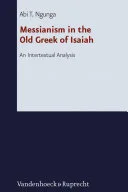
Messianism in the Old Greek of Isaiah
 72
72

Messianism in the Old Greek of Isaiah
Ngunga's meticulous analysis of messianism in the Septuagint Isaiah is a significant contribution, particularly for its focus on the translator's hermeneutical strategy. The argument that the translator actively engaged in intertextual readings to shape the messianic portrayal is compelling. A notable strength is the systematic approach across the entire LXX-Isaiah, avoiding piecemeal interpretations. However, the dense academic prose, while necessary for the subject matter, may present a barrier to those less familiar with Septuagintal scholarship or advanced hermeneutical theory. The exploration of specific translation choices, such as how Hebrew concepts of kingship and divine intervention were rendered in Greek, offers a nuanced perspective. Ultimately, this is a specialized work that rewards careful reading with a deeper understanding of early messianic expectations.
📝 Description
72
Abi T. Ngunga's 2023 study examines messianism in the Old Greek Isaiah.
Abi T. Ngunga's "Messianism in the Old Greek of Isaiah" analyzes messianic ideas in the Septuagint's rendering of Isaiah. Ngunga argues that the Greek translator used an "intertextual hermeneutic," treating the original Hebrew not just as text to be rendered, but as a source for theological interpretation. This method, Ngunga suggests, created new layers of meaning.
The book is for biblical scholars, especially those studying the Septuagint and Old Testament prophecy. Theologians and advanced students of ancient languages interested in the evolution of messianic concepts in early Jewish and Christian thought will also find it valuable. A working knowledge of textual criticism and hermeneutics is assumed.
This work discusses the Septuagint, the Greek translation of the Hebrew Bible created between the 3rd and 1st centuries BCE. Ngunga's research enters the ongoing conversation about how the Septuagint translators worked and what theological points they intended, specifically concerning Isaiah. The study addresses the need to explore messianism throughout the entire Greek Bible.
While not strictly Gnostic, this book touches upon interpretive traditions that informed later esoteric movements. The Septuagint itself, as an ancient Greek rendering of Hebrew scripture, became a foundational text for diverse theological and mystical explorations. Ngunga's focus on how the translator's interpretive methods shaped messianic understanding in this Greek version highlights how scripture could be recontextualized and imbued with new theological significance, a process common in esoteric traditions that seek deeper or alternative meanings within established religious texts.
💡 Why Read This Book?
• Gain insight into the translator's hermeneutical method in LXX-Isaiah, understanding how translation itself served as interpretation, a concept Ngunga thoroughly explores. • Uncover specific nuances of messianic expectation as presented in the Greek version of Isaiah, distinct from other textual traditions, which is a core focus of the 2012 publication. • Appreciate the scholarly need for in-depth studies on the Greek Bible, as highlighted in the introductory chapter, to grasp the broader landscape of ancient religious thought.
⭐ Reader Reviews
Honest opinions from readers who have explored this book.
❓ Frequently Asked Questions
What is the primary focus of Abi T. Ngunga's book on Isaiah?
The book's primary focus is the theme of messianism within the Old Greek translation of Isaiah (LXX-Isaiah), examining how the translator's hermeneutical approach shaped this portrayal.
What is an 'intertextual hermeneutic' as discussed in the book?
It refers to a method of reading and interpreting a text by understanding its connections and references to other texts, suggesting the Isaiah translator used this as a key interpretive tool.
When was 'Messianism in the Old Greek of Isaiah' first published?
The book was first published on November 21, 2012.
Who is the intended audience for this scholarly work?
The work is intended for scholars of biblical studies, Septuagint studies, and theologians interested in the evolution of messianic concepts in ancient texts.
Does the book discuss issues related to the translation of LXX-Isaiah?
Yes, Ngunga addresses several issues pertaining to LXX-Isaiah as a translation, contributing to the understanding of its textual and theological characteristics.
What is the main scholarly gap Ngunga's work aims to address?
Ngunga aims to address a gap in scholarship regarding the investigation of messianism specifically within the entire corpus of the Old Greek of Isaiah.
🔮 Key Themes & Symbolism
Translator as Interpreter
The work posits that the translator of the Old Greek Isaiah was not a passive conduit but an active theological interpreter. By employing an intertextual hermeneutic, the translator engaged with existing textual traditions, shaping the portrayal of messianism. This perspective elevates the translation process itself to an act of theological commentary, revealing layers of meaning embedded within the Greek text that go beyond a literal rendering of the Hebrew.
Messianism in LXX-Isaiah
This theme delves into the specific manifestations of messianic expectation as found within the Septuagint version of Isaiah. Ngunga's analysis moves beyond identifying individual messianic prophecies to understanding how the collective corpus of LXX-Isaiah constructs a unique theological narrative. It examines the Greek rendering of Hebrew terms and concepts associated with the awaited figure, offering a distinct perspective on early messianic thought.
Hermeneutical Methodologies
The book critically examines the 'intertextual hermeneutic' as employed by the Isaiah translator. This involves analyzing how the translator likely read and integrated other scriptural texts or traditions into their work on Isaiah. Ngunga uses this lens to demonstrate how the translator's interpretive choices significantly influenced the theological message, particularly concerning messianic themes.
Septuagintal Studies
As a work focused on LXX-Isaiah, it situates itself within the broader field of Septuagintal studies. It addresses scholarly discussions concerning the nature of the Greek Bible, translation techniques, and the theological implications of rendering Hebrew scriptures into Koine Greek. The study highlights the importance of examining the Septuagint as an independent witness to ancient Jewish thought.
💬 Memorable Quotes
“The translator of Isaiah employed an intertextual hermeneutic as a mode of reading.”
— This core assertion suggests the Greek translator actively interpreted the Hebrew text by referencing other scriptures, thereby shaping the theological message of Isaiah, especially regarding messianic themes.
“Scholarship needs to investigate messianism in the Greek Bible, particularly in LXX-Isaiah.”
— This highlights a perceived lacuna in existing research, emphasizing the unique contributions the Septuagint version of Isaiah can offer to understanding the development of messianic expectations.
“Issues related to LXX-Isaiah as a translation require careful handling.”
— This points to the complexity of the Septuagint text, acknowledging that understanding its theological content necessitates grappling with its specific translational challenges and characteristics.
“The corpus of the Old Greek of Isaiah is explored in its entirety.”
— This signifies the comprehensive scope of Ngunga's study, indicating a thorough examination of the entire Septuagint Isaiah rather than focusing on isolated passages or chapters.
“Messianism is explored through the lens of the translator's interpretive strategy.”
— This emphasizes the methodological focus, centering the analysis not just on the content of messianic prophecies but on *how* the translator's hermeneutics influenced their presentation.
🌙 Esoteric Significance
Tradition
While not overtly aligned with a singular esoteric tradition like Hermeticism or Kabbalah, the work's focus on textual interpretation and hidden meanings aligns with a broader esoteric hermeneutical impulse. The study of ancient scriptures for deeper, often symbolic or prophetic, layers of meaning is a practice found across many esoteric lineages. Ngunga's methodological emphasis on uncovering the translator's intent and interpretive strategy can be seen as a form of 'gnosis' – a hidden knowledge derived from meticulous textual engagement.
Symbolism
The concept of messianism itself carries profound symbolic weight, representing hope, redemption, and divine intervention. Within the context of LXX-Isaiah, the Greek translation may subtly alter or emphasize certain symbolic aspects of the expected messianic figure. Ngunga's analysis of how Hebrew prophetic imagery is rendered in Greek could reveal shifts in symbolic understanding, potentially impacting how later traditions interpreted these prophecies.
Modern Relevance
Contemporary esoteric thinkers and biblical scholars interested in textual criticism and the evolution of religious ideas can draw from Ngunga's work. Those exploring Gnostic interpretations, early Christian origins, or comparative mysticism may find value in how the LXX translation itself is presented as a site of theological development and interpretive action, influencing subsequent mystical and theological traditions.
👥 Who Should Read This Book
• Advanced biblical studies students and scholars specializing in the Septuagint, seeking to deepen their understanding of Isaiah's Greek version and its messianic content. • Researchers in comparative religion and ancient textual traditions, interested in how translations can shape theological concepts and contribute to religious evolution. • Theologians and exegetes looking for rigorous academic analysis of messianic themes, offering a nuanced perspective distinct from purely Hebraic textual studies.
📜 Historical Context
Abi T. Ngunga's "Messianism in the Old Greek of Isaiah" (2012) emerges within a vibrant academic landscape dedicated to the Septuagint (LXX), the ancient Greek translation of the Hebrew Bible, primarily produced between the 3rd and 1st centuries BCE. This period saw significant intellectual currents in Hellenistic Judaism, where Jewish scripture was being interpreted and adapted for a Greek-speaking audience. Ngunga's work engages with ongoing scholarly debates about the nature of LXX translation, particularly the work of scholars like Dominique Barthélemy and Emanuel Tov, who have explored the diverse translation techniques employed. The book addresses a perceived need to investigate messianism specifically within the entirety of the LXX-Isaiah, building upon earlier, more localized studies. Its reception is primarily within academic circles, contributing to the specialized field of biblical studies and Septuagintal research, rather than a broader public or a specific contemporary author engaging directly with its arguments.
📔 Journal Prompts
The translator's intertextual hermeneutic in LXX-Isaiah: how might this method reveal veiled meanings?
Messianic portrayals in the Old Greek of Isaiah: what shifts in emphasis are observable compared to Hebrew versions?
The significance of translation issues in LXX-Isaiah: how do textual variations impact theological interpretation?
The scholarly need for investigating messianism in the Greek Bible: what unique insights does LXX-Isaiah offer?
Exploring the translator's interpretive strategy: what can we infer about their theological aims?
🗂️ Glossary
Septuagint (LXX)
The ancient Greek translation of the Hebrew Bible, produced in stages between the 3rd and 1st centuries BCE, primarily for the Greek-speaking Jewish diaspora.
LXX-Isaiah
The specific book of Isaiah as it appears in the Septuagint (Greek translation), representing a distinct textual tradition from the Hebrew Masoretic Text.
Messianism
The belief in and expectation of a messiah, a divinely appointed figure (often a king or prophet) who will bring salvation, justice, or a new era.
Intertextual Hermeneutic
An interpretive approach that understands a text's meaning through its relationship with and references to other texts, suggesting the translator actively engaged in such connections.
Corpus
A collection or body of writings, in this context referring to all the texts within the Old Greek translation of Isaiah.
Textual Criticism
The scholarly discipline of analyzing textual evidence to determine the original form of a text, often involving comparing different manuscript versions.
Hermeneutics
The theory and methodology of interpretation, especially the interpretation of biblical texts, wisdom literature, or philosophical writings.