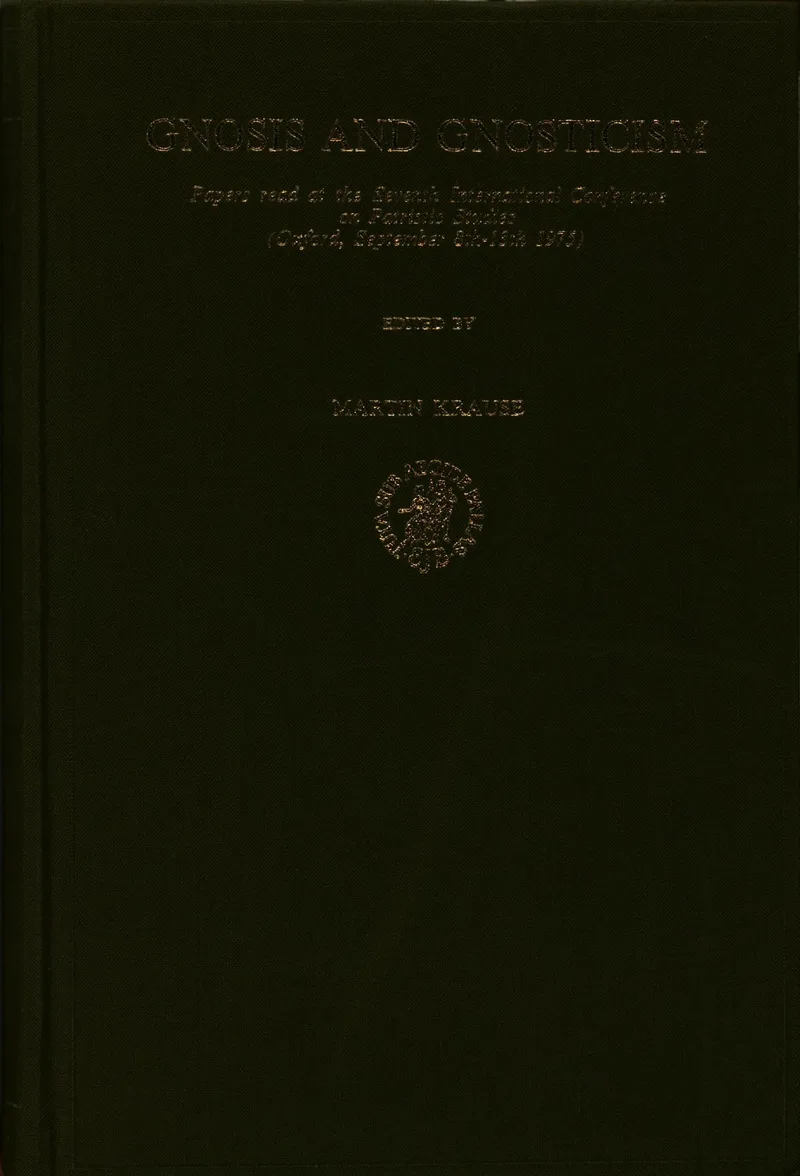
Gnosis and Gnosticism
 81
81

Gnosis and Gnosticism
Martin Krause's 'Gnosis and Gnosticism' offers a rigorous engagement with the foundational texts of early Gnostic movements. Its strength lies in its direct analysis of Coptic Gnostic texts from Nag Hammadi, providing scholars with critical insights into the intellectual landscape of the second and third centuries CE. The inclusion of scholarly contributions, such as Scopello's work on Homeric citations and Morard's interpretation of the 'Apocalypse of Adam,' enriches the discourse. However, the dense academic prose and the assumption of prior knowledge can present a barrier for the uninitiated. The detailed examination of Gnostic polemics against ecclesiastical Christianity, while informative, sometimes lacks the broader comparative context that might illuminate its findings for a wider audience. It serves as a valuable, albeit specialized, resource for those already immersed in the field.
📝 Description
81
### What It Is 'Gnosis and Gnosticism' presents a scholarly examination of early Christian esoteric thought, focusing on the Gnostic movements and their complex relationship with orthodox Christianity. The work, originally published in 1977, draws heavily on the monumental discoveries at Nag Hammadi, a collection of Coptic Gnostic texts unearthed in Egypt.
### Who It's For This book is intended for students of comparative religion, scholars of early Christianity, and individuals interested in the historical roots of esoteric philosophy. It requires a foundational understanding of theological and historical contexts, offering detailed analysis rather than introductory overviews.
### Historical Context The 1977 publication arrived at a pivotal moment for Gnostic studies, following the 1945 discovery of the Nag Hammadi library. This cache of texts provided unprecedented direct access to Gnostic writings, which had previously been known primarily through the refutations of their opponents. The work engages with this new material, offering interpretations of texts like the 'Apocalypse of Adam'.
### Key Concepts The volume explores core Gnostic doctrines, including the concept of *gnosis* itself – a form of salvific knowledge. It delves into the dualistic cosmology often found in Gnostic systems, the figure of the Demiurge, and the Gnostic critique of the Old Testament God. The polemics against established church doctrine are a significant focus.
💡 Why Read This Book?
• Gain direct engagement with the analysis of Coptic Gnostic texts from the Nag Hammadi discovery, offering unique insights not found in general introductions. • Understand the specific polemics of Gnostics against ecclesiastical Christianity, as detailed in texts like the Nag-Hammadi tractates, clarifying historical theological disputes. • Explore the concept of *gnosis* as salvific knowledge through scholarly interpretation of foundational Gnostic writings, deepening your understanding of esoteric epistemology.
⭐ Reader Reviews
Honest opinions from readers who have explored this book.
❓ Frequently Asked Questions
What are the key Gnostic texts analyzed in 'Gnosis and Gnosticism'?
The book critically examines several Coptic Gnostic texts discovered at Nag Hammadi, including 'The Apocalypse of Adam' and 'The Exegesis of the Soul', alongside discussions of 'The Dialogue of the Savior'.
When was 'Gnosis and Gnosticism' first published?
The original publication date for Martin Krause's 'Gnosis and Gnosticism' was 1977, a period of intense scholarly interest following the Nag Hammadi finds.
Who were the primary authors contributing to this collection?
While Martin Krause is the primary editor and contributor, the volume also features scholarly articles by Maddalena Scopello and Françoise Morard on specific texts.
What is the central concept of 'gnosis' as presented in the book?
'Gnosis' is presented as a form of salvific knowledge, an intuitive, experiential understanding that leads to liberation from the material world, central to Gnostic soteriology.
Does the book discuss Gnostic views on creation?
Yes, the work explores Gnostic cosmology, including the concept of the Demiurge and the Gnostic critique of the creation narrative found in the Old Testament.
Is this book suitable for beginners in Gnosticism studies?
While comprehensive, the book assumes a degree of familiarity with theological and historical concepts, making it more suitable for intermediate to advanced students of esotericism.
🔮 Key Themes & Symbolism
The Nag Hammadi Library
The book places significant emphasis on the Coptic Gnostic texts unearthed at Nag Hammadi in 1945. It analyzes these primary sources, including 'The Apocalypse of Adam' and 'The Dialogue of the Savior', to reconstruct Gnostic beliefs and practices. The work highlights how these discoveries revolutionized the understanding of Gnosticism, moving beyond accounts written by its detractors to reveal the internal perspectives of Gnostic communities.
Gnosis as Salvific Knowledge
Central to the volume is the exploration of *gnosis*, the Greek word for knowledge, which in Gnostic contexts signifies a direct, intuitive, and salvific understanding. This knowledge is not merely intellectual but experiential, providing liberation from the material world and the ignorance imposed by the Demiurge. The book details how this pursuit of gnosis formed the core of Gnostic soteriology and spiritual practice.
Critique of Ecclesiastical Christianity
A substantial portion of the work is dedicated to the polemical writings of Gnostics against what they perceived as the corrupt and ignorant doctrines of the emerging orthodox Christian church. The book examines how Gnostics reinterpreted biblical narratives and figures, often contrasting the true, transcendent God with the flawed creator deity of the Old Testament.
Gnostic Cosmology and Soteriology
The text delves into the intricate cosmological frameworks of Gnosticism, often characterized by complex hierarchies of divine beings and a dualistic worldview. It explains the concept of the Pleroma, the divine fullness, and the fall of Sophia that led to the creation of the material realm by a lesser, ignorant deity, the Demiurge. The path to salvation through gnosis is presented as the means to return to the divine source.
💬 Memorable Quotes
“The Gnostic seeks a salvific knowledge that transcends empirical and rational understanding.”
— This highlights the core Gnostic concept of *gnosis*, emphasizing its role not just as intellectual assent but as a transformative, liberating insight into the true nature of reality and the divine.
“The texts from Nag Hammadi offer direct access to Gnostic self-representation.”
— This points to the critical importance of the Nag Hammadi library, allowing scholars to study Gnostic thought from the perspective of its adherents, rather than solely through the critiques of their opponents.
“Gnosticism often presented a radical critique of the creator deity of the Old Testament.”
— This captures the dualistic tendency in Gnosticism, where the material world's imperfect creation is attributed to a lesser, ignorant deity, distinct from the supreme, unknowable God.
“The polemic against the church aimed to expose perceived ignorance and error in mainstream doctrine.”
— This emphasizes the confrontational aspect of early Gnosticism, where Gnostics actively challenged and debated the theological tenets of the developing orthodox Christian church.
“Salvation is achieved through the awakening of the divine spark within.”
— This summarizes a common Gnostic soteriological theme: the inherent divine element (spirit, spark) trapped within the material body, which must be awakened through gnosis to return to its divine origin.
🌙 Esoteric Significance
Tradition
This work is deeply rooted in the study of Gnosticism, one of the most significant esoteric traditions of late antiquity. It focuses on the Gnostic interpretation of cosmology, theology, and salvation, specifically through the lens of Coptic texts. It positions Gnosticism as a distinct spiritual path that offered an alternative to mainstream religious and philosophical systems of its time, emphasizing direct spiritual experience and knowledge.
Symbolism
Key symbols explored include the Pleroma, representing the divine fullness from which emanations occur, and the figure of Sophia (Wisdom), whose descent and subsequent fall often initiates the creation of the material world. The Demiurge, the flawed creator of this world, is another central symbolic figure representing ignorance and limitation, against which the Gnostic seeks liberation.
Modern Relevance
Contemporary esoteric thinkers and groups, particularly those interested in alternative spiritualities and the reinterpretation of ancient wisdom traditions, continue to draw from Gnostic thought. The emphasis on personal gnosis, the critique of materialist worldviews, and the exploration of consciousness align with modern movements in consciousness studies and New Age philosophies.
👥 Who Should Read This Book
• Students of comparative religion and early Christianity seeking in-depth analysis of Gnostic texts and their historical context. • Scholars of esoteric traditions interested in the primary sources and scholarly interpretations of Gnosticism, particularly those emerging post-Nag Hammadi discovery. • Advanced practitioners of mystical or philosophical traditions looking to understand the historical roots and theological frameworks of Gnostic thought.
📜 Historical Context
Published in 1977, 'Gnosis and Gnosticism' emerged in a period of burgeoning scholarly and popular interest in Gnosticism, largely fueled by the sensational discovery of the Nag Hammadi library in 1945. Martin Krause's work directly engaged with these newly accessible Coptic texts, offering interpretations of key documents like the 'Apocalypse of Adam'. This era saw Gnostic studies move beyond reliance on the polemics of Church Fathers like Irenaeus. The intellectual currents included comparative mythology, early Christian history, and the burgeoning field of esoteric studies. While not facing direct censorship, the academic reception was one of rigorous scholarly debate, with scholars like Elaine Pagels also publishing influential works around this time that engaged with similar themes, contributing to a broader re-evaluation of early Christian diversity.
📔 Journal Prompts
The concept of *gnosis* as salvific knowledge: How does this differ from conventional learning?
The critique of the Demiurge: What aspects of the material world might Gnostics have found flawed?
The 'Apocalypse of Adam': What insights does this text offer into Gnostic eschatology?
The role of polemics: How did Gnostics articulate their differences with ecclesiastical Christianity?
The interpretation of Homeric citations: What might this reveal about Gnostic engagement with Hellenistic culture?
🗂️ Glossary
Gnosis
A Greek term meaning 'knowledge,' central to Gnosticism, signifying a direct, intuitive, and salvific understanding of divine mysteries and the true nature of reality.
Nag Hammadi
An Egyptian town near which a collection of early Christian and Gnostic texts, known as the Nag Hammadi library, was discovered in 1945.
Coptic
The final stage of the ancient Egyptian language, written using a modified Greek alphabet, used for many Gnostic texts found in Egypt.
Demiurge
In Gnosticism, the lesser, often ignorant or malevolent creator of the material universe, distinct from the supreme, transcendent God.
Pleroma
The divine realm or fullness, the totality of divine powers and emanations in Gnostic cosmology, from which the material world is seen to have fallen away.
Soteriology
The doctrine of salvation, explaining how humans are saved and what the results of that salvation are.
Polemic
A strong verbal or written attack on someone or something; in this context, Gnostic writings criticizing or refuting orthodox Christian doctrines.









![Brahmandic Gyanum [Universal Knowledge]](/img/thumb/brahmandic-gyanum-universal-knowledge-vashisht-vaid-346050.webp)