A Study in the Theology of the Corinthian Opponents of Paul and Its Relation to Gnosticism
 77
77

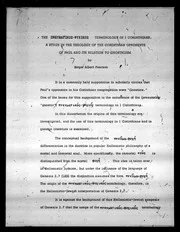
A Study in the Theology of the Corinthian Opponents of Paul and Its Relation to Gnosticism



Birger Albert Pearson's 'A Study in the Theology of the Corinthian Opponents of Paul and Its Relation to Gnosticism' is an indispensable text for anyone charting the esoteric currents within early Christianity. Pearson's rigorous scholarship illuminates the theological landscape of Corinth, revealing the sophisticated, proto-Gnostic ideas that confronted the Apostle Paul. He masterfully connects the dots between Pauline polemics and the burgeoning Gnostic worldview, offering a compelling argument for the deep esoteric roots of early Christian dissent. This work is essential reading for scholars and serious practitioners seeking to grasp the hidden knowledge and symbolic richness of this pivotal era, offering profound insights into the spiritual battles that shaped Western esotericism. A true gem.
📝 Description
77
Delve into the labyrinthine corridors of early Christian thought with Birger Albert Pearson's seminal work, 'A Study in the Theology of the Corinthian Opponents of Paul and Its Relation to Gnosticism.' This profound exploration unearths the hidden currents of mystical belief that challenged nascent Pauline orthodoxy in Corinth. Pearson meticulously dissects the esoteric doctrines and symbolic language employed by Paul's adversaries, revealing a sophisticated theological landscape where divine knowledge, cosmic hierarchies, and the spiritual liberation of the soul were paramount. Imagine ancient whispers of secret wisdom, debated in dimly lit rooms, hinting at a reality beyond the material veil. This book is for the dedicated seeker who yearns to understand the esoteric underpinnings of Western spiritual history, the philosophical chasm between emergent Gnosticism and institutionalizing Christianity, and the enduring quest for transcendent understanding. It illuminates how early Christian communities grappled with profound questions of existence, salvation, and the divine spark within.
✍️ Author
Birger Albert Pearson
The following is a list of notable deaths in April 2025. Entries for each day are listed alphabetically by surname.
💡 Why Read This Book?
Uncover the veiled theology of Paul's Corinthian rivals and its profound connection to Gnosticism. This book is essential for scholars, esoteric practitioners, and seekers of hidden spiritual knowledge who wish to understand the philosophical and mystical challenges that shaped early Christianity. It offers a unique lens into ancient debates about salvation, divine revelation, and the nature of reality, illuminating pathways to esoteric understanding.
⭐ Reader Reviews
Honest opinions from readers who have explored this book.
❓ Frequently Asked Questions
What is the primary focus of this study?
The study primarily focuses on the theological beliefs of Paul's opponents in Corinth and how these beliefs relate to early Gnostic thought, exploring their esoteric doctrines and symbolic interpretations.
How does this book relate to Gnosticism?
It establishes a significant connection, arguing that the Corinthian opponents' theology shares fundamental characteristics with Gnosticism, particularly in its emphasis on secret knowledge and spiritual liberation.
Who were the Corinthian opponents of Paul?
They were individuals or groups within the Corinthian church who held theological views distinct from, and often opposed to, those promoted by the Apostle Paul, likely possessing a more esoteric or dualistic outlook.
What is the significance of this research?
The research is significant for understanding the diversity of early Christian thought, the origins of Gnosticism, and the complex spiritual landscape of the 1st century CE, revealing hidden theological currents.
Is this book suitable for beginners in esotericism?
While academically rigorous, the book offers foundational insights into early esoteric thought. Beginners may find it more accessible with some prior exposure to ancient religious studies or Gnostic concepts.
🔮 Key Themes & Symbolism
Proto-Gnostic Currents in Corinth
This theme excavates the theological landscape of the Corinthian church, revealing how certain factions held beliefs that predated or paralleled later Gnostic systems. Pearson argues that these opponents possessed a sophisticated understanding of divine mysteries, cosmic order, and the path to spiritual enlightenment, distinct from Pauline orthodoxy. Their theology likely emphasized a dualistic worldview, the presence of divine sparks within humanity, and the necessity of esoteric knowledge for salvation, setting the stage for the widespread Gnostic movements of subsequent centuries.
Theological Dissonance and Pauline Polemic
This theme examines the intellectual and spiritual conflict between the Apostle Paul and his adversaries in Corinth. Pearson highlights how Paul's epistles serve as a critical lens through which to understand these opposing viewpoints. The 'opponents' likely challenged Paul's authority and teachings with their own interpretations of Christ, revelation, and the nature of the Church. Their theological dissonances reveal a vibrant and contentious period in early Christianity, where differing metaphysical and soteriological frameworks vied for dominance.
The Esoteric Interpretation of Salvation
Central to Pearson's study is the concept of salvation as understood by these Corinthian thinkers. Unlike conventional salvation through faith and adherence to specific doctrines, their approach likely involved a process of gnosis – a direct, intuitive knowledge of the divine that liberates the soul from material bondage. This theme explores the esoteric pathways they proposed, the symbolic language they employed to describe the spiritual journey, and the implications of their views for the broader development of mystical traditions within and alongside Christianity.
💬 Memorable Quotes
“The divine spark within.”
— A core Gnostic concept referring to a fragment of the divine essence trapped within the material realm, seeking liberation through knowledge.
“Knowledge is liberation.”
— The central tenet of Gnosticism, positing that true salvation is achieved through esoteric understanding and direct apprehension of spiritual truths.
“The Demiurge and the True God.”
— A Gnostic cosmological idea distinguishing a flawed creator god of the material world from a transcendent, supreme divine being.
“Ascent through the spheres.”
— A common Gnostic motif representing the soul's journey through various cosmic realms to reach the divine pleroma.
“The veiled mysteries of Christ.”
— Suggests that the Corinthian opponents may have interpreted Christ's nature and mission through a lens of hidden, esoteric revelations.
🌙 Esoteric Significance
Tradition
This work is deeply rooted in the study of early Christian esotericism and its connections to Gnosticism. It explores a tradition that emphasizes direct, intuitive knowledge (gnosis) of the divine as the primary means of salvation. This tradition often posits a dualistic cosmology, a divine spark within humanity, and a process of spiritual ascent and liberation from the material world, challenging conventional religious frameworks.
Symbolism
The symbolism explored relates to the esoteric interpretation of Christian narratives and concepts. This includes veiled meanings in scripture, cosmic symbolism representing spiritual realms and hierarchies, and the symbolic representation of the divine nature and the human soul's journey. The Corinthian opponents likely employed rich symbolic language to convey their understanding of divine mysteries and the path to spiritual awakening.
Modern Relevance
In contemporary esotericism, understanding the roots of Gnosticism and its early Christian manifestations is crucial. This study offers insights into enduring questions about the nature of reality, the human condition, and the pursuit of spiritual knowledge. It provides a historical context for modern mystical practices and philosophical inquiries into consciousness, liberation, and the hidden dimensions of existence.
👥 Who Should Read This Book
Scholars of early Christianity, New Testament studies, and the history of Gnosticism will find this book indispensable for its rigorous analysis and scholarly contribution. Esoteric practitioners and seekers of hidden spiritual knowledge will benefit from its exploration of ancient mystical traditions and the development of Gnostic thought. Those interested in the philosophical underpinnings of Western spirituality and the diverse interpretations of early Christian theology will discover profound insights. Beginners to the subject may find it challenging but rewarding with dedicated study.
📜 Historical Context
This study is situated in the vibrant, tumultuous landscape of the 1st century CE, a period of intense philosophical and religious ferment across the Roman Empire. Early Christianity was itself a nascent movement, grappling with its identity and seeking to articulate its core doctrines amidst a milieu rich with Hellenistic philosophy, mystery cults, and nascent Gnostic ideas. The Corinthian church, a cosmopolitan hub, was a fertile ground for diverse theological perspectives. Paul's efforts to guide and correct the Corinthian community reflect the profound theological debates and the emergence of distinct spiritual pathways, including those that would later be recognized as Gnostic. This era witnessed a critical juncture where various interpretations of divine truth and human salvation were being forged.
📔 Journal Prompts
Reflect on the concept of 'hidden knowledge' in your own spiritual journey. How has it manifested?
Consider the tension between exoteric (public) and esoteric (private) teachings in religious traditions. What are the benefits and drawbacks of each?
Imagine you are a Corinthian hearing both Paul and his opponents. What questions would arise about salvation and the nature of the divine?
How does the idea of spiritual liberation from the material world resonate with you today?
Explore the symbolism of 'divine sparks' in different spiritual or philosophical contexts you are familiar with.
🗂️ Glossary
Gnosticism
A diverse set of religious and philosophical movements that flourished in the early centuries CE, characterized by an emphasis on salvation through esoteric knowledge (gnosis) and often a dualistic worldview.
Gnosis
Greek for 'knowledge.' In Gnosticism, it refers to a special, intuitive, or revelatory knowledge of divine mysteries that leads to spiritual liberation.
Pleroma
In Gnostic cosmology, the spiritual realm or fullness of God, comprising a hierarchy of divine beings or emanations.
Demiurge
In Gnostic thought, a subordinate creator deity, often identified with the God of the Old Testament, who fashioned the imperfect material world.
Soteriology
The doctrine of salvation, concerning the means by which salvation is achieved and the nature of the salvation itself.