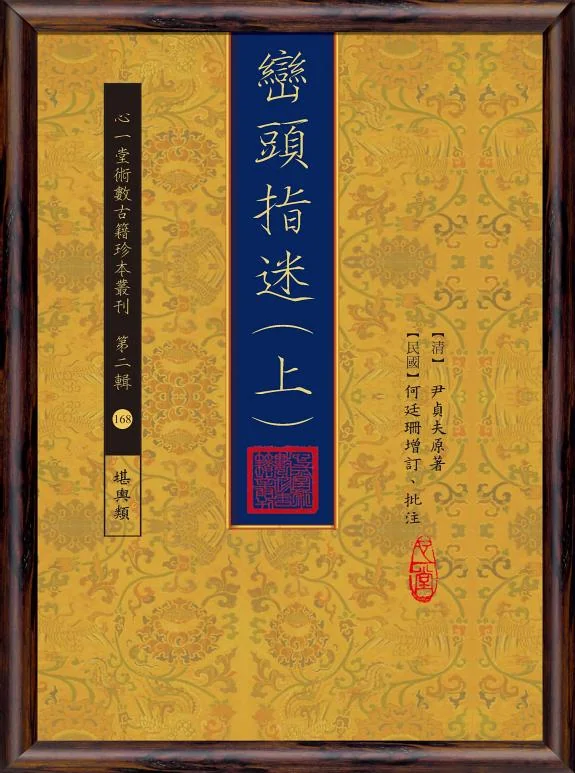
巒頭指迷(上)(下)【兩冊不分售】
 75
75

巒頭指迷(上)(下)【兩冊不分售】
The dual authorship of 巒頭指迷 presents a fascinating study in the transmission of esoteric knowledge. Yin Zhenfu lays the groundwork with traditional Luántou principles, meticulously detailing how mountain ranges, water flows, and surrounding terrain constitute the physical basis for geomantic assessment. He Tangshan’s intervention, however, is where the book truly distinguishes itself. His extensive annotations, reportedly intended for disciples, go beyond mere clarification, offering a rare glimpse into the practical application and theoretical underpinnings that might otherwise remain within closed-door teachings. The "leaking of heavenly secrets" is palpable in his discussions on integrating form with advanced Qi calculations, such as the elusive Lai Pan (天星) and Jiang Pan (三元玄空) methods. While the sheer density of technical information, particularly in He’s additions, can be daunting for newcomers, the book’s strength lies in its uncompromising adherence to empirical observation of landscape and its sophisticated synthesis with metaphysical principles. The inclusion of He's "Essay on Preserving Scenic Sites" and "Excerpts of Forty-Four Illustrations of Fine Tombs" adds significant practical value. Ultimately, 巒頭指迷 serves as a vital, albeit challenging, resource for those dedicated to the authentic study of Chinese geomancy.
📝 Description
75
This 1936 edition of Luántou Zhǐmí combines Qing Dynasty geomantic principles with Republican era commentary.
巒頭指迷 (Luántou Zhǐmí), which translates to "Pointing Out the Mysteries of Landscape Formations," is a significant work on the physical aspect of Chinese geomancy. This particular edition includes the original text by Yin Zhenfu from the Qing Dynasty alongside extensive additions, annotations, and commentary by He Tangshan, who worked during the Republican era. The combined work details how terrestrial features such as dragon veins (lóng), guardian sands (shā), energy points (xué), water courses (shuǐ), and celestial influences (xīngchén) affect auspicious and inauspicious energies.
He Tangshan, the reviser, was known for integrating form (xíngshì) with Qi (lǐqì) and drew upon traditions influenced by Jiang Dahong and Lai Bu-yi. His commentary, informed by his forty years of experience, aims to deepen the understanding of traditional teachings, particularly how landscape form interacts with Qi and spatial calculations. The book is aimed at practitioners and scholars of Feng Shui who are interested in the rigorous study of Luántou and its practical application in situ.
巒頭指迷 belongs to the branch of Chinese geomancy that prioritizes the physical topography, known as Luántou or 'form school,' as opposed to the 'compass school' (Pánlóng). This tradition emphasizes the direct influence of the earth's physical features on human destiny and auspiciousness. The text's focus on 'revealing heavenly secrets' suggests it was part of a lineage transmission, where specific knowledge was passed down through dedicated practitioners. Its compilation and augmentation during the Republican era reflect an effort to preserve and transmit these specialized, often orally transmitted, geomantic teachings.
💡 Why Read This Book?
• Learn the critical Luántou principles of Feng Shui, including the "ninety-nine transformations" of dragon, sand, acupoint, water, and stars, directly from a traditional text. • Understand the advanced integration of form (巒頭) with Qi (理氣) by studying He Tangshan's annotations, which reveal secrets of the Lai Pan (天星) and Jiang Pan (三元玄空) systems. • Gain practical insights from He Tangshan's forty years of experience, detailed in sections like "Essay on Preserving Scenic Sites" and "Excerpts of Forty-Four Illustrations of Fine Tombs."
⭐ Reader Reviews
Honest opinions from readers who have explored this book.
❓ Frequently Asked Questions
What is the primary focus of 巒頭指迷 (Luántou Zhǐmí)?
The book primarily focuses on the Luántou (巒頭) aspect of Feng Shui, which involves the analysis of physical landscape formations such as mountains, water, and terrain to determine auspicious sites.
Who were the main contributors to this edition of 巒頭指迷?
The edition features the original work by Yin Zhenfu (尹貞夫) from the Qing Dynasty, significantly augmented with additions, annotations, and commentary by He Tangshan (何廷珊) from the Republican era.
What makes He Tangshan's contributions significant?
He Tangshan's additions are highly valued because they reportedly "leak heavenly secrets," revealing practical applications and advanced techniques, including the integration of form with Qi calculations like Lai's Tian Xing and Jiang's San Yuan Xuan Kong.
Does the book cover both residential and tomb site selection?
Yes, the book discusses principles applicable to selecting auspicious sites in general, with specific sections like He Tangshan's "Excerpts of Forty-Four Illustrations of Fine Tombs" addressing tomb site selection in detail.
Is 巒頭指迷 suitable for beginners in Feng Shui?
While it contains foundational Luántou principles, the depth of He Tangshan's annotations and the integration of complex Qi methods make it more suitable for intermediate to advanced practitioners and scholars of Feng Shui.
What is the significance of the "ninety-nine transformations" mentioned?
The "ninety-nine transformations" refer to the intricate variations and patterns within landscape formations (dragon, sand, acupoint, water, stars) that geomancers analyze to understand the flow and quality of Qi.
🔮 Key Themes & Symbolism
Form and Landscape Analysis
The book's primary theme is the meticulous examination of the physical environment (巒頭, luántou). It details how mountain ranges (龍, lóng), surrounding terrain (砂, shā), water courses (水, shuǐ), and specific energy points (穴, xué) are interpreted as carriers of Qi. This involves recognizing subtle patterns, formations, and the "ninety-nine transformations" that signify auspicious or inauspicious energies, forming the bedrock of practical geomancy.
Integration of Form and Qi
A crucial aspect is the synthesis of landscape form (巒頭) with temporal and energetic calculations (理氣, lǐqì). He Tangshan's annotations emphasize this coordination, revealing how physical terrain interacts with astrological cycles and specific Qi methodologies like Lai's Tian Xing and Jiang's San Yuan Xuan Kong. This integration aims to provide a more accurate and potent geomantic assessment.
Transmission of Esoteric Knowledge
The work highlights the historical methods of transmitting specialized knowledge within geomantic lineages. He Tangshan's commentary, originally for disciples, represents a rare instance of "leaking heavenly secrets" (洩漏天機) into print. The book's scarcity and the emphasis on practical, experiential knowledge underscore the importance of guarded teachings in traditional Chinese metaphysics.
Site Selection Principles
Central to the text is the application of Luántou principles to site selection, particularly for tombs (佳城, jiāchéng) and potentially residences. Concepts like "gazing at Qi to find the point" (望氣尋穴) and detailed illustrations provide guidance for practitioners seeking to identify locations that harness beneficial terrestrial energies for prosperity and well-being.
💬 Memorable Quotes
Direct passages from the work, attributed to the author.
“The ninety-nine transformations of dragon, sand, acupoint, water, and stars.”
— This phrase expresses the core analytical framework of Luántou geomancy, referring to the myriad ways in which landscape features manifest and interact, dictating the flow and quality of terrestrial Qi.
“Form-Qi coordination is essential for accurate assessment.”
— This principle, emphasized by He Tangshan, highlights that understanding the physical landscape alone is insufficient; it must be synchronized with temporal cycles and energetic calculations for effective Feng Shui practice.
“He Tangshan's annotations were originally for disciples, thus "leaking heavenly secrets."”
— This indicates that the commentary within this text contains advanced or previously guarded knowledge, intended for an inner circle, making its publication a significant event for broader study.
“Gazing at Qi to find the point (望氣尋穴).”
— This refers to a specific observational technique in geomancy, where practitioners visually assess the subtle signs of Qi in the landscape to pinpoint the most auspicious location for an acupoint (穴).
“The integration of landscape form with temporal cycles (形運合參).”
— This concept stresses the dynamic interplay between the static physical environment and the changing energetic influences over time, a key element for precise geomantic calculations.
🌙 Esoteric Significance
Tradition
This work firmly belongs to the tradition of Chinese Feng Shui, specifically the Luántou (巒頭) school, which emphasizes the analysis of physical landforms. It integrates principles from prominent lineage masters like Jiang Dahong (三元, San Yuan) and Lai Bu-yi (天星, Tian Xing), bridging empirical observation with complex energetic calculations. It represents a practical, form-focused approach within the broader spectrum of Chinese metaphysical arts, aiming to harmonize human activity with terrestrial Qi.
Symbolism
Key symbols include the 'Dragon' (龍, lóng), representing the sinuous flow of mountain ranges and terrestrial energy lines; 'Sand' (砂, shā), denoting the protective or enclosing formations around a site; and 'Acupoint' (穴, xué), the specific location where Qi concentrates and can be harnessed. Water (水, shuǐ) symbolizes wealth and vitality, its path being a critical factor. Celestial bodies (星辰, xīngchén) also feature, linking terrestrial formations to cosmic influences.
Modern Relevance
Contemporary Feng Shui practitioners, particularly those focused on classical forms and rigorous analysis, continue to draw upon the principles outlined in 巒頭指迷. The emphasis on direct landscape observation and the integration of form with advanced Qi methods remains relevant for consultants seeking depth beyond superficial applications. Scholars of Chinese cosmology and traditional architecture also find value in its detailed exposition of historical geomantic practices.
👥 Who Should Read This Book
• Advanced Feng Shui practitioners seeking to deepen their understanding of Luántou (巒頭) analysis, moving beyond basic principles to nuanced interpretations of landscape formations. • Scholars of Chinese metaphysics and cultural history interested in the transmission of esoteric knowledge and the practical application of geomancy during the Qing and Republican eras. • Geomancers aiming to integrate the study of physical terrain with sophisticated Qi calculation methods, such as Lai's Tian Xing (天星) and Jiang's San Yuan Xuan Kong (三元玄空), as detailed in He Tangshan's annotations.
📜 Historical Context
Emerging from the fertile intellectual ground of late Qing and early Republican China, 巒頭指迷 represents a crucial intersection of traditional geomancy and evolving scholarly practices. The Qing Dynasty (1644-1912) saw extensive development in Feng Shui literature, often with a tension between empirical observation (Luántou) and abstract calculations (Lǐqì). He Tangshan's additions in the Republican era (post-1912) reflect a period where traditional arts were being re-examined, codified, and sometimes transmitted through more accessible means, albeit with a continued emphasis on lineage secrets. He Tangshan explicitly aligns himself with the prestigious San Yuan school, notably citing Jiang Dahong, a towering figure in 18th-century geomancy, and Lai Bu-yi. This places the work within a lineage that sought to harmonize the physical landscape with intricate calendrical and cosmological systems. Unlike purely theoretical works, He Tangshan's practical focus and his inclusion of detailed tomb site analysis suggest an engagement with the real-world application of geomancy, possibly in response to the social and political shifts of the time. The rarity of this specific augmented edition points to the challenges of disseminating such specialized knowledge, where oral transmission often held precedence over print.
📔 Journal Prompts
The "ninety-nine transformations" of landscape features: How might these variations manifest in a familiar local environment?
He Tangshan's "leaking of heavenly secrets": What ethical considerations arise when sharing profound knowledge?
Dragon veins (龍) and sand formations (砂): Reflect on the symbolic representation of protective and flowing energies in natural landscapes.
The concept of "form-Qi coordination" (形運合參): How does the physical environment interact with unseen energetic cycles?
The practice of "gazing at Qi to find the point" (望氣尋穴): What observational skills are essential for perceiving subtle energetic signatures?
🗂️ Glossary
巒頭 (Luántou)
The 'form' or physical landscape aspect of Feng Shui, focusing on the analysis of mountains, water, terrain, and other visible environmental features.
理氣 (Lǐqì)
The 'principles and Qi' aspect of Feng Shui, involving calculations based on time, direction, and cosmic energies to assess auspiciousness.
龍 (Lóng)
Literally 'dragon,' referring to the undulating lines of mountain ranges that are believed to carry terrestrial Qi.
砂 (Shā)
Literally 'sand,' referring to the surrounding hills, mounds, or terrain formations that protect or enclose an auspicious site.
穴 (Xué)
Literally 'acupoint' or 'cave,' denoting the specific location of concentrated Qi where a dwelling or tomb should ideally be situated.
水 (Shuǐ)
Water, a critical element in Feng Shui, symbolizing wealth and vitality. Its flow, direction, and form are meticulously analyzed.
形運合參 (Xíngyùn Hēncān)
The integrated study of form (巒頭) and temporal cycles/Qi (理氣), emphasizing that both physical landscape and time-based energies must be considered together.
This book appears in 1 collection
🔮 Readers Also Liked
Browse all →







From the “Geomancy” Collection
View all →







More Free Occult Philosophy Books
View all →