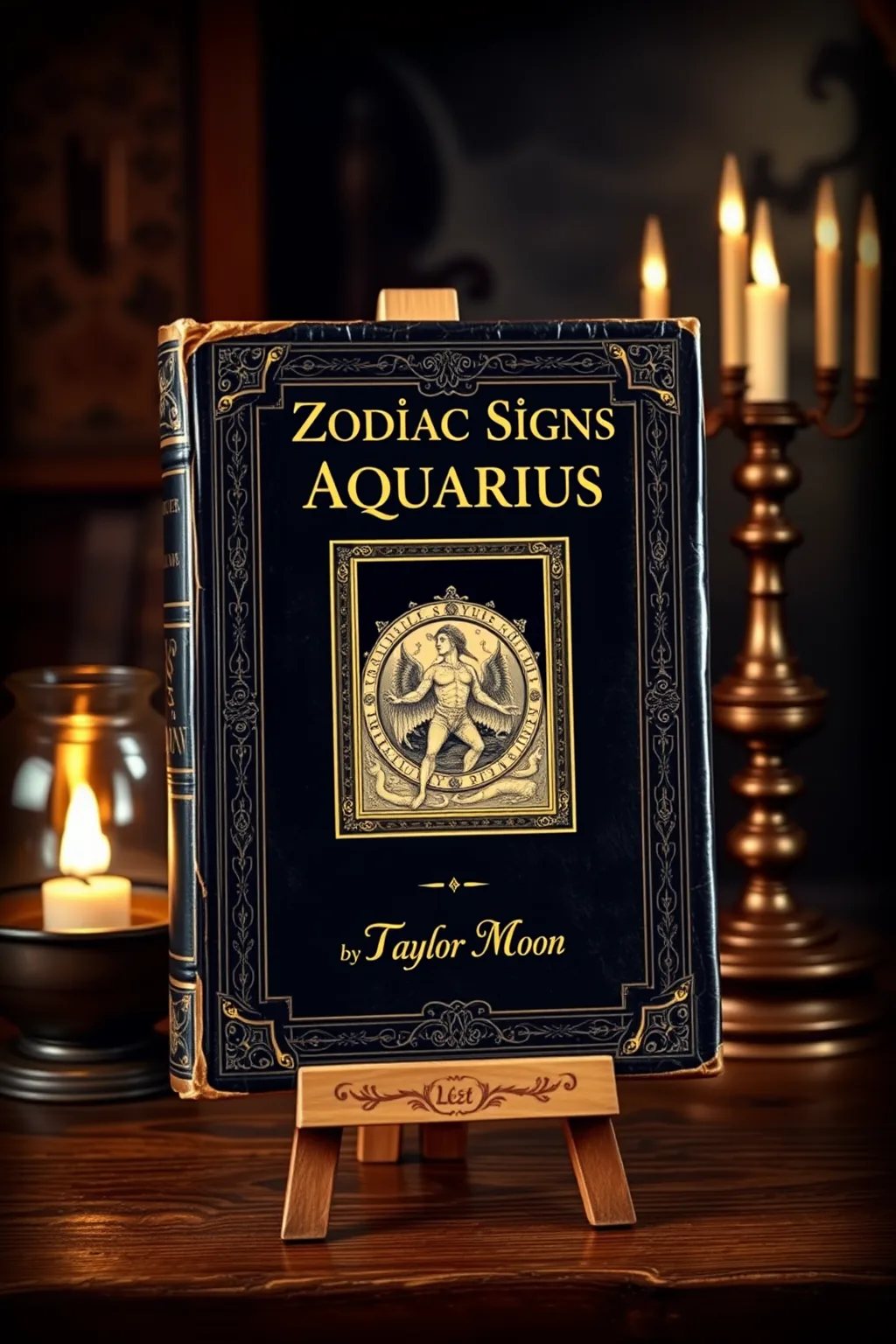
Zodiac Signs: Aquarius
 71
71

Zodiac Signs: Aquarius
Taylor Moon's "Zodiac Signs: Aquarius" offers a grounded perspective on a sign often characterized by its ethereal and forward-thinking nature. The book avoids jargon, presenting astrological concepts in an accessible manner, particularly in its discussion of how Aquarian traits evolve from childhood to maturity. A notable strength is the practical application of astrological principles to everyday life, such as navigating workplace dynamics or understanding friendship styles. However, the work occasionally leans towards simplification, especially when discussing the sign's historical associations with rebellion and social reform. The passage detailing the Aquarian parent, balancing independence with emotional connection, exemplifies the book's capacity for nuanced, yet relatable, advice. While not a deep dive into esoteric lineages, it serves as a solid primer for those new to astrological self-exploration. It provides a functional, if not revolutionary, overview of the Water Bearer.
📝 Description
71
### What It Is Aquarius, the eleventh sign of the zodiac, is detailed in this volume as a guide to understanding its unique characteristics and cosmic influence. Published in 2020 as part of a contemporary astrological series, the book explores the sign's archetypal energies from infancy through adulthood. It positions astrological signs not as fixed destinies but as dynamic forces shaping our earthly missions and interactions.
### Who It's For This work is intended for individuals seeking a practical understanding of the Aquarius zodiac sign. It caters to those interested in how their astrological profile manifests across various life domains, including personal growth, academic pursuits, professional environments, and interpersonal relationships. Readers looking for actionable insights into friendship, romance, and familial roles from an Aquarian perspective will find value here.
### Historical Context The book emerges from a modern resurgence in astrological study, building upon foundational concepts established by figures like Ptolemy in the 2nd century CE. While classical astrology focused on celestial mechanics and fate, contemporary interpretations, like those in this series, emphasize astrology as a tool for self-awareness and personal development. This shift reflects a broader cultural interest in esoteric knowledge that gained traction in the late 20th century.
### Key Concepts Central to the exploration of Aquarius is the concept of its ruling planets, traditionally Saturn and modernly Uranus, and their dual influence on innovation and structure. The book examines the Aquarian drive for humanitarianism, intellectual curiosity, and a progressive outlook. It also touches upon common challenges, such as detachment or a tendency towards aloofness, offering guidance on integrating these traits constructively.
💡 Why Read This Book?
• Gain specific insights into the Aquarian approach to relationships, from friendship to romance, by understanding their innate need for intellectual stimulation and shared ideals, as discussed in the "lover" and "friend" sections. • Explore the Aquarian's evolving nature from youth to adulthood, learning how the influence of Saturn and Uranus shapes their developmental path, as detailed in the growth sections. • Discover practical strategies for integrating Aquarian strengths, such as innovation and humanitarianism, into professional settings, drawing from the "work" chapter's analysis.
⭐ Reader Reviews
Honest opinions from readers who have explored this book.
❓ Frequently Asked Questions
When was Zodiac Signs: Aquarius first published?
Zodiac Signs: Aquarius, authored by Taylor Moon, was first published on February 4, 2020, as part of a contemporary series on astrological signs.
What is the main purpose of this book on Aquarius?
The book aims to provide readers with a practical guide to understanding the Aquarius zodiac sign, focusing on its manifestations in personal growth, relationships, and professional life.
Does the book discuss Aquarius's historical astrological connections?
Yes, it situates Aquarius within the broader context of zodiacal study, referencing classical astrological concepts while emphasizing modern interpretations of its influence.
How does the book explain Aquarius's role in friendships?
It examines how Aquarians function best as friends, highlighting their intellectual compatibility, loyalty, and sometimes unconventional approaches to companionship.
Is this book suitable for beginners in astrology?
Absolutely. The book is designed for those new to astrology, offering clear explanations and practical advice without overwhelming the reader with complex technical details.
What are the key planetary influences mentioned for Aquarius?
The book discusses Aquarius's traditional ruler, Saturn, and its modern ruler, Uranus, explaining how their combined energies contribute to the sign's innovative and structured nature.
🔮 Key Themes & Symbolism
Aquarian Growth Arc
This theme traces the developmental journey of the Aquarius individual from childhood through adulthood. It examines how the sign's core traits, influenced by its ruling planets (Saturn and Uranus), manifest differently at various life stages. The book explores how Aquarian curiosity and humanitarian impulses evolve, shaping their interactions at school, in the workplace, and within family structures, offering a progressive view of astrological influence.
Zodiacal Mission
The work posits that each zodiac sign carries a unique 'cosmic calling' or mission on Earth, rather than a predetermined fate. For Aquarius, this mission is often tied to innovation, social progress, and intellectual advancement. The book encourages readers to view their astrological sign as a key to understanding their purpose and potential contributions to the world.
Interpersonal Dynamics
A significant focus is placed on how Aquarians function within different relational contexts. This includes detailed explorations of their roles as friends, lovers, and parents. The book analyzes the Aquarian need for independence, intellectual connection, and shared ideals, offering guidance on fostering healthy and fulfilling relationships that honor their unique approach to intimacy and community.
Astrology as a Tool
The book positions astrology not as a predictive science but as a vital tool for self-understanding and navigating life's complexities. It emphasizes that understanding one's astrological sign provides a framework for self-awareness, helping individuals to better comprehend their motivations, challenges, and inherent strengths in relation to universal forces.
💬 Memorable Quotes
“Our astrological sign is a key to uncovering our mission here on earth.”
— This statement reframes astrology from deterministic fate to a guiding principle for purpose. It suggests that understanding one's Aquarian nature can illuminate their unique path and contributions.
“Learn about how your sign grows from child to adult.”
— This highlights the book's developmental approach, emphasizing that Aquarian traits are not static but evolve. It promises insights into personal maturation through an astrological lens.
“Fits in at school and at work, and functions best as a friend, lover, parent, and more.”
— This indicates the book's practical focus, applying Aquarian archetypes to concrete life situations and relationship roles for actionable understanding.
“Astrology is a vital tool for understanding our place in the world.”
— This frames astrology as a practical instrument for self-discovery and contextualization within the larger cosmos, rather than mere superstition.
“A cosmic calling rather than a fated destiny.”
— This crucial distinction positions astrological signs as potentials and purposes to be actualized, empowering the individual rather than dictating their life.
🌙 Esoteric Significance
Tradition
This work engages with the Western esoteric tradition, particularly modern psychological astrology, which draws heavily from Hermetic principles of correspondence and the macrocosm/microcosm relationship. While not explicitly Kabbalistic or Gnostic, it inherits the Hermetic lineage's emphasis on celestial influence as a symbolic language for understanding human nature and destiny. It moves away from predictive Hellenistic astrology towards a more self-exploratory model popularized in the 20th century.
Symbolism
A key symbol explored is the Water Bearer (Aquarius's glyph), representing the pouring forth of knowledge and innovation, often associated with humanitarian ideals. The dual rulership by Saturn (structure, discipline) and Uranus (rebellion, genius) is central, symbolizing the tension between established order and radical change inherent in the Aquarian archetype. These symbols are interpreted through the lens of personal potential and societal contribution.
Modern Relevance
Contemporary thinkers and practitioners in fields like transpersonal psychology and New Age spirituality often utilize archetypal zodiacal frameworks similar to those presented here. Astrologers like Liz Greene and Howard Sasportas, who integrated psychological depth into their work, represent the lineage this book follows. Its accessible approach makes it relevant for modern self-help movements and online astrological communities seeking practical guidance.
👥 Who Should Read This Book
• Individuals new to astrology seeking a clear and practical introduction to the Aquarius sign's characteristics and life applications. • Those interested in understanding their own or a loved one's Aquarian traits in contexts like relationships, career, and personal development. • Readers exploring contemporary psychological astrology who prefer actionable advice over deep theoretical dives into ancient texts.
📜 Historical Context
Published in 2020, "Zodiac Signs: Aquarius" arrives during a period of renewed public interest in astrology, a practice with roots stretching back to Babylonian times and codified by Hellenistic scholars like Ptolemy in his 2nd-century work, the Tetrabiblos. This contemporary series departs from the deterministic interpretations prevalent in classical astrology, aligning instead with a psychological and self-help oriented approach that gained momentum in the late 20th century, influenced by figures like Dane Rudhyar. While the astrological community saw debates regarding the validity and interpretation of signs, works like this aimed to democratize astrological knowledge, making it accessible beyond specialized circles. Its release predates the significant astrological events of the early 2020s, which further amplified public engagement with the zodiac.
📔 Journal Prompts
Aquarian independence: How does your need for autonomy manifest in your friendships?
The Water Bearer's pour: Reflect on a time you shared knowledge or innovation.
Saturn's structure vs. Uranus's disruption: Describe a personal challenge where these energies clashed.
Your cosmic calling: What unique mission might your Aquarian nature inspire?
Child to adult: Trace the evolution of your Aquarian-influenced traits.
🗂️ Glossary
Aquarius
The eleventh astrological sign in the zodiac, typically associated with individuals born between approximately January 20 and February 18. It is an Air sign known for its progressive, independent, and humanitarian qualities.
Zodiac
A belt of the heavens extending about 9 degrees on either side of the ecliptic, divided into twelve equal parts or signs, each named after a constellation.
Ruling Planet
In astrology, a planet traditionally or modernly assigned to govern a specific zodiac sign, influencing its core characteristics and energies.
Air Sign
One of the four elemental categories in astrology (alongside Fire, Earth, and Water). Air signs (Gemini, Libra, Aquarius) are associated with intellect, communication, and social interaction.
Uranus
The seventh planet from the Sun, considered the modern ruler of Aquarius. It is associated with innovation, rebellion, sudden change, and technological advancement.
Saturn
The sixth planet from the Sun, traditionally the ruler of Aquarius. It is associated with structure, discipline, responsibility, limitations, and karma.
Archetype
In psychology and mythology, a universally understood symbol, character, or pattern of behavior that is thought to be part of the collective unconscious.