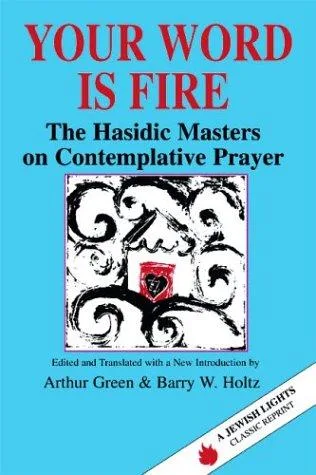
Your word is fire
 71
71

Your word is fire
Arthur Green and Barry W. Holtz's 'Your Word Is Fire' tackles the formidable task of dissecting the linguistic architecture of esoteric thought. Its strength lies in its unwavering scholarly rigor, presenting complex ideas with precision. A notable passage delves into the Semitic roots of creation narratives, highlighting how primordial sounds are posited as the very fabric of existence, a concept often reduced to metaphor in less critical analyses. However, the work’s density can be a barrier; it demands a reader already steeped in the subject matter, offering little concession to the uninitiated. The academic tone, while appropriate for its scholarly aims, sometimes overshadows the inherent wonder of the subject. Despite this, the book offers a vital, if challenging, perspective on how words shape worlds in mystical thought.
📝 Description
71
### What It Is 'Your Word Is Fire' presents a rigorous examination of foundational texts and concepts within esoteric traditions. It is not an introductory primer but a scholarly engagement with primary sources, aiming to illuminate the intricate philosophical underpinnings that shape various mystical paths. The work meticulously analyzes the language and symbolic systems employed by ancient and medieval thinkers, revealing deeper layers of meaning.
### Who It's For This book is intended for advanced students of comparative religion, philosophy, and occult studies. Readers who have already established a working knowledge of major esoteric lineages and are seeking to deepen their understanding of specific textual traditions will find significant value. It appeals to those who appreciate detailed exegesis and are comfortable with dense academic prose.
### Historical Context Published in 1993, 'Your Word Is Fire' emerged during a period of renewed academic interest in esoteric studies, moving beyond earlier critiques. While scholars like Frances Yates had previously explored Renaissance Hermeticism, Green and Holtz's work contributed to a more nuanced understanding of textual transmission and interpretation within these traditions. The book navigates a landscape shaped by earlier works that often dismissed or oversimplified mystical thought.
### Key Concepts The core of the book revolves around the power of language and its relationship to consciousness and reality within esoteric frameworks. It explores how specific terminologies and narrative structures in sacred texts are not merely descriptive but are considered active agents in shaping experience and perception. The interplay between divine utterance and human understanding is a recurring motif.
💡 Why Read This Book?
• Gain a granular understanding of how specific Hebrew terms related to divine speech are interpreted within Kabbalistic cosmology, a depth not found in general introductions. • Appreciate the nuanced differences in the philosophical implications of textual interpretation between early Gnostic traditions and later medieval mystical schools, as explored in the comparative analysis. • Grasp the concept of *'Mekorot'* (sources) as analyzed in the book, understanding its role in the transmission and evolution of esoteric knowledge across centuries.
⭐ Reader Reviews
Honest opinions from readers who have explored this book.
❓ Frequently Asked Questions
What is the primary focus of 'Your Word Is Fire' regarding language?
The book primarily examines how language, particularly in ancient and esoteric texts, is viewed not just as a communicative tool but as a fundamental force shaping reality and consciousness, especially within traditions like Kabbalah.
Who are Arthur Green and Barry W. Holtz?
Arthur Green is a scholar of Jewish mysticism, particularly Kabbalah, and Barry W. Holtz is a scholar of Jewish thought and spirituality. Their collaboration brings deep expertise to the subject matter.
When was 'Your Word Is Fire' first published?
The book was first published in 1993, placing it within a period of significant academic re-evaluation and scholarly interest in esoteric traditions.
Does the book offer practical exercises for esoteric practice?
No, 'Your Word Is Fire' is a scholarly work focused on textual analysis and philosophical exploration, rather than a guide for practical esoteric techniques or rituals.
What kind of esoteric traditions does the book primarily discuss?
While it touches on broader themes, the book has a significant focus on Jewish mysticism, particularly Kabbalah, and explores concepts relevant to Gnostic and Hermetic traditions through its linguistic lens.
Is 'Your Word Is Fire' accessible to beginners in esoteric studies?
It is generally not recommended for absolute beginners. The book assumes a foundational understanding of religious studies and esoteric concepts due to its academic depth and specific terminology.
🔮 Key Themes & Symbolism
The Semiotics of the Sacred
This theme explores how sacred texts within traditions like Kabbalah are not merely repositories of information but are understood as active, potent forces. The book analyzes the specific linguistic structures, etymologies, and symbolic resonances that imbue these texts with creative and transformative power. It delves into how divine utterance is conceptualized as the very foundation of existence, and how human engagement with these words can mirror the creative act, thereby influencing consciousness and reality.
Linguistic Creation and Cosmic Order
Central to the work is the concept that language functions as a blueprint for the cosmos. The authors examine how primordial sounds, letters, and words are seen in various esoteric systems as the building blocks of reality. This section dissects the intricate relationship between the Hebrew alphabet, divine names, and the unfolding of creation, illustrating how the structure of language mirrors the structure of the universe and spiritual hierarchies.
Interpretation as Esoteric Practice
The book highlights that the act of interpreting esoteric texts is itself a form of spiritual practice. It examines the methods and philosophical assumptions underlying the exegesis of mystical literature, demonstrating how different interpretive strategies can unlock distinct layers of meaning and facilitate spiritual realization. The focus is on how understanding the 'word' becomes a path to understanding the divine and the self.
The Power of Divine Utterance
This theme investigates the theological and philosophical implications of divine speech in esoteric traditions. It addresses how the 'word' of God is understood as having ontological status – it is not just communication but the very act of bringing forth existence. The book contrasts this with human speech, exploring the spiritual disciplines aimed at aligning human utterance with divine intention.
💬 Memorable Quotes
“The primordial letters are not inert symbols but potent forces.”
— This statement encapsulates the book's core argument: that within esoteric traditions, the foundational elements of language possess an inherent power to shape reality and consciousness, far beyond their conventional communicative function.
“Understanding the structure of divine speech reveals the structure of the cosmos.”
— This highlights the belief that the universe is fundamentally ordered according to principles embedded within divine language, suggesting that linguistic analysis can lead to insights into cosmic architecture and spiritual laws.
“Exegesis is not merely reading, but an act of co-creation.”
— This emphasizes the active role of the interpreter in esoteric traditions, positing that through deep engagement and understanding of sacred texts, the reader participates in the ongoing creation and revelation of meaning.
“The word carries ontological weight.”
— This paraphrased concept suggests that in the esoteric view explored, words are not simply representations but possess a real, substantive existence and power that influences the nature of being itself.
“Hebrew roots offer a key to understanding cosmic origins.”
— This interpretation points to the book's focus on the specific linguistic and symbolic significance attributed to the Hebrew language within traditions like Kabbalah, viewing its etymological and structural elements as fundamental to creation narratives.
🌙 Esoteric Significance
Tradition
The work primarily engages with the Jewish esoteric tradition, particularly Kabbalah, exploring its foundational concepts concerning language and creation. It also touches upon Gnostic and Hermetic ideas through a comparative linguistic lens. It departs from purely historical accounts by emphasizing the active, ontological role of language within these traditions, framing it as a core element of spiritual practice and cosmic ordering.
Symbolism
Key symbols include the Hebrew alphabet, where individual letters are seen as primordial forces and building blocks of existence. Divine Names are also central, understood not just as labels but as conduits of divine power and essence. The concept of *'Otiyyot'* (letters) and their permutations is explored as a method for understanding cosmic structure and accessing higher realities.
Modern Relevance
Contemporary thinkers and practitioners in fields like comparative mysticism, hermeneutics of religion, and Jewish philosophy continue to draw on the book's rigorous analysis of language's role in spiritual traditions. Its insights are relevant to modern explorations of consciousness, semiotics, and the power of intention in ritual and meditation.
👥 Who Should Read This Book
• Advanced students of Kabbalah and Jewish mysticism seeking a deep dive into the philosophical underpinnings of sacred language. • Comparative religion scholars interested in the ontological status of text and utterance across different esoteric traditions. • Philosophers of language and religion examining the relationship between symbolic systems and perceived reality.
📜 Historical Context
Published in 1993, 'Your Word Is Fire' emerged during a period when academic study of esoteric traditions was gaining significant traction, moving beyond earlier dismissive attitudes. Scholars like Gershom Scholem had already laid groundwork in Jewish mysticism, but Green and Holtz contributed a focused examination of linguistic theory within these frameworks. The book engaged with intellectual currents seeking to understand religious experience through textual analysis, contrasting with more phenomenological approaches prevalent at the time. It navigated a landscape where earlier scholarship often treated mystical texts as mere historical artifacts rather than living sources of philosophical inquiry. The work's reception was within academic circles, contributing to the growing body of literature on Western esotericism.
📔 Journal Prompts
The concept of 'Mekorot' as a source of divine utterance.
How the interpretation of specific Hebrew letters shapes cosmological understanding.
The ontological weight of divine speech in creation narratives.
Reflecting on the power dynamics between human utterance and divine intention.
Analyzing the function of 'Otiyyot' in esoteric textual practices.
🗂️ Glossary
Otiyyot
Hebrew term for 'letters'. In Kabbalistic thought, these are not merely phonetic signs but fundamental building blocks of creation, imbued with divine energy and meaning.
Mekorot
Plural of 'Makor', meaning 'source' or 'spring'. In an esoteric context, it refers to the ultimate origins or foundational principles from which divine revelation or cosmic order flows.
Ontological Status
The philosophical concept concerning the nature of being or existence. In this context, it refers to words or divine speech having a real existence and power, not just symbolic representation.
Semiotics
The study of signs and symbols and their interpretation. In the book's context, it refers to the analysis of how sacred words function as potent symbols within religious and mystical frameworks.
Exegesis
Critical explanation or interpretation of a text, especially of scripture. The book examines how esoteric traditions engage in specific forms of exegesis to uncover deeper spiritual meanings.
Divine Utterance
The concept of God's speech as a creative and fundamental force, central to many creation myths and esoteric cosmologies, particularly within Abrahamic traditions.
Kabbalah
A system of Jewish mysticism that seeks to understand the nature of God and the universe through esoteric interpretations of the Torah and other sacred texts.