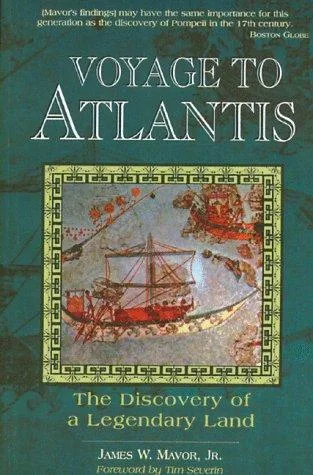
Voyage to Atlantis
 82
82

Voyage to Atlantis
James W. Mavor Jr.'s *Voyage to Atlantis* offers a commendably grounded examination of the enduring legend. Mavor eschews the more fanciful interpretations, instead focusing on geological and geographical evidence to postulate a potential reality behind Plato's account. His meticulous compilation of theories regarding Atlantis's location, particularly his engagement with geological shifts and Plato's specific descriptions, forms the book's core strength. However, the work occasionally suffers from the inherent limitations of its subject matter; despite Mavor's rigorous approach, definitive proof remains elusive, leaving much to speculation. A particularly compelling section discusses the possibility of Atlantis being a memory of the Minoan civilization's destruction, a concept Mavor explores with scholarly care. Ultimately, *Voyage to Atlantis* serves as a valuable historical survey of attempts to locate the lost continent, more so than a conclusive argument for its existence.
📝 Description
82
James W. Mavor Jr. examined the Atlantis myth as a potential echo of a real landmass in his 1969 book.
Published in 1969, Voyage to Atlantis examines the legend of the island continent. James W. Mavor Jr. does not dismiss Atlantis as pure fantasy, but instead considers it a possible reflection of a submerged landmass or a significant historical occurrence. The book gathers geographical theories, geological findings, and ancient texts that could support the idea of such a place. Mavor uses sources like Plato's dialogues to build a reasonable story about Atlantis's location and its disappearance.
This work is aimed at readers interested in archaeology, ancient history, mythology, and speculative geography. It appeals to those who like to solve historical puzzles and look into unconventional ideas about the past. Individuals fascinated by Plato's account of Atlantis, or who want to understand the scientific and pseudoscientific research into its existence, will find Mavor's research noteworthy. It is suitable for students of comparative mythology and anyone curious about advanced ancient civilizations that may have existed before recorded history.
Voyage to Atlantis emerged during a time when interest in Atlantis was resurfacing, influenced by archaeological finds and ongoing debates about prehistory. The mid-20th century saw many Atlantis theories, sometimes tied to figures like Ignatius Donnelly. Mavor's contribution focused on a more grounded, geological viewpoint, placing his work within a scientific discussion that differed from purely mystical interpretations. His 1969 publication appeared alongside other speculative books attempting to connect ancient myths with new scientific insights into the Earth.
💡 Why Read This Book?
• Gain a structured overview of historical and geological theories surrounding Atlantis, understanding the scientific discourse that shaped interpretations since Plato's original dialogues. • Explore specific geographical hypotheses for Atlantis's location, such as those discussed in relation to the Atlantic Ocean or the Mediterranean, moving beyond pure myth. • Appreciate the intellectual climate of 1969, when Mavor's work contributed to a more geologically informed discussion of ancient legends, contrasting with earlier speculative eras.
⭐ Reader Reviews
Honest opinions from readers who have explored this book.
❓ Frequently Asked Questions
What is the primary argument of James W. Mavor Jr.'s Voyage to Atlantis?
Mavor argues that the legend of Atlantis may stem from a real geographical event or submerged landmass, meticulously compiling historical, geological, and geographical evidence to support plausible locations and scenarios for its existence.
When was Voyage to Atlantis first published?
Voyage to Atlantis was first published in 1969, a period marked by significant interest in ancient mysteries and speculative historical theories.
Which ancient text is most central to the discussion of Atlantis?
Plato's dialogues, specifically the *Timaeus* and *Critias*, are central to the discussion of Atlantis, providing the primary ancient source for its description and story.
Does Mavor propose a specific location for Atlantis?
Mavor explores several potential locations for Atlantis, examining theories that place it in the Atlantic Ocean, the Mediterranean, and other regions, based on geological and historical data.
What kind of evidence does Mavor use to support his theories?
Mavor utilizes geographical surveys, geological data concerning sea-level changes and landmasses, and comparative analysis of ancient texts and myths to build his case.
How does Voyage to Atlantis differ from purely fictional accounts of Atlantis?
Unlike purely fictional works, Mavor's book is a scholarly investigation attempting to ground the Atlantis legend in potential historical and geological realities, drawing on scientific research and historical analysis.
🔮 Key Themes & Symbolism
Geological Underpinnings of Myth
Mavor meticulously investigates how geological events might have inspired or informed the Atlantis legend. He discusses theories of submerged landmasses, catastrophic floods, and significant sea-level changes that occurred over millennia. The work contrasts with purely allegorical interpretations by seeking tangible, Earth-based phenomena that could have led to the myth's creation. This theme highlights the interconnectedness of human storytelling and the dynamic nature of our planet's physical history, suggesting that even the most fantastic tales may have roots in observable reality.
Plato as Historical Source
A significant aspect of *Voyage to Atlantis* is its critical examination of Plato's dialogues, *Timaeus* and *Critias*, as potential historical records rather than mere philosophical allegories. Mavor analyzes the detailed descriptions provided by Plato, including geographical features, societal structures, and the timeline of events, attempting to correlate them with known historical and geological data. This theme explores the challenges of interpreting ancient texts and the possibility that foundational myths contain kernels of historical truth, requiring careful scholarly dissection.
Speculative Cartography of Atlantis
The book engages with various speculative maps and geographical models proposed for Atlantis throughout history. Mavor surveys different proposed locations, from the Mid-Atlantic Ridge to the Aegean Sea, evaluating the merits and drawbacks of each based on the available evidence. This theme underscores the enduring human fascination with lost lands and the persistent quest to pinpoint their physical existence, reflecting a desire to connect with a mythical golden age or advanced precursor civilization.
The Cataclysmic Event
Central to many Atlantis narratives is the idea of a sudden, catastrophic end. Mavor explores potential natural disasters that could have led to the destruction of a civilization, such as earthquakes, volcanic eruptions, or tsunamis. He examines how such events, particularly those affecting coastal or island populations, could be remembered and mythologized over generations. This theme examines the psychological impact of natural disasters and their role in shaping collective memory and ancient legends.
💬 Memorable Quotes
Direct passages from the work, attributed to the author.
“Plato's account of Atlantis is not necessarily pure fiction.”
— This interpretation suggests that Mavor views Plato's dialogues as potentially containing factual elements or historical memories, rather than being solely philosophical constructs or imaginative tales.
“Geological evidence points to significant changes in landmass and sea levels.”
— This highlights Mavor's focus on scientific data, suggesting that shifts in Earth's geography over long periods might offer a plausible explanation for the existence and subsequent disappearance of a land like Atlantis.
“Ancient texts must be critically examined for historical kernels.”
— This reflects Mavor's scholarly approach, emphasizing the need for rigorous analysis of ancient writings to discern potential factual content from purely allegorical or mythological elements.
“Various locations have been proposed for Atlantis, each with supporting arguments.”
— This indicates the book's scope in surveying different theories and geographical hypotheses about Atlantis, acknowledging the ongoing debate and the lack of a single, universally accepted location.
💡 Key Ideas
Editorial paraphrase of the work's core concepts — not direct quotes.
The myth of Atlantis may be a distorted memory of a real event.
This paraphrase captures Mavor's central thesis: that the enduring legend of Atlantis could originate from a genuine historical occurrence, passed down and transformed through oral tradition and storytelling.
🌙 Esoteric Significance
Tradition
While not strictly adhering to a single esoteric lineage, Mavor's work intersects with the broader tradition of Hermeticism and esoteric philosophies that explore lost ancient wisdom and precursor civilizations. It engages with the archetype of Atlantis as a repository of advanced knowledge, a common theme in Theosophical and New Age thought. Mavor's departure lies in his attempt to find rational, scientific explanations for the myth, bridging the gap between esoteric lore and empirical investigation, rather than solely relying on channeled information or mystical intuition.
Symbolism
The primary symbol is Atlantis itself—representing a lost golden age, advanced technology, or a utopian/dystopian civilization destroyed by hubris or natural cataclysm. Other symbols explored implicitly include the vast ocean as a repository of forgotten history, and Plato's detailed descriptions (e.g., the concentric rings of land and water) which function as symbolic representations of order, power, and eventual dissolution. These elements resonate with archetypal patterns of creation, destruction, and remembrance found across various mystical traditions.
Modern Relevance
Mavor's meticulous research continues to inform contemporary discussions on Atlantis, particularly among those who seek a more scientifically plausible basis for the legend. His work is referenced in modern speculative history and alternative archaeology circles. Thinkers exploring ancient global connections or the potential impact of geological catastrophes on early human societies might draw inspiration from his methodology. While the specific theories may be updated by new geological findings, the book's spirit of critical inquiry into myth persists in ongoing popular and academic fascination with lost civilizations.
👥 Who Should Read This Book
• Students of comparative mythology and ancient history seeking to understand the scholarly discourse around the Atlantis legend beyond pure fantasy. • Readers interested in speculative geography and geology who enjoy exploring theories about lost continents and Earth's prehistoric past. • Individuals fascinated by Plato's dialogues and the historical attempts to interpret his account of Atlantis through a lens of potential historical reality.
📜 Historical Context
Published in 1969, *Voyage to Atlantis* emerged during a period of intense speculation and academic interest in the legend, heavily influenced by earlier works like Ignatius Donnelly's *Atlantis: The Antediluvian World* (1882). Mavor’s book distinguished itself by grounding its inquiry in geological and geographical evidence, seeking a scientific basis for the myth. This contrasted with more mystical or pseudoscientific interpretations that often dominated popular discourse. The era saw ongoing debates in archaeology and geology about prehistoric civilizations and catastrophic events, providing a fertile ground for such explorations. While figures like Thor Heyerdahl were conducting daring expeditions based on historical theories, Mavor's approach was more methodical. The reception of such works often divided scholars between those dismissing Atlantis as pure myth and those open to its potential historical roots, a debate Mavor sought to inform with his research.
📔 Journal Prompts
The geographical theories presented for Atlantis's location.
Plato's description of Atlantean society and governance.
The geological evidence suggesting submerged landmasses.
The concept of a catastrophic event leading to a lost civilization.
The potential for ancient myths to contain historical truths.
🗂️ Glossary
Atlantis
The legendary island continent described by the Greek philosopher Plato in his dialogues *Timaeus* and *Critias*, often depicted as a powerful, advanced civilization that ultimately sank into the sea.
Timaeus
One of Plato's dialogues, in which the philosopher Critias recounts a story, supposedly passed down from the Egyptian priests, about the island continent of Atlantis.
Critias
Another of Plato's dialogues, which provides further details about Atlantis, its geography, history, and eventual destruction, though it remains unfinished.
Cataclysm
A violent natural event, such as an earthquake, flood, or volcanic eruption, capable of causing widespread destruction and potentially leading to the disappearance of landmasses or civilizations.
Speculative Geography
The study and theorizing about geographical locations, landmasses, or continents that are not confirmed by current scientific or historical evidence, often based on ancient myths or legends.
Minoan Civilization
A Bronze Age Aegean civilization centered on the island of Crete, known for its advanced culture and potentially catastrophic end, sometimes linked by theorists to the Atlantis myth.
Continental Drift
The theory that the Earth's continents have moved over geologic time relative to each other, thus appearing to have 'drifted' across the ocean bed. Relevant to understanding potential past configurations of landmasses.
🔮 Readers Also Liked
Browse all →









More by James W. Mavor
All books →
More Free Occult Philosophy Books
View all →