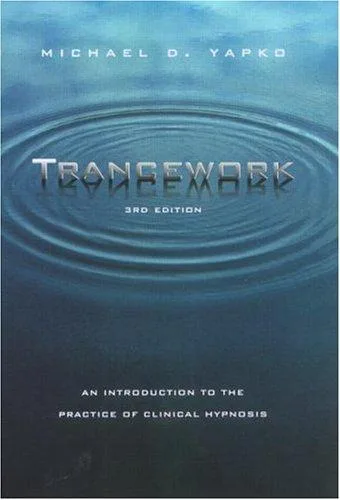
Trancework
 71
71

Trancework
Michael D. Yapko's *Trancework* offers a meticulously structured examination of hypnotherapy, presenting it not as a parlor trick but as a clinical discipline. Yapko meticulously dissects the components of trance induction and utilization, moving from foundational principles to advanced applications. A particular strength lies in his clear articulation of the client's active role in the trance process, demystifying the experience and empowering both patient and practitioner. The chapter discussing the utilization of a client's own frame of reference, for instance, provides practical strategies for tailoring hypnotic suggestions effectively, avoiding the pitfalls of generic approaches. However, the sheer density of clinical detail, while valuable for professionals, might present a steep learning curve for those new to the field without direct supervision. The work demands careful study and practice. Despite this, *Trancework* stands as an essential, authoritative guide for serious practitioners seeking to master the art and science of hypnotherapy.
📝 Description
71
### What It Is Trancework is a comprehensive manual by Michael D. Yapko, first published in 2018, detailing the theory and application of hypnotherapy. It moves beyond simplistic notions of hypnosis to present a sophisticated, multi-faceted approach to therapeutic trance states. The book systematically breaks down the process of inducing, deepening, and utilizing trance for a wide array of psychological and behavioral issues.
### Who It's For This work is primarily aimed at mental health professionals, including psychotherapists, psychologists, counselors, and clinical social workers, who wish to integrate or enhance their use of hypnosis in practice. It is also suitable for graduate students in psychology and related fields seeking a rigorous academic foundation in hypnotherapy. Laypersons with a serious, dedicated interest in the mechanics of altered states and their therapeutic potential may also find value, provided they approach it with a critical and informed perspective.
### Historical Context Hypnosis has a complex history, evolving from the "mesmerism" of Franz Mesmer in the late 18th century through the work of figures like Jean-Martin Charcot and Milton H. Erickson. Yapko's 2018 publication arrives in an era where hypnosis, after periods of skepticism and pseudoscientific association, is increasingly recognized within mainstream psychology and medicine. It builds upon the legacy of Ericksonian hypnotherapy, which emphasized indirect suggestion and naturalistic trance induction, contrasting with earlier, more authoritarian methods.
### Key Concepts The book explores various techniques for eliciting and managing trance, including ideomotor responses, dissociation, and the utilization of a client's own frame of reference. It emphasizes the importance of rapport, pacing, and tailored interventions. Key concepts include the distinction between somnambulistic and non-somnambulistic trance states, the use of metaphors and storytelling, and the ethical considerations inherent in guiding clients through altered states of consciousness.
💡 Why Read This Book?
• Understand the specific techniques for eliciting and deepening trance states, moving beyond superficial understanding to practical application, as detailed in Yapko's exploration of ideomotor responses. • Learn how to tailor hypnotic interventions to an individual client's unique perspective and communication style, a core tenet of the Ericksonian approach Yapko references. • Gain insight into the ethical considerations and clinical applications of hypnosis for a range of psychological issues, as presented in the book's systematic breakdown of therapeutic goals.
⭐ Reader Reviews
Honest opinions from readers who have explored this book.
❓ Frequently Asked Questions
When was Michael D. Yapko's Trancework first published?
Michael D. Yapko's *Trancework* was first published in 2018. This edition provides a contemporary overview of hypnotherapy techniques and theory, building on decades of clinical practice and research in the field.
What is the primary focus of Trancework?
The primary focus of *Trancework* is the theory and application of clinical hypnotherapy. It details how to induce, deepen, and utilize trance states for therapeutic purposes across various psychological issues.
Is Trancework suitable for beginners in hypnotherapy?
While comprehensive, *Trancework* is best suited for mental health professionals or graduate students. Beginners may find the depth of clinical detail challenging without direct supervision or foundational knowledge in psychotherapy.
What historical figures or movements influence the concepts in Trancework?
*Trancework* is significantly influenced by the legacy of Milton H. Erickson and his approach to naturalistic, indirect hypnotherapy, contrasting with earlier, more authoritarian methods.
What are some key concepts explored in Trancework?
Key concepts include ideomotor responses, dissociation, rapport building, client-centered suggestion, and the distinction between various trance states, all presented within a clinical framework.
What distinguishes Yapko's approach from earlier forms of hypnosis?
Yapko's approach, influenced by Erickson, emphasizes indirect suggestion, client utilization, and naturalistic trance induction, diverging from the direct, authoritarian commands common in earlier forms of hypnosis like mesmerism.
🔮 Key Themes & Symbolism
The Art of Trance Induction
This theme examines the meticulous craft of guiding individuals into hypnotic states. Yapko moves beyond simple relaxation, detailing methods like ideomotor signaling and pacing to establish rapport and create the optimal conditions for trance. The focus is on a client-centered approach, recognizing that each individual's journey into trance is unique and requires sensitive, adaptive techniques. It emphasizes the subtle interplay between therapist and client, where suggestion is often indirect and interwoven with the client's own experiences and frame of reference.
Therapeutic Utilization of Trance
Beyond induction, this theme addresses the practical application of hypnotic states for therapeutic outcomes. Yapko illustrates how trance can facilitate access to subconscious resources, reframe problematic beliefs, and promote behavioral change. The work explores techniques for post-hypnotic suggestion, metaphoric communication, and the management of dissociation, all aimed at addressing issues ranging from anxiety and phobias to habit disorders. The ethical dimension of utilizing altered states for healing is also a crucial component.
Ericksonian Principles in Practice
A significant thread throughout *Trancework* is the influence of Milton H. Erickson. Yapko elaborates on Erickson's innovative methods, such as the utilization of a client's existing behaviors and perceptions, indirect suggestions, and the construction of unique therapeutic narratives. This section highlights how these principles allow for highly personalized and effective hypnotherapy, departing from more rigid, directive models and emphasizing the inherent capacity for change within the individual.
Clinical Hypnosis as a Discipline
Yapko positions hypnotherapy as a serious clinical modality, grounded in psychological theory and empirical observation. This theme underscores the importance of professional training, ethical practice, and a thorough understanding of psychopathology. It debunks common misconceptions about hypnosis, presenting it as a legitimate tool within the broader landscape of psychotherapy, requiring skill, knowledge, and careful integration into a comprehensive treatment plan.
💬 Memorable Quotes
“Trance is a state of focused attention and heightened suggestibility.”
— This definition encapsulates the core of hypnotic experience, highlighting its dual nature: an internal concentration and an external responsiveness. It serves as a foundational concept for understanding how therapeutic interventions within trance can be effective.
“The client's frame of reference is the most valuable resource.”
— This principle emphasizes tailoring therapeutic strategies to the individual's worldview, beliefs, and experiences. It suggests that effective hypnotherapy respects and utilizes the client's unique perspective rather than imposing an external one.
“Ideomotor responses can serve as a bridge between conscious and unconscious communication.”
— This points to the subtle physical movements that can occur in hypnosis, acting as a non-verbal language. It highlights how these involuntary responses can be used to gauge understanding, confirm suggestions, or bypass conscious resistance.
“Hypnosis is not about control, but about collaboration.”
— This reorients the common misconception of hypnosis as mind control. It frames the therapeutic relationship as a partnership, where the therapist guides and the client actively participates in their own healing process.
“Dissociation can be a pathway to processing overwhelming experiences.”
— This highlights a specific psychological mechanism utilized in trance. It suggests that by temporarily separating aspects of experience, individuals can gain distance and begin to integrate traumatic or highly charged events more effectively.
🌙 Esoteric Significance
Tradition
While not overtly aligned with a specific esoteric lineage like Kabbalah or Hermeticism, *Trancework* engages with principles that resonate with mystical traditions. The focus on altered states of consciousness, accessing subconscious resources, and the power of focused intention touches upon universal themes found in shamanism, Gnosticism, and various contemplative practices. Yapko's clinical approach, however, grounds these concepts in empirical psychology, offering a secularized framework for exploring inner states that have long been the domain of esoteric inquiry.
Symbolism
The book implicitly engages with symbolism through the use of metaphor and narrative within hypnotic suggestion. While not detailing specific esoteric symbols, it explores how abstract concepts and personal imagery can function symbolically for the individual. For example, the 'frame of reference' itself can be seen as a symbolic representation of a person's internal world and belief system, which the therapist learns to navigate and influence through symbolic language.
Modern Relevance
Contemporary therapeutic modalities, particularly those focused on mindfulness, trauma-informed care, and psychodynamic approaches, often echo the principles laid out in *Trancework*. Thinkers and practitioners in fields like Somatic Experiencing, Internal Family Systems (IFS), and even certain branches of positive psychology draw upon the understanding of altered states, the subconscious, and the power of internal narrative that Yapko meticulously details. His work provides a foundational text for understanding the clinical application of states of mind often explored in more esoteric contexts.
👥 Who Should Read This Book
• Mental health professionals (psychologists, therapists, counselors) seeking to integrate or refine hypnotherapy techniques into their practice, particularly those interested in Ericksonian approaches. • Graduate students in psychology and related fields needing a comprehensive, clinically-oriented textbook on the theory and application of hypnosis. • Researchers in consciousness studies or psychophysiology interested in the empirical and clinical dimensions of altered states of awareness.
📜 Historical Context
Michael D. Yapko's *Trancework*, published in 2018, emerged in an era where clinical hypnosis, after significant periods of public skepticism and academic marginalization, was gaining renewed traction within mainstream psychology and medicine. The book stands on the shoulders of giants like Milton H. Erickson, whose pioneering work in the mid-20th century shifted hypnotherapy towards more naturalistic and indirect methods, moving away from the authoritarian "stage hypnosis" popularizations and the more rigid techniques of early practitioners. Yapko's approach integrates these Ericksonian principles with contemporary cognitive-behavioral and systemic perspectives. While figures like Franz Mesmer laid early groundwork in the late 18th century, and Jean-Martin Charcot furthered neurological studies in the late 19th century, the field has continually evolved. Yapko’s work reflects this maturation, offering a sophisticated clinical manual that acknowledges the therapeutic potential while navigating the complex history and sometimes contentious reception of hypnosis.
📔 Journal Prompts
The client's frame of reference: How might your own biases influence your perception of another's experience?
Ideomotor responses: What subtle physical cues do you notice in others (or yourself) that might indicate unspoken feelings or thoughts?
The distinction between somnambulistic and non-somnambulistic trance: Reflect on different levels of awareness you experience throughout a typical day.
Therapeutic utilization: Consider a personal challenge and how accessing different internal resources might offer a new perspective.
Rapport: Analyze a successful collaboration you've experienced. What elements contributed to its effectiveness?
🗂️ Glossary
Ideomotor Response
An involuntary physical movement or change (e.g., a slight hand lift) that occurs in response to a suggestion or thought, often used in hypnosis to communicate with the unconscious mind.
Dissociation
A psychological process involving a disconnection between thoughts, memories, feelings, actions, or sense of identity. In hypnosis, it can be utilized therapeutically.
Trance
An altered state of consciousness characterized by focused attention, heightened suggestibility, and often, a diminished awareness of external stimuli.
Frame of Reference
An individual's unique perspective, beliefs, values, and experiences through which they interpret the world. In hypnotherapy, working within this frame is crucial for effective suggestion.
Rapport
A harmonious relationship characterized by mutual trust and understanding between the therapist and client, considered essential for effective hypnotherapy.
Post-hypnotic Suggestion
A suggestion given during hypnosis that is intended to be acted upon after the trance state has ended, aimed at facilitating behavioral or cognitive changes.
Somnambulism
A deep state of trance characterized by profound suggestibility and often involving phenomena like amnesia or hallucinations, considered one of the more intense levels of hypnotic response.