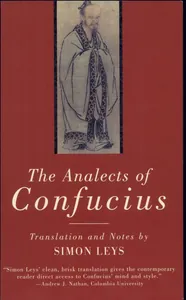
The wisdom of Confucius

 79
79

The wisdom of Confucius
The "Wisdom of Confucius" presents a distilled version of ethical thought that has long anchored East Asian civilization. What is striking, even in translation, is the directness and practical nature of Confucius's pronouncements. There's little room for abstract theorizing; instead, the focus is consistently on how one ought to act in the world, whether as a ruler or a private citizen. The emphasis on *li* (propriety) as the outward manifestation of inner virtue (*ren*) provides a clear framework for social interaction, though its application can feel prescriptive to a modern sensibility. One passage that lingers is the admonition to avoid imposing on others what one does not desire for oneself, a formulation of the Golden Rule that feels both simple and profound. However, the sheer aphoristic style, while concise, can sometimes lack the depth of sustained argument, leaving the reader to bridge interpretive gaps. The work's strength lies in its unwavering focus on character development and social order, but its potential limitation for contemporary readers is navigating the deeply hierarchical social structures it implicitly endorses. Ultimately, this is an indispensable primer on a philosophical system that continues to inform global ethics.
📝 Description
79
### What It Is
The "Wisdom of Confucius" is not a single narrative text but a compilation of dialogues, aphorisms, and teachings attributed to Confucius (Kong Fuzi), a pivotal Chinese philosopher and teacher whose ideas profoundly shaped East Asian thought. This particular edition likely presents selections from foundational texts such as the Analects, the Great Learning, and the Doctrine of the Mean, offering readers direct access to his ethical, social, and political philosophy. These teachings, originally compiled by his disciples, focus on personal cultivation, good governance, and harmonious social relations.
### Who It's For
This work is essential for anyone interested in the roots of East Asian philosophy and ethics. It appeals to students of comparative religion, political science, and ethics seeking foundational texts. Individuals interested in ancient wisdom traditions, self-improvement through moral cultivation, and the principles of effective leadership will find substantial material here. It is also for those who appreciate aphoristic wisdom and direct, practical guidance on living a virtuous life.
### Historical Context
Confucius lived during the Spring and Autumn period of Chinese history (roughly 771 to 476 BCE), a time of significant political fragmentation and intellectual ferment. His teachings emerged as a response to the perceived moral decline and social disorder of his era. He sought to revive the ethical principles and ceremonial order of earlier dynasties, emphasizing virtues like benevolence (ren), righteousness (yi), propriety (li), wisdom (zhi), and trustworthiness (xin). His philosophy offered a framework for social stability and personal integrity that would influence Chinese governance and culture for over two millennia, often in dialogue with Legalist and Daoist schools of thought.
### Key Concepts
The core of Confucius's philosophy revolves around the concept of *ren* (仁), often translated as benevolence, humanity, or humaneness, representing the ideal moral quality of a person. Another central concept is *li* (禮), which encompasses rites, rituals, etiquette, and propriety, serving as the outward expression of *ren* and the foundation of social order. The idea of the *junzi* (君子), or gentleman/superior person, represents the cultivated individual who embodies these virtues. Confucius also stressed the importance of education and self-reflection for moral development and the concept of filial piety (*xiao*, 孝) as the cornerstone of familial and social harmony.
💡 Why Read This Book?
• Learn the core tenets of *ren* (benevolence) and *li* (propriety), understanding how Confucius envisioned moral cultivation as the basis for social harmony, a concept central to his teachings during the Spring and Autumn period. • Grasp the ideal of the *junzi* (superior person) as Confucius defined it, providing a concrete model for personal ethical development and leadership that transcends mere social status. • Understand the foundational role of filial piety (*xiao*) in Confucian thought, recognizing its significance not just within the family but as a microcosm for broader societal order and governance.
⭐ Reader Reviews
Honest opinions from readers who have explored this book.
❓ Frequently Asked Questions
What is the historical period during which Confucius lived and taught?
Confucius lived and taught during China's Spring and Autumn period, which spanned from approximately 771 to 476 BCE. This era was characterized by political fragmentation and frequent warfare among various states.
What does the concept of 'ren' mean in Confucian philosophy?
'Ren' (仁) is a central concept in Confucianism, often translated as benevolence, humanity, or humaneness. It represents the ideal moral virtue of empathy, compassion, and concern for others.
How did Confucius's teachings differ from Legalist philosophy?
While Legalism emphasized strict laws and harsh punishments to maintain order, Confucius advocated for moral cultivation, ritual propriety (*li*), and virtuous leadership as the primary means of achieving social harmony.
What is the significance of 'li' in Confucian thought?
'Li' (禮) refers to rites, rituals, etiquette, and proper conduct. Confucius believed that adherence to *li* was essential for expressing inner virtue (*ren*) and maintaining social order and harmony.
Who were Confucius's primary disciples, and how were his teachings recorded?
Confucius's teachings were primarily recorded by his disciples and their followers in texts like the Analects. Key disciples included Zengzi, Yan Hui, and Zigong, who preserved and disseminated his philosophy.
Is 'The Wisdom of Confucius' a single book written by him?
No, 'The Wisdom of Confucius' is typically a compilation of sayings and dialogues attributed to Confucius and recorded by his disciples, most notably found in the Analects. He himself did not author a single, cohesive book.
🔮 Key Themes & Symbolism
Moral Cultivation (*Xiu Shen*)
The heart of Confucian philosophy lies in the continuous process of self-improvement and moral cultivation. This involves diligent study, introspection, and the practice of virtues like benevolence (*ren*) and propriety (*li*). The goal is to transform oneself into a *junzi* (superior person), capable of ethical leadership and harmonious social interaction. This internal focus on character development is presented not as an end in itself, but as the necessary foundation for effective governance and a stable society, a concept explored extensively in texts compiled during the turbulent Spring and Autumn period.
Social Harmony and Order (*He*)
Confucius's teachings are deeply concerned with establishing and maintaining social harmony. He believed that a well-ordered society stemmed from individuals fulfilling their roles and responsibilities according to established rites (*li*) and ethical principles. Filial piety (*xiao*) is presented as the bedrock of this order, extending outwards to loyalty to the ruler and respect for elders. This emphasis on collective well-being and structured relationships provided a vital counterpoint to the political chaos of his era and influenced governance across East Asia for centuries.
Ethical Governance
Confucius advocated for a form of governance led by virtuous individuals who rule through moral example rather than coercion or strict legal codes. The ideal ruler, a *junzi*, embodies benevolence and righteousness, inspiring the populace to follow the Way (*Dao*). This contrasts sharply with the Legalist school, which favored absolute power and strict laws. Confucius argued that a ruler's personal virtue is the most effective tool for maintaining order and securing the people's loyalty, a philosophy that profoundly shaped imperial Chinese administration.
The Superior Person (*Junzi*)
The concept of the *junzi* represents the ethical ideal in Confucianism. It is not a title of birthright but an attained state of moral excellence achieved through learning, reflection, and practice. A *junzi* embodies virtues such as sincerity, trustworthiness, courage, and a profound sense of humanity (*ren*). This ideal serves as a aspirational figure for individuals and leaders alike, guiding their conduct and shaping their understanding of proper social and political engagement, a recurring motif throughout the Analects.
💬 Memorable Quotes
“Do not impose on others what you do not wish for yourself.”
— This aphorism encapsulates the principle of reciprocity and empathy central to Confucian ethics. It serves as a practical guideline for interpersonal conduct, encouraging individuals to consider the perspectives and feelings of others before acting, thereby fostering mutual respect and minimizing conflict.
“To know what you know and what you do not know, that is true knowledge.”
— This statement highlights the importance of intellectual honesty and self-awareness. True wisdom, according to Confucius, lies not in possessing vast amounts of information, but in recognizing the limits of one's own understanding and acknowledging what remains unknown.
“The superior person understands righteousness; the small person understands profit.”
— This contrasts the motivations of an ethically developed individual (*junzi*) with those driven purely by self-interest. It suggests that genuine leadership and societal well-being stem from prioritizing moral principles over personal gain, a core tenet of Confucian political thought.
“Learning without thought is labor lost; thought without learning is perilous.”
— This emphasizes the symbiotic relationship between theoretical knowledge and practical application. Confucius believed that true understanding requires both the acquisition of information through study and the critical reflection upon that information to integrate it into one's life.
“Our greatest glory is not in never falling, but in rising every time we fall.”
— This interpretation highlights the Confucian emphasis on resilience and perseverance in the face of adversity. It frames moral progress not as an unbroken ascent but as a process of learning from mistakes and continuing to strive for ethical perfection.
🌙 Esoteric Significance
Tradition
While Confucius's philosophy is primarily socio-ethical, its emphasis on cosmic order, ritual, and the cultivation of virtue places it within a broader cosmological framework that has been interpreted esoterically. It shares ground with Taoist concepts of aligning with the natural Way (*Dao*) and can be seen as a precursor to Neo-Confucianism's metaphysical explorations. Its focus on achieving harmony between the individual, society, and Heaven (*Tian*) suggests an underlying aspiration for a unified, ordered existence that resonates with certain esoteric traditions seeking cosmic integration.
Symbolism
Key symbols in Confucian thought include the *junzi* (君子), the ideal person, representing the cultivated human potential and the goal of moral perfection. The concept of *li* (禮), encompassing rites and proper conduct, symbolizes the structured framework necessary for social harmony and the expression of inner virtue. Heaven (*Tian*, 天) represents a supreme, impersonal cosmic order or moral force, suggesting a transcendent dimension that guides human affairs and demands ethical alignment.
Modern Relevance
Contemporary thinkers and practitioners in fields ranging from ethics and political philosophy to business management continue to draw on Confucian principles. Schools of thought emphasizing virtue ethics and communitarianism find resonance in his focus on character development and social responsibility. Furthermore, the global interest in mindfulness and self-cultivation practices often intersects with Confucian ideals of disciplined thought and ethical living, bridging ancient wisdom with modern psychological and spiritual pursuits.
👥 Who Should Read This Book
• Students of East Asian philosophy and history seeking foundational texts on ethics and governance, particularly those interested in the period from 500 BCE onwards. • Individuals focused on personal development and character building, looking for practical wisdom on how to cultivate virtues like benevolence, integrity, and respect. • Leaders and aspiring leaders interested in ethical governance and the principles of ruling through moral example rather than force or manipulation.
📜 Historical Context
Confucius (Kong Fuzi) lived and taught during China's tumultuous Spring and Autumn period (c. 771–476 BCE), a time marked by the decline of Zhou dynasty authority and endemic warfare among feudal states. His philosophy emerged as a response to this perceived moral and social chaos. He sought to revive the perceived order and ethical principles of earlier eras, emphasizing personal virtue, ritual propriety (*li*), and benevolent governance. His ideas offered a powerful alternative to the increasingly dominant Legalist school, which advocated for strict laws and harsh punishments. Confucius's teachings were primarily compiled by his disciples in texts like the Analects, which became foundational to Chinese education and statecraft. His contemporary, Laozi, founder of Daoism, offered a contrasting philosophical path focused on naturalness and spontaneity, further diversifying the intellectual landscape of the era. The enduring influence of Confucianism is evident in its adoption and adaptation by subsequent dynasties, shaping East Asian culture for over two millennia.
📔 Journal Prompts
The principle of *ren* (benevolence) in your daily interactions.
The application of *li* (propriety) in contemporary social situations.
Your personal definition of the *junzi* (superior person) today.
Reflections on filial piety (*xiao*) within your family structure.
The balance between learning and critical thought in your own life.
🗂️ Glossary
Ren (仁)
The core Confucian virtue, often translated as benevolence, humanity, or humaneness. It signifies empathy, compassion, and a deep concern for the well-being of others.
Li (禮)
Encompasses rites, rituals, propriety, etiquette, and social norms. Confucius viewed *li* as the outward expression of *ren* and essential for maintaining social order and harmony.
Junzi (君子)
Literally 'son of a ruler' or 'lord's son,' but commonly translated as 'gentleman' or 'superior person.' It denotes an individual who has achieved moral excellence through self-cultivation.
Xiao (孝)
Filial piety, the virtue of respect for one's parents, elders, and ancestors. Confucius considered it the foundation of all ethical conduct and social order.
Yi (義)
Righteousness or justice. It refers to the moral disposition to do good and act according to what is right, often contrasted with acting for personal profit.
Tian (天)
Heaven, often understood as a cosmic moral order or a supreme guiding force. Confucius believed in aligning one's actions with the will of Heaven.
Dao (道)
The Way. In Confucianism, it refers to the natural moral order of the universe and the path of ethical conduct that individuals should follow.








![Tales of Mystery and Imagination [25 stories]](/img/thumb/tales-of-mystery-and-imagination-25-stories-edgar-allan-poe-202357.webp)