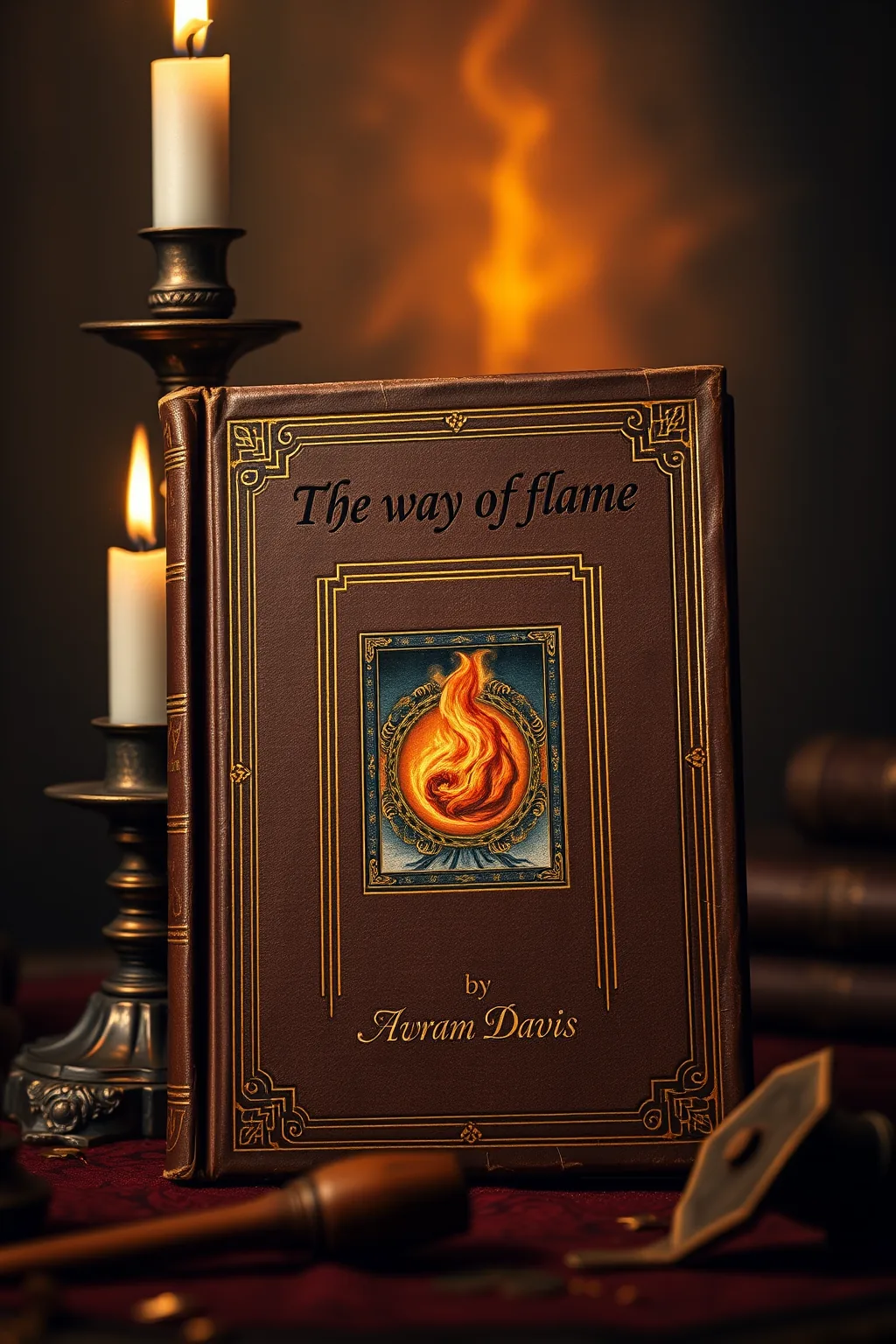
The way of flame
 78
78

The way of flame
Avram Davis’s *The Way of Flame* offers a starkly focused approach to esoteric practice, eschewing the common tendency to synthesize or broadly survey. Its strength lies in this very specificity; the text presents a coherent, if demanding, system for inner work. Davis’s prose, particularly in his detailed explanations of energetic mechanics, avoids airy mysticism, grounding abstract concepts in what feels like lived experience. A notable limitation, however, is the relative scarcity of direct engagement with other traditions or thinkers, which can make the system feel somewhat insular. The passage describing the "Kindling of the Inner Fire" is particularly potent, illustrating the book's capacity for direct, experiential instruction. It is a text for the dedicated practitioner, not the casual browser.
📝 Description
78
### What It Is
The Way of Flame, first published in 1996 by Avram Davis, is a focused exploration within esoteric literature. It presents a singular perspective on spiritual development, eschewing broad overviews for a deep dive into a specific, often intensely personal, path. The book is not an introductory primer but rather a guide for those already familiar with the landscape of metaphysical inquiry, offering a structured approach to inner transformation. Its prose is direct, aiming to impart understanding rather than simply entertain.
### Who It's For
This work is intended for serious students of esoteric disciplines who seek a rigorous, internally consistent system of practice. Readers who appreciate a non-dogmatic yet authoritative voice, and who are prepared to engage with challenging concepts, will find value here. It is particularly suited for individuals drawn to the dynamics of inner fire and its role in consciousness expansion, and those who are looking for practical application of abstract principles rather than purely theoretical discourse.
### Historical Context
Published in the mid-1990s, a period of burgeoning interest in personalized spirituality and the integration of diverse esoteric traditions, *The Way of Flame* emerged amidst a landscape populated by authors such as Doreen Valiente, whose work on modern witchcraft was gaining traction, and the continued influence of figures like Aleister Crowley and Dion Fortune. Davis’s contribution offered a distinct, focused path that, while not directly engaging with public debate or major academic discourse at the time of its release, carved out a niche for practitioners seeking specific modalities of inner work. The book’s independent publication allowed for an unfiltered expression of its core ideas.
### Key Concepts
The central concept revolves around the "Flame" as a metaphor for divine spark, transformative energy, and the activating principle within consciousness. Davis explores the cultivation and direction of this inner fire as a means to achieve spiritual illumination and heightened awareness. Other significant ideas include the nature of the subtle body, the mechanics of energetic transference, and the stages of spiritual ascent, all framed within a unique cosmology that emphasizes direct experience over received dogma. The work also touches upon the importance of intention and focus in directing these energies.
💡 Why Read This Book?
• Gain a practical framework for understanding and cultivating internal energetic forces, as detailed in the book's specific methods for "Kindling the Inner Fire," offering a unique approach to personal spiritual acceleration. • Explore the concept of the "Subtle Body" as presented by Davis, providing a distinct model for energetic anatomy that differs from more common yogic or Hermetic interpretations found elsewhere. • Benefit from a focused, non-synthesized esoteric path, allowing for a deeper immersion into Avram Davis's specific cosmology and practices, which can lead to more concentrated personal development than generalized spiritual guides.
⭐ Reader Reviews
Honest opinions from readers who have explored this book.
❓ Frequently Asked Questions
When was Avram Davis's 'The Way of Flame' first published?
The book 'The Way of Flame' by Avram Davis was first published in 1996, marking its entry into the esoteric literature landscape of the late 20th century.
What is the primary focus of 'The Way of Flame'?
The primary focus is on the cultivation and directed use of inner spiritual energy, often metaphorically referred to as 'flame,' as a means for consciousness expansion and spiritual development.
Is 'The Way of Flame' suitable for beginners in esotericism?
While it offers a clear path, the book's depth and specific terminology suggest it is best suited for those with some foundational knowledge of metaphysical concepts and esoteric practices.
Does the book mention specific meditative techniques?
Yes, the work details particular techniques for focusing consciousness and directing internal energies, aiming to 'kindle' the inner flame as described in its core teachings.
What makes Avram Davis's approach distinct from other esoteric authors?
Davis's approach is characterized by its singular focus on the 'flame' as a central energetic principle and its direct, often rigorous, methodology, rather than synthesizing multiple traditions.
Are there specific symbols discussed in 'The Way of Flame'?
The central symbol is the 'flame' itself, representing divine spark and transformative energy. The book also explores related concepts of light and internal energetic structures.
🔮 Key Themes & Symbolism
The Inner Flame
The central theme is the 'Flame' as the divine spark within, the engine of consciousness, and the primary agent of spiritual transformation. Davis presents this not as a passive concept but as an active, cultivable energy. The book details methods for its ignition, sustentation, and directed application, emphasizing its role in awakening dormant potentials and facilitating a direct connection to higher states of being. This internal fire is depicted as the core of individual spiritual alchemy.
Energetic Mechanics
A significant portion of the work is dedicated to explaining the underlying mechanics of spiritual energy. Davis outlines how this energy functions within the subtle body, how it can be influenced by focused intention and will, and the principles governing its flow and transformation. This section provides a theoretical, yet practically oriented, map for practitioners aiming to understand the energetic processes involved in their spiritual work.
Stages of Ascent
The book maps out a progression of spiritual development, conceptualized as stages of 'ascent' powered by the cultivation of the inner flame. These stages are not merely philosophical but are presented as experiential thresholds that can be consciously navigated. Davis provides insights into the challenges and transformations encountered at each level, offering guidance for practitioners seeking to advance along their chosen path with clarity and purpose.
Consciousness and Will
Central to the practice described in 'The Way of Flame' is the power of focused consciousness and directed will. The book asserts that the individual's ability to concentrate their mental and energetic resources is paramount in igniting and guiding the inner flame. This theme underscores the active role the practitioner plays in their own spiritual evolution, positioning the will as a crucial tool for manifesting inner change.
💬 Memorable Quotes
“The Flame is not found, but kindled.”
— This statement emphasizes that spiritual essence or divine potential is not an external object to be discovered, but an internal power that requires active cultivation and focused effort to awaken.
“Energy follows intention, and intention is the forge.”
— This highlights the critical role of directed mental focus and willpower in shaping and directing the flow of subtle energies within the practitioner's being.
“The Subtle Body is the crucible.”
— This metaphor suggests that the non-physical aspects of the self serve as the environment or vessel where energetic transformations and spiritual alchemy, driven by the 'Flame,' take place.
“To ascend is to refine, not to escape.”
— This interpretation suggests that spiritual progress involves purifying and elevating one's current state of being and consciousness, rather than seeking to abandon the physical or material realm entirely.
“The path is paved with focused intent.”
— This emphasizes that consistent and deliberate mental effort is the fundamental requirement for making progress along the spiritual journey outlined in the book.
🌙 Esoteric Significance
Tradition
While not strictly adhering to a single historical lineage, *The Way of Flame* draws heavily from the Western Esoteric tradition, particularly its Hermetic and alchemical currents. It emphasizes an internal, practical alchemy focused on the transformation of consciousness through the cultivation of inner fire. The work departs from more ceremonial or ritualistic traditions by prioritizing direct energetic manipulation and focused will as the primary means of spiritual advancement, aligning with a more psychological and immanent approach to the Great Work.
Symbolism
The dominant symbol is the 'Flame,' representing the divine spark, the animating principle of consciousness, and the transformative energy of spiritual awakening. Other significant motifs include light, often associated with illumination and higher awareness, and the concept of the 'Subtle Body,' which serves as the internal landscape or 'crucible' for energetic operations. These symbols function not merely as decorative elements but as integral components of the practical system presented, guiding the practitioner's focus and understanding.
Modern Relevance
Contemporary practitioners of internal alchemy, energy work, and consciousness studies often find resonance with Davis's focused approach. His emphasis on directed will and internal energetic mechanics appeals to those seeking practical, repeatable methods for spiritual development outside of traditional religious or broadly synthesized New Age frameworks. The book's principles can be seen as informing modern somatic practices and mindfulness techniques that focus on cultivating internal states of awareness and energetic vitality.
👥 Who Should Read This Book
• Dedicated practitioners of internal alchemy seeking a focused system for cultivating spiritual energy and consciousness. They will gain a specific methodology for igniting and directing their inner 'Flame.' • Students of esoteric psychology interested in the mechanics of will and consciousness. They will find a practical model for how focused intent can drive personal transformation. • Individuals drawn to the concept of inner fire as a central transformative agent. They will benefit from a detailed exploration of this principle beyond its common symbolic usage.
📜 Historical Context
Emerging in 1996, *The Way of Flame* arrived during a period where the internet was beginning to democratize access to esoteric knowledge, yet printed works still held significant authority. This era saw a continued interest in Western esotericism, building on the foundations laid by figures like Aleister Crowley and Dion Fortune in the early to mid-20th century. While academic study of occultism was gaining some traction, much of the practical esoteric landscape was driven by independent publishers and authors. Davis’s work did not directly engage with the popular New Age syntheses prevalent at the time, nor did it appear within the orbit of major academic critiques, such as those examining Theosophy or Gnosticism. Its distinctiveness lay in its focused, almost austere, presentation of a specific inner discipline, offering a counterpoint to more eclectic or overtly ceremonial approaches.
📔 Journal Prompts
The Kindling of the Inner Fire: What obstacles hinder its ignition in your practice?
Reflect on the 'Subtle Body' as the forge for your energetic work.
Identify a moment where focused intent shifted your internal energetic state.
Consider the 'Stages of Ascent' as a map for your current spiritual journey.
How does the concept of 'refining' relate to your personal definition of spiritual progress?
🗂️ Glossary
The Flame
The central metaphor and energetic principle in the book, representing the divine spark, animating consciousness, and the power of spiritual transformation.
Kindling
The act of initiating or igniting the Inner Flame, referring to the initial stages of awakening spiritual energy and consciousness.
Subtle Body
The non-physical energetic structure within which spiritual energies operate and transform; the internal landscape for the practice described.
Energetic Mechanics
The principles governing the flow, manipulation, and transformation of spiritual energies within the individual, as detailed by the author.
Stages of Ascent
A conceptual framework outlining the progressive levels or phases of spiritual development achievable through dedicated practice.
Focused Intent
The directed application of consciousness and will towards a specific goal or energetic outcome, crucial for the book's practical methods.
Crucible
A term used metaphorically to describe the Subtle Body as the vessel or environment where energetic transformations occur.