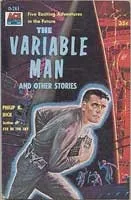
The variable man, and other stories
 71
71

The variable man, and other stories
Philip K. Dick's "The Variable Man, and Other Stories" presents a potent distillation of his early thematic preoccupations. The titular story, "The Variable Man," offers a compelling examination of precognition and its paradoxes, particularly how knowledge of the future can alter it, thereby invalidating the knowledge itself. Dick’s strength lies in creating scenarios that feel simultaneously absurd and deeply plausible, forcing a confrontation with the fragility of our perceived reality. A notable limitation, however, is the occasional unevenness in pacing across the collected stories, some of which feel more like thought experiments than fully realized narratives. The concept of the 'variable man' himself, an individual whose unpredictable nature disrupts deterministic systems, serves as a powerful metaphor for human agency in the face of overwhelming external forces. This collection serves as an essential primer for understanding Dick's evolving literary project.
📝 Description
71
Philip K. Dick's 1957 collection "The Variable Man, and Other Stories" probes unstable realities.
This collection gathers early speculative fiction by Philip K. Dick. The stories often place characters in situations where what seems real is not, and objective truth proves elusive or is actively manipulated. Dick's protagonists frequently struggle with a world that shifts beneath their feet, questioning the nature of certainty itself.
Readers will find narratives that challenge fundamental ideas about identity and existence. These stories pose significant existential questions, focusing on the subjective experience of reality rather than offering easy solutions. For fans of Dick's later, more recognized works, this volume shows the initial development of his recurring thematic concerns, laying the groundwork for his more complex explorations of consciousness and perception.
Published in the mid-20th century, these stories emerged during a time of significant social and technological upheaval. Dick's writing reflects anxieties from the Cold War era, the dawn of the space age, and philosophical ideas gaining traction like existentialism and phenomenology. This period saw a growing interest in how subjective experience shapes our understanding of the world and the inherent limits of relying solely on empirical evidence. Dick consistently grappled with these themes, questioning the solidity of perceived reality.
💡 Why Read This Book?
• Gain insight into the philosophical underpinnings of precognition as explored in the story "The Variable Man," understanding how knowledge of the future can paradoxically render it unknowable. • Explore Dick's early fascination with the instability of reality, a theme he would later expand upon in works published in the 1960s, challenging fixed perceptions of existence. • Appreciate the literary context of mid-20th century speculative fiction, noting how Dick's narrative experiments in these stories prefigured later developments in existential science fiction.
⭐ Reader Reviews
Honest opinions from readers who have explored this book.
❓ Frequently Asked Questions
When was "The Variable Man, and Other Stories" first published?
While the specific collection "The Variable Man, and Other Stories" was published in 2016, the individual stories within it, including "The Variable Man," were originally written and published in the early to mid-1950s, reflecting a specific era of post-war American speculative fiction.
What are the main themes in Philip K. Dick's "The Variable Man"?
The central themes revolve around determinism versus free will, the paradoxes of precognition, and the nature of reality itself. The story questions whether an individual can truly be predicted or controlled when their very nature defies absolute categorization.
How does "The Variable Man" relate to Philip K. Dick's later works?
It serves as an early exploration of concepts that would become hallmarks of Dick's oeuvre: the unreliability of perception, the nature of identity, and the potential for simulated or altered realities. The seeds of ideas found in novels like "Do Androids Dream of Electric Sheep?" are present here.
Is "The Variable Man, and Other Stories" a good introduction to Philip K. Dick?
Yes, this collection offers a solid introduction to Dick's foundational ideas and narrative style. It showcases his ability to craft compelling speculative scenarios that probe deep philosophical questions, making it accessible for new readers.
What is the significance of the 'variable man' concept?
The 'variable man' represents an anomaly within deterministic systems, an entity whose actions cannot be reliably predicted by even advanced technology or prescience. This concept highlights Dick's enduring interest in the unpredictable nature of consciousness and agency.
Where can I find more information on Philip K. Dick's early career?
Scholarly articles and biographies focusing on Philip K. Dick's career often detail his prolific output during the 1950s. Academic databases and literary criticism sites are excellent resources for exploring his formative years as a writer.
🔮 Key Themes & Symbolism
The Paradox of Precognition
Dick frequently grappled with how knowledge of the future impacts its unfolding. In "The Variable Man," the very act of predicting an individual's actions can lead to those actions being altered, creating a causal loop where the prediction becomes false precisely because it was made. This challenges deterministic views, suggesting that consciousness or a 'variable' element within individuals inherently resists complete foreknowledge, a concept that echoes Gnostic ideas of a flawed, imperfect creation resistant to absolute divine decree.
Subjectivity of Reality
Many of Dick's early stories, including those in this collection, highlight the subjective nature of perceived reality. Characters often struggle with unreliable memories, implanted experiences, or environments that shift without logical explanation. This aligns with phenomenological inquiry, which emphasizes lived experience over objective, external measurement, forcing readers to question what constitutes 'real' and how our internal states shape our external world.
Technological Determinism and Human Agency
Dick explored the tension between advanced technology and individual free will. In "The Variable Man," sophisticated predictive machines are rendered fallible by the 'variable' nature of the human subject. This reflects mid-20th-century anxieties about automation and control, positing that human consciousness, with its inherent unpredictability, remains a crucial, irreducible factor that technology cannot fully encompass.
The Nature of Identity
Through doppelgängers, mistaken identities, and characters questioning their own memories or origins, Dick consistently probed the fluidity of identity. This collection presents early instances of characters whose sense of self is precarious, challenged by external manipulation or internal inconsistencies, touching upon themes relevant to existentialist philosophy's focus on self-creation.
💬 Memorable Quotes
“He was a variable man. A variable man is one who cannot be predicted.”
— This core concept defines the protagonist's nature as an anomaly. It suggests that true freedom or individuality lies in unpredictability, a quality that defies systems of absolute control or deterministic analysis, hinting at a fundamental resistance to being fully known or cataloged.
“The future is not fixed. It changes with every decision.”
— This reflects a central theme in Dick's work: the dynamic and mutable nature of time and destiny. It implies that our choices, even seemingly small ones, have the power to reshape what is to come, underscoring the significance of present action over predetermined fate.
“How can you trust your own memories when they can be implanted?”
— This question probes the very foundation of personal identity and reality. If memory, the bedrock of selfhood, can be artificially constructed or altered, then the entire edifice of our perceived existence becomes suspect, aligning with Gnostic doubts about the material world.
“The machines told me what would happen. But they were wrong.”
— This statement highlights the fallibility of technological prediction when confronted with human unpredictability. It suggests a limitation to purely logical or data-driven systems when attempting to comprehend complex, emergent phenomena like consciousness or free will.
“Perhaps reality is only what we agree it is.”
— This idea touches upon constructivist epistemology, suggesting that shared consensus plays a significant role in defining what we accept as real. It challenges the notion of an objective, singular reality, pointing towards a more fluid, intersubjective understanding of existence.
🌙 Esoteric Significance
Tradition
Dick's work, while couched in science fiction, often touches upon Gnostic themes. The idea of a flawed or illusory material reality, the search for hidden truth, and the concept of a divine spark within humanity are recurrent motifs. His protagonists often seek liberation from a deceptive demiurgic system, mirroring the Gnostic quest for gnosis (knowledge) to escape the material prison. The 'variable man' himself can be seen as an embodiment of the spark of true consciousness resisting the materialist, deterministic 'aeons' of the world.
Symbolism
The concept of the 'variable man' serves as a potent symbol for irreducible human consciousness and free will, an element that defies mechanistic prediction. Shifting realities and doppelgängers symbolize the illusory nature of the material world and the fragmented or uncertain nature of identity within it. Advanced, seemingly omniscient technology often represents the flawed, controlling 'archons' or demiurgic forces that attempt to impose order and predictability on a fundamentally free or divine essence.
Modern Relevance
Contemporary discussions in philosophy of mind, consciousness studies, and even virtual reality development echo Dick's concerns about the nature of reality and identity. Thinkers exploring simulation theory or the ethical implications of artificial intelligence often engage with the questions Dick posed decades ago. His persistent questioning of perceived reality continues to inform speculative fiction and philosophical discourse on what it means to be human in an increasingly complex, technologically mediated world.
👥 Who Should Read This Book
• Aspiring writers of philosophical science fiction seeking to understand narrative techniques for exploring complex ideas. • Students of mid-20th century American literature interested in the development of existential themes within popular genres. • Readers fascinated by the intersection of technology, consciousness, and the nature of reality, who enjoy narratives that challenge conventional perception.
📜 Historical Context
Philip K. Dick's "The Variable Man, and Other Stories" emerged from the fertile ground of 1950s American speculative fiction, a period marked by Cold War anxieties, the burgeoning space race, and a growing interest in existential philosophy. Writers like Robert Heinlein and Isaac Asimov were also exploring themes of societal futures and technological advancement, though Dick's focus often veered towards the internal, psychological implications of these changes. The era saw a rise in science fiction magazines like Astounding Science Fiction, which published many of these early tales, serving as a crucial venue for disseminating new ideas. Dick’s work, particularly its exploration of subjective reality and paranoia, can be seen as a counterpoint to the more optimistic or technologically deterministic narratives prevalent at the time. The intellectual currents of phenomenology and existentialism, popularized by thinkers like Jean-Paul Sartre, provided a philosophical backdrop for Dick's persistent questioning of objective truth and individual agency.
📔 Journal Prompts
The 'variable man' and his resistance to prediction.
Moments where reality felt unstable in the stories.
The function of unreliable memory in constructing identity.
The limitations of technology as depicted by Dick.
Parallels between Gnostic themes and the stories' narratives.
🗂️ Glossary
Precognition
The ability to perceive or know future events. In Dick's work, this often leads to paradoxes where the knowledge itself influences or prevents the event.
Determinism
The philosophical position that every event, including human cognition, decision, and action, is causally determined by an unbroken chain of prior occurrences. Dick often explores the limitations of this concept.
Phenomenology
A philosophical approach that emphasizes the study of conscious experience as experienced from the subjective or first-person point of view. Dick's focus on internal perception aligns with this.
Gnosticism
A complex set of religious and philosophical ideas emphasizing spiritual knowledge (gnosis) for salvation. Key themes include a flawed creator, an illusory material world, and a divine spark within humanity.
Demiurge
In Gnostic and Platonic philosophy, a divine craftsman or subordinate deity responsible for creating the material universe. Often depicted as flawed or malevolent, imposing a restrictive order.
Doppelgänger
A look-alike or double of a living person. In literature, it often symbolizes a fractured psyche, hidden aspects of the self, or external threats to identity.
Existentialism
A philosophy emphasizing individual existence, freedom, and choice. It posits that humans define their own meaning in life and try to make rational decisions despite existing in an irrational universe.