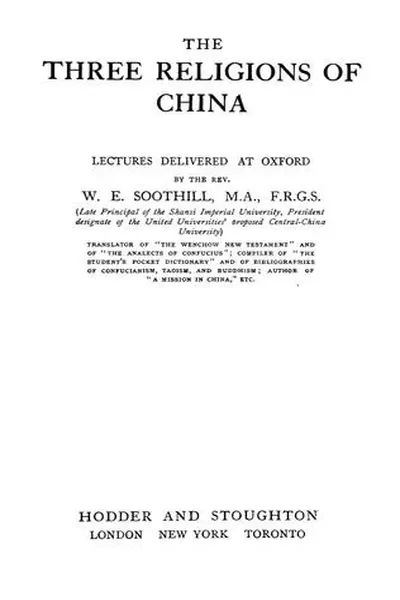
The three religions of China
 77
77

The three religions of China
Soothill’s early 20th-century account of China’s three main religions offers a comprehensive, if somewhat dated, survey. Its strength lies in its detailed exposition of Confucian ethics, Taoist cosmology, and the introduction of Buddhism into the Chinese milieu, drawing from extensive missionary experience. The clarity with which Soothill outlines the interconnections between these traditions is commendable, particularly in his discussion of how Confucianism provided a social framework, Taoism a spiritual depth, and Buddhism a metaphysical reach. However, the work betrays its era through a subtle, though present, Christian apologetic undercurrent and a lack of engagement with later critical scholarship that might offer more nuanced interpretations of Taoist practices or the evolution of Buddhist sects within China.
A particularly insightful passage details the concept of 'wu wei' (non-action) in Taoism, explaining it not as passivity but as effective action in accordance with natural flow. While valuable for its historical perspective, readers seeking contemporary scholarly consensus on these religions will need to supplement this text. Nevertheless, for understanding the historical reception and early academic framing of these traditions in the West, Soothill’s work remains a significant reference point.
Read more ↓
This book provides a valuable historical lens on the study of Chinese religions.
📝 Description
77
### What It Is The three religions of China, by William Edward Soothill, offers a foundational exploration of the interwoven spiritual and philosophical traditions that have shaped Chinese civilization. Originally published in 1923, this work examines Confucianism, Taoism, and Buddhism, presenting their core tenets, historical development, and societal impact. Soothill, a seasoned missionary and scholar, aimed to provide a clear, accessible overview for a Western audience unfamiliar with the nuances of Eastern thought.
### Who It's For This book is intended for students of comparative religion, philosophy, and East Asian studies. It is also valuable for those interested in the historical roots of global spiritual practices and the cross-cultural exchange of ideas. Readers seeking an introduction to the foundational texts and figures of China's major belief systems will find this a solid starting point.
### Historical Context Published in the early 20th century, Soothill's work emerged during a period of significant Western engagement with Eastern philosophies, partly fueled by figures like Helena Blavatsky and the burgeoning Theosophical Society. While Soothill’s perspective is that of a Christian missionary, his scholarship reflects an earnest attempt to understand and present these complex traditions. The era saw a growing academic interest in comparative religion, though often filtered through colonial or missionary lenses. Contemporary scholars like James Legge had already laid groundwork in translating Chinese classics, providing a backdrop against which Soothill's synthesis was received.
### Key Concepts The book dissects the core principles of each religion. For Confucianism, it highlights the emphasis on social harmony, filial piety (xiao), and ethical governance through the cultivation of virtue (ren). Taoism is presented through its pursuit of naturalness (ziran), the concept of the Tao as the ineffable cosmic principle, and practices aimed at achieving balance and longevity. Buddhism's introduction to China and its adaptation, particularly the Mahayana school, are discussed in terms of its doctrines of karma, reincarnation, and the path to enlightenment.
💡 Why Read This Book?
• Understand the foundational principles of Confucianism, Taoism, and Buddhism as presented in the early 20th century, learning about concepts like 'ren' (benevolence) and 'ziran' (naturalness). • Gain insight into the historical context of Western engagement with Eastern spirituality, particularly during the period surrounding its 1923 publication. • Appreciate the complex interplay between these three major traditions in shaping Chinese society and philosophy, as explored in Soothill's detailed analysis.
⭐ Reader Reviews
Honest opinions from readers who have explored this book.
❓ Frequently Asked Questions
What is the primary focus of William Edward Soothill's 'The three religions of China'?
The book primarily focuses on Confucianism, Taoism, and Buddhism, examining their core doctrines, historical evolution, and societal influence in China. Soothill, a missionary scholar, aimed to present these traditions to a Western audience.
When was 'The three religions of China' first published?
The book was first published in 1923, placing it within the early 20th-century wave of Western scholarship on Eastern philosophies.
What are some key concepts discussed regarding Confucianism in the book?
Soothill discusses Confucianism's emphasis on social harmony, ethical governance, filial piety (xiao), and the cultivation of virtue (ren) as central tenets shaping societal structure.
How does the book explain the Taoist concept of 'wu wei'?
The book interprets 'wu wei' not as idleness but as a form of effective action aligned with the natural course of things (ziran), a principle central to Taoist philosophy.
Is 'The three religions of China' considered an objective academic text by modern standards?
While informative, the book reflects the perspectives and biases of its time, including a missionary viewpoint. Modern scholarship offers more critical and nuanced interpretations of these religions.
Who would benefit most from reading this book?
Students of comparative religion, East Asian studies, philosophy, and anyone interested in the historical development and Western reception of Chinese spiritual traditions would find this book beneficial.
🔮 Key Themes & Symbolism
Confucian Social Order
Soothill meticulously details how Confucianism provided a framework for social harmony and ethical governance in China. The book emphasizes concepts like 'ren' (benevolence) and 'xiao' (filial piety) as cornerstones of this philosophy, illustrating how these principles were intended to cultivate virtuous individuals and a stable society. The focus is on the practical application of these ethics in daily life and statecraft, presenting Confucianism as the bedrock of Chinese social structure and moral education, deeply influencing family relationships and political ideology across centuries.
Taoist Pursuit of the Tao
The exploration of Taoism centers on its enigmatic concept of the 'Tao'—the ineffable, natural order of the universe. Soothill elucidates the Taoist ideal of 'ziran' (naturalness) and 'wu wei' (non-action), explaining these not as passivity but as effortless alignment with cosmic principles. The text touches upon practices aimed at achieving balance, longevity, and spiritual harmony, positioning Taoism as a counterpoint to Confucian social rigidity, offering a path of inner cultivation and mystical connection to the natural world.
Buddhism's Chinese Synthesis
This section examines the introduction and adaptation of Buddhism into Chinese culture, particularly the Mahayana school. Soothill outlines key Buddhist doctrines such as karma, reincarnation, and the pursuit of enlightenment, while also highlighting how these concepts were integrated with existing Chinese philosophical and religious landscapes. The book explores the evolution of Buddhist thought and practice within China, noting its influence on art, literature, and popular spirituality, demonstrating a significant cross-cultural spiritual transformation.
Interconnectedness of Traditions
A central thesis is the inseparable nature of these three traditions in shaping Chinese civilization. Soothill argues that Confucianism provided the social and ethical structure, Taoism offered spiritual depth and a connection to nature, and Buddhism contributed metaphysical concepts and soteriological goals. The work illustrates how these distinct yet often complementary systems coexisted and influenced one another, creating a unique syncretic spiritual environment that defined Chinese identity and worldview for millennia.
💬 Memorable Quotes
“The Tao that can be told is not the eternal Tao.”
— This aphorism, foundational to Taoism, highlights the ineffable nature of the ultimate reality. It suggests that any attempt to define or articulate the Tao through language is inherently limited, pointing towards a direct, intuitive understanding beyond conceptualization.
“Filial piety is the root of all virtue.”
— Representing a core Confucian tenet, this statement emphasizes the paramount importance of respect and duty towards one's parents and ancestors. It positions family relationships as the primary training ground for moral development and social responsibility.
“To act without acting is the principle of Wu Wei.”
— This paraphrased concept captures the essence of Taoist 'wu wei'. It signifies acting in harmony with the natural flow of events, without forcing outcomes, leading to effectiveness through minimal effort and spontaneous action.
“Karma determines the cycle of rebirth.”
— This succinctly explains a fundamental Buddhist doctrine. It posits that an individual's actions (karma) in this life directly influence their future circumstances and the nature of their subsequent rebirths.
“Confucianism supplied the framework for society.”
— This interpretation highlights Confucianism's role in establishing social order, ethics, and governance. It suggests that its principles provided the structural and moral scaffolding upon which Chinese society was built and maintained.
🌙 Esoteric Significance
Tradition
This work falls broadly within the tradition of comparative religion scholarship influenced by Theosophical and early Orientalist studies. While not strictly an esoteric text itself, it provided foundational material for Western esotericists seeking to understand the philosophical underpinnings of Eastern traditions. It bridges academic study with an implicit interest in the spiritual and metaphysical dimensions that appealed to esoteric circles seeking universal wisdom beyond Western paradigms.
Symbolism
The book implicitly touches upon potent symbols. For Taoism, the concept of the 'Tao' itself functions as a primary symbol of the ineffable, the underlying principle of existence. The yin-yang symbol, though not detailed extensively by Soothill, represents the Taoist concept of cosmic balance and the interplay of complementary forces. For Buddhism, the wheel of Dharma signifies the Buddha's teachings and the cycle of rebirth, a key concept explored in the text.
Modern Relevance
Contemporary thinkers and practitioners in fields like comparative spirituality, mindfulness, and East Asian philosophy continue to draw upon historical accounts like Soothill's to understand the lineage of these traditions. While modern scholarship has advanced significantly, the book remains a reference for tracing the historical reception of Chinese religions in the West and appreciating the foundational scholarly attempts to synthesize them for a global audience.
👥 Who Should Read This Book
• Students of comparative religion and East Asian studies: Gain a historical overview of Confucianism, Taoism, and Buddhism, understanding their core tenets as presented in the early 20th century. • Aspiring scholars of esoteric traditions: Acquire foundational knowledge of the philosophical and spiritual systems that have profoundly influenced global esoteric thought and practice. • Readers interested in cultural history: Explore how these three religions interacted and shaped Chinese society, appreciating the intellectual currents of the 1923 publication era.
📜 Historical Context
William Edward Soothill's "The three religions of China," published in 1923, emerged during a period of intense Western scholarly and missionary interest in Eastern philosophies. This era, marked by figures like Helena Blavatsky and the rise of Theosophy, saw a burgeoning desire to understand non-Western spiritual systems, though often through a Eurocentric lens. Soothill, a seasoned missionary, sought to present a clear exposition of Confucianism, Taoism, and Buddhism for a Western audience. His work can be situated alongside the efforts of scholars like James Legge, who had previously undertaken significant translations of Chinese classics. While Soothill's perspective was informed by his Christian faith, his detailed exploration reflected a growing academic engagement with comparative religion. The book's reception likely aligned with the intellectual currents of the time, contributing to the Western discourse on Chinese spirituality, even as it represented an early, somewhat dated, scholarly approach compared to later critical analyses.
📔 Journal Prompts
The concept of 'ren' (benevolence) in Confucianism: How might cultivating this virtue impact interpersonal dynamics?
Reflecting on 'ziran' (naturalness): In what aspects of modern life is adherence to natural principles challenging?
The Buddhist doctrine of karma: Consider a past action and its potential long-term consequences.
The Taoist principle of 'wu wei': Identify an area where applying effortless action might yield better results than forceful effort.
The syncretic nature of Chinese religions: How do different belief systems coexist and influence each other in contemporary society?
🗂️ Glossary
Tao (or Dao)
The fundamental, ineffable principle underlying all reality in Taoism. It represents the natural order of the universe and the source from which all things arise.
Confucianism
A philosophical and ethical system developed from the teachings of Confucius, emphasizing personal and governmental morality, social justice, and sincerity.
Taoism (or Daoism)
A philosophy and religion originating in ancient China, emphasizing living in harmony with the Tao, the natural flow of the universe.
Buddhism
A religion and philosophy originating in ancient India, teaching a path of self-enlightenment and liberation from suffering through practices like meditation and ethical conduct.
Ren (仁)
A core Confucian virtue, often translated as benevolence, humaneness, or goodness. It signifies a deep sense of empathy and care for others.
Xiao (孝)
A fundamental Confucian concept representing filial piety, the virtue of respect for one's parents, elders, and ancestors.
Wu Wei (無為)
A Taoist concept meaning 'non-action' or 'effortless action'. It refers to acting in accordance with the natural flow of the universe, without forcing or striving.