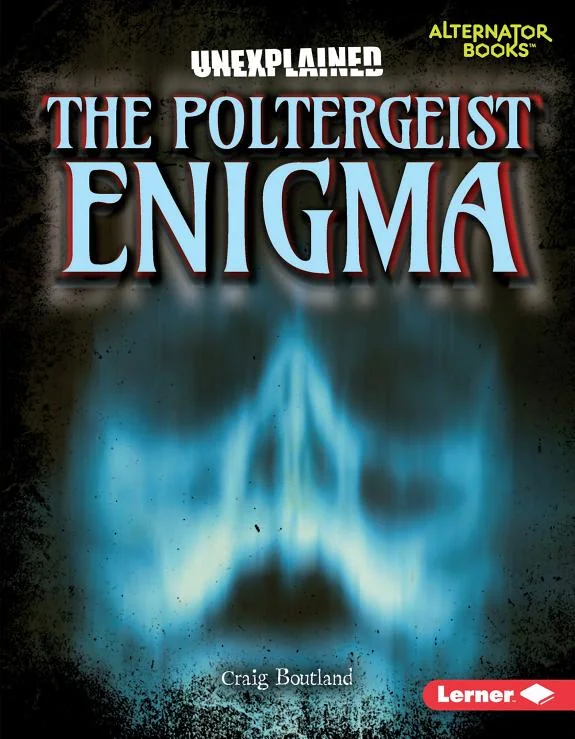
The Poltergeist Enigma
 80
80

The Poltergeist Enigma
Craig Boutland’s "The Poltergeist Enigma" avoids the typical ghost-hunter hyperbole, instead offering a sober, evidence-focused survey of a notoriously slippery subject. The strength lies in its systematic approach, presenting a compelling overview of historical cases and parapsychological research that lends a surprising weight to the phenomena. Boutland’s willingness to engage with scientific frameworks, particularly the concept of RSPK, elevates the discussion beyond mere anecdote. A limitation, however, is the inherent difficulty in definitively proving such elusive events; while the evidence presented is substantial, the final leap to absolute certainty remains elusive, as acknowledged by the author. The detailed examination of the 1970s Drummer Case, with its documented physical manifestations and psychological correlations, stands out as a particularly strong section. Ultimately, Boutland provides a valuable, grounded perspective for anyone seeking to understand the poltergeist beyond sensationalism.
📝 Description
80
### What It Is Craig Boutland's "The Poltergeist Enigma" presents a rigorous examination of the phenomena commonly labeled as poltergeist activity. Far from a sensationalist collection of ghost stories, the work methodically sifts through historical accounts, witness testimonies, and scientific investigations to build a case for the reality of these unsettling disturbances. It explores the patterns, characteristics, and potential explanations that have emerged over centuries of inquiry, challenging readers to consider the implications of unexplained physical manifestations.
### Who It's For This book is intended for serious students of the paranormal, researchers of anomalous phenomena, and anyone intrigued by the persistent mystery of poltergeists. It will appeal to those who prefer evidence-based exploration over pure speculation and who seek to understand the historical and theoretical underpinnings of the subject. Readers interested in the intersection of psychology, physics, and the unexplained will find ample material for consideration.
### Historical Context The study of poltergeist phenomena has a long and varied history, stretching back at least to the medieval period. Boutland's work situates this research within broader historical trends, from early spiritualist movements of the 19th century to more contemporary parapsychological investigations. The book engages with figures and cases that have shaped the discourse, acknowledging the skepticism and scientific scrutiny that have always accompanied such claims. It positions the poltergeist not as a modern invention but as a recurring element in human experience and documentation.
### Key Concepts Central to "The Poltergeist Enigma" is the concept of "recurrent spontaneous psychokinesis" (RSPK), a term used to describe the statistically significant occurrence of poltergeist activity, often linked to a specific individual, typically an adolescent. The work also dissects various theories, including those positing psychological origins, environmental influences, and even more speculative energetic or dimensional interactions. It examines the evidence for physical effects like object displacement, auditory phenomena, and temperature changes, seeking coherent frameworks to understand these events.
💡 Why Read This Book?
• Gain a structured understanding of the historical progression of poltergeist research, including key figures and documented events from the 19th century onwards, offering context often missed in anecdotal accounts. • Explore the scientific theories proposed to explain poltergeist activity, such as Recurrent Spontaneous Psychokinesis (RSPK), providing a framework for analyzing phenomena beyond simple supernatural explanations. • Analyze specific case studies detailed in the book, such as the Drummer Case, to critically evaluate the evidence for physical disturbances and their potential psychological or environmental triggers.
⭐ Reader Reviews
Honest opinions from readers who have explored this book.
❓ Frequently Asked Questions
What is the primary theory Boutland explores regarding the cause of poltergeist activity?
Boutland extensively explores the theory of Recurrent Spontaneous Psychokinesis (RSPK), which suggests that certain individuals, often adolescents, can unconsciously generate the physical phenomena associated with poltergeists through intense emotional states or psychological stress.
Does "The Poltergeist Enigma" offer explanations for noises and object movement?
Yes, the book meticulously details historical accounts of unexplained noises, object displacement, and other physical disturbances attributed to poltergeists, examining them through various theoretical lenses, including RSPK and environmental factors.
What historical periods does the book cover regarding poltergeist phenomena?
The work spans centuries, referencing accounts from early spiritualist movements in the 19th century through to more contemporary parapsychological investigations, demonstrating the long-standing nature of these reported events.
Is "The Poltergeist Enigma" suitable for skeptics?
Absolutely. The book's strength lies in its evidence-based approach and critical analysis, making it valuable for skeptics who wish to understand the arguments and data presented by researchers in the field of anomalous phenomena.
What is the significance of the Drummer Case mentioned in the book?
The Drummer Case is a significant example discussed, illustrating a documented instance of poltergeist activity with notable physical manifestations and psychological correlations, which Boutland uses to support his analytical framework.
Does the book suggest poltergeists are spirits or something else?
While acknowledging historical interpretations involving spirits, Boutland primarily focuses on scientific and psychological explanations, particularly RSPK, offering a more grounded perspective on the nature of poltergeist phenomena.
🔮 Key Themes & Symbolism
Recurrent Spontaneous Psychokinesis
The book extensively details the concept of Recurrent Spontaneous Psychokinesis (RSPK), a parapsychological theory positing that poltergeist phenomena are unconsciously generated by individuals, often adolescents experiencing psychological stress. Boutland examines how RSPK accounts for the localized and often intermittent nature of these disturbances, moving beyond simplistic notions of external spirits to explore internal, human-generated causation. This focus provides a scientific framework for understanding seemingly inexplicable physical events.
Historical Case Studies
Boutland meticulously presents and analyzes a range of historical accounts and documented cases of poltergeist activity. From the earliest recorded incidents to more recent investigations, the work provides context by showing how these phenomena have been perceived and studied across different eras. The critical examination of these cases, including their strengths and weaknesses, allows readers to assess the empirical evidence and the evolution of research methodologies.
Skepticism and Scientific Scrutiny
A significant theme is the rigorous skepticism and scientific scrutiny that poltergeist research has always faced. Boutland addresses common objections and provides counterarguments based on empirical data, engaging with the challenges of studying phenomena that are often elusive and difficult to replicate under controlled conditions. This balanced approach acknowledges the need for critical evaluation while advocating for open-minded investigation of anomalous events.
Psychological and Environmental Factors
The work explores the interplay between psychological states and the physical environment in the manifestation of poltergeist activity. It investigates how stress, emotional turmoil, and even specific environmental conditions might contribute to or trigger these events. By considering these factors, Boutland offers a multi-faceted understanding that integrates human consciousness with observable physical effects, suggesting that the explanation is likely complex and not easily reducible.
💬 Memorable Quotes
“The hallmark of the poltergeist is its capacity to manifest physical effects without visible means.”
— This statement encapsulates the core mystery of poltergeist phenomena – the direct, observable manipulation of the physical world by unseen forces, challenging conventional physics and logic.
“Often, the focus shifts to the agent, the individual at the center of the disturbance, rather than an external entity.”
— This highlights a key shift in research, moving from attributing activity to ghosts or spirits towards understanding the role of the human psyche, particularly the 'agent,' in generating these events.
“Statistical analysis reveals patterns that suggest more than random chance is at play.”
— This points to the parapsychological method of identifying statistically significant correlations and recurrences in reported phenomena, arguing that these patterns imply an underlying, non-random cause.
“The scientific community remains divided on the validity and explanation of these occurrences.”
— This acknowledges the ongoing debate and lack of consensus within mainstream science regarding the existence and nature of poltergeist phenomena, reflecting the challenges in their empirical verification.
“Understanding the poltergeist enigma requires examining both the subjective experience and the objective physical evidence.”
— This emphasizes a dual approach to studying poltergeists, recognizing that a complete picture must integrate the witness accounts and internal experiences with verifiable physical manifestations.
🌙 Esoteric Significance
Tradition
While not strictly adhering to a single esoteric lineage, "The Poltergeist Enigma" intersects with traditions that explore the power of the human mind and consciousness to influence the material world. It touches upon concepts found in Western esotericism, particularly those related to subtle energies, psychic forces, and the potential for focused will or emotional states to manifest observable effects. The work departs from purely spiritualist interpretations by seeking more grounded, often psychological or quasi-physical, explanations within the framework of parapsychology.
Symbolism
The poltergeist phenomenon itself can be viewed symbolically as a manifestation of repressed psychic energy or internal turmoil breaking into the external world. Object displacement, for instance, can symbolize the disruption of order or the chaotic release of pent-up emotions. The frequent association with adolescents might symbolize the tumultuous transition from childhood to adulthood, a period of intense psychic and emotional flux where boundaries between the internal and external can blur.
Modern Relevance
In contemporary discussions surrounding consciousness studies, quantum physics' implications for reality, and the continued interest in anomalous phenomena, Boutland's work remains relevant. It provides a crucial historical and evidential foundation for those exploring the limits of current scientific understanding. Thinkers and practitioners interested in fields like subtle energy research, consciousness-based healing, or even fringe physics may find value in its rigorous examination of unexplained physical effects and their potential origins within human consciousness.
👥 Who Should Read This Book
• Researchers of anomalous phenomena seeking a comprehensive overview of historical poltergeist cases and the scientific theories attempting to explain them. • Skeptics interested in a fact-based analysis of paranormal claims, who want to understand the evidence presented by proponents of poltergeist activity. • Students of parapsychology looking for detailed case studies and theoretical frameworks, such as RSPK, to deepen their understanding of psychokinetic phenomena.
📜 Historical Context
Published in 2019, Craig Boutland's "The Poltergeist Enigma" emerges in an era where paranormal research, though often relegated to popular media, continues to grapple with questions of evidence and explanation. This work arrives decades after the foundational research in parapsychology by figures like J.B. Rhine and the more focused investigations into psychokinesis. It follows a period where spiritualism in the late 19th and early 20th centuries had popularized the idea of communication with the dead, a distinct but related field. Boutland’s approach, however, leans towards scientific analysis rather than mediumship. Unlike the more sensationalist paranormal investigation shows that gained traction in the early 2000s, "The Poltergeist Enigma" seeks a more academic and evidence-based understanding, engaging with theories like RSPK, which gained prominence in parapsychological circles from the mid-20th century onward. The book implicitly engages with the ongoing debate between materialistic explanations and those that allow for consciousness to directly affect physical reality.
📔 Journal Prompts
The concept of Recurrent Spontaneous Psychokinesis (RSPK) and its link to adolescent stress.
Documented instances of object displacement and their potential interpretations.
The historical evolution of poltergeist research from spiritualism to parapsychology.
The balance between skepticism and open-minded inquiry in studying anomalous events.
Personal reflections on the boundary between internal psychological states and external physical reality.
🗂️ Glossary
Poltergeist
A phenomenon characterized by unexplained physical disturbances, such as moving objects, noises, and fires, often attributed to an unseen force or entity.
Recurrent Spontaneous Psychokinesis (RSPK)
A parapsychological theory suggesting that poltergeist activity is unconsciously generated by a specific individual, often an adolescent, through psychological stress or emotional turmoil.
Psychokinesis (PK)
The purported ability to influence physical objects or systems with the mind alone, without the use of conventional physical means.
Agent
In parapsychology, the person believed to be the source or focus of anomalous phenomena, such as psychokinesis.
Parapsychology
The study of alleged psychic phenomena and other paranormal claims, including telepathy, precognition, and psychokinesis.
Spiritualism
A religious movement, popular in the 19th century, that affirmed the possibility of communicating with the spirits of the dead.
Anecdotal Evidence
Evidence based on personal accounts rather than systematic scientific investigation; often considered less reliable but can provide initial leads for research.