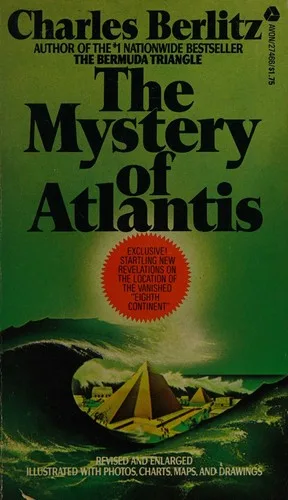
The mystery of Atlantis
 76
76

The mystery of Atlantis
Charles Berlitz’s 1976 exploration of Atlantis is less a rigorous academic treatise and more a passionate compilation of evidence, both credible and dubious, for a lost world. Berlitz excels at marshaling disparate accounts—Plato’s dialogues, biblical narratives, and even reports of unexplained phenomena—into a seemingly coherent whole. His enthusiasm for the subject is palpable, making the narrative accessible even to those unfamiliar with the deep lore of Atlantis. A particular strength lies in his synthesis of various theories regarding Atlantean technology and its potential influence on ancient societies. However, the book's primary limitation is its often uncritical acceptance of anecdotal evidence and its tendency to present speculation as fact. For instance, Berlitz’s discussion of supposed Atlantean survivals in Egyptian hieroglyphs, while intriguing, lacks substantial corroboration. The work ultimately serves as an engaging primer on the Atlantis legend, but readers seeking definitive proof will find it wanting. It remains a significant popular account that fueled decades of further speculation.
📝 Description
76
### What It Is Charles Berlitz's "The Mystery of Atlantis," first published in 1976, presents a compelling case for the existence of the lost continent of Atlantis. The book synthesizes ancient texts, anecdotal evidence, and speculative theories to construct a narrative that posits Atlantis as a technologically advanced civilization that predates recorded history. Berlitz draws on a wide range of sources, from Plato's dialogues to modern archaeological findings, to support his central thesis.
### Who It's For This work is intended for readers interested in mysteries of the ancient world, alternative histories, and the enduring legend of Atlantis. It appeals to those who question conventional historical timelines and seek explanations for enigmatic archaeological sites and historical accounts. Individuals fascinated by the intersection of myth, history, and speculative science will find material to consider.
### Historical Context "The Mystery of Atlantis" emerged during a period of renewed public interest in esoteric subjects and ancient mysteries. The 1970s saw a surge in popular books exploring UFOs, psychic phenomena, and lost civilizations. Berlitz's work tapped into this cultural zeitgeist, offering a comprehensive, albeit speculative, overview of the Atlantis myth and its alleged historical underpinnings, building upon earlier works by figures like Ignatius Donnelly.
### Key Concepts The book explores the concept of a highly advanced Atlantean civilization possessing knowledge and technology far beyond that of their contemporaries. It examines potential geographical locations for Atlantis, including the Atlantic Ocean, the Mediterranean, and even Antarctica. Berlitz also touches upon theories of cataclysmic events that led to its destruction and the dispersal of its survivors, seeding ancient cultures worldwide.
💡 Why Read This Book?
• Gain an overview of the primary arguments for Atlantis's existence, including references to Plato's *Timaeus* and *Critias*, offering foundational concepts for understanding the legend. • Explore the hypothesis of a technologically advanced pre-historic civilization, examining Berlitz's synthesis of ancient texts and modern theories about lost knowledge. • Consider the potential global dispersal of Atlantean survivors and their influence on early human cultures, engaging with speculative historical connections presented in the book.
⭐ Reader Reviews
Honest opinions from readers who have explored this book.
❓ Frequently Asked Questions
When was Charles Berlitz's "The Mystery of Atlantis" first published?
Charles Berlitz's "The Mystery of Atlantis" was first published in 1976, becoming a significant work in the popular exploration of ancient mysteries.
What is the main argument presented in "The Mystery of Atlantis"?
The book argues for the historical existence of Atlantis as an advanced civilization that was destroyed by a cataclysm, with its survivors influencing global cultures.
Does Berlitz offer specific locations for Atlantis?
Yes, Berlitz explores various proposed locations for Atlantis, including the Atlantic Ocean, the Mediterranean, and even Antarctica, based on interpretations of ancient texts and geological theories.
What sources does Berlitz use to support his claims?
Berlitz draws upon a wide array of sources, including Plato's dialogues, ancient myths, geological theories, archaeological anomalies, and anecdotal accounts of unexplained phenomena.
Is "The Mystery of Atlantis" considered a scientific or historical text?
No, "The Mystery of Atlantis" is generally considered speculative and popular literature rather than a peer-reviewed scientific or historical text, though it discusses historical and scientific concepts.
What impact did "The Mystery of Atlantis" have?
The book significantly boosted public interest in the Atlantis myth and inspired further research and speculation, becoming a bestseller and a reference point for discussions on lost civilizations.
🔮 Key Themes & Symbolism
The Legend of Atlantis
Berlitz presents Atlantis not as mere myth but as a factual historical civilization. He compiles accounts from Plato's *Timaeus* and *Critias*, alongside other ancient traditions, to paint a picture of a highly advanced society. The work details their sophisticated technology, societal structure, and sudden, catastrophic demise, exploring how this narrative has persisted through millennia and across cultures, suggesting a shared ancestral memory or historical record.
Cataclysm and Survival
A central theme is the catastrophic event that led to Atlantis's destruction. Berlitz examines various theories, from geological upheavals like floods and earthquakes to more speculative causes, linking these to potential global extinction events. The book also focuses on the idea of Atlantean survivors who escaped the cataclysm, carrying their knowledge and culture to other parts of the world, thereby influencing the development of early civilizations such as those in Egypt, Mesoamerica, and elsewhere.
Ancient Technology and Knowledge
The work speculates on the advanced technological and scientific capabilities of the Atlanteans. Berlitz explores concepts such as advanced energy sources, sophisticated engineering, and potentially even psychic or esoteric knowledge. This theme positions Atlantis as a source of lost wisdom that predates modern science, suggesting that humanity has regressed in certain areas and that rediscovering this ancient knowledge could be key to future progress.
Geographical Speculation
Berlitz engages with the ongoing debate about Atlantis's physical location. He reviews and critiques various proposed sites, ranging from the traditional oceanic location described by Plato to alternative theories placing it in the Mediterranean, the Caribbean, or even Antarctica. This exploration highlights the enduring mystery of Atlantis and the challenges of reconciling ancient narratives with modern geography and geology.
💬 Memorable Quotes
“Plato's account is the foundation for the Atlantean legend.”
— This highlights the primary textual source Berlitz relies upon, emphasizing that the entire modern fascination with Atlantis stems directly from the philosophical dialogues written by Plato around 360 BC.
“Atlantis was destroyed by a great cataclysm.”
— This encapsulates the core narrative of Atlantis's end, suggesting a sudden, violent, and widespread destructive event that wiped out the civilization, a theme common in discussions of lost worlds.
“Survivors of Atlantis may have spread their knowledge globally.”
— This interpretation points to the diffusionist theory often associated with Atlantis, positing that remnants of its advanced civilization seeded technological and cultural developments in various ancient societies worldwide.
“The location of Atlantis remains a subject of debate.”
— This acknowledges the speculative nature of the book and the ongoing mystery surrounding Atlantis's geographical placement, reflecting the diverse theories from oceanic sites to landmasses like Antarctica.
“Ancient myths may hold echoes of historical events.”
— This suggests that Berlitz views myths not as pure fantasy but as distorted recollections of real occurrences, particularly concerning catastrophic events and lost civilizations like Atlantis.
🌙 Esoteric Significance
Tradition
Berlitz's work engages with the broader esoteric tradition of exploring lost ancient civilizations, particularly as popularized by Theosophy and later New Age movements. While not strictly adhering to a single lineage like Hermeticism or Gnosticism, it draws from the Theosophical concept of root races and cyclic history, positing Atlantis as a highly advanced, pre-diluvian civilization whose fall and dispersal are key to understanding global mythology and human origins.
Symbolism
The primary symbol is Atlantis itself, representing lost knowledge, advanced technology, and a golden age tragically ended. The cataclysm that destroyed it symbolizes divine judgment or natural forces reclaiming hubris. The supposed survivors embody the transmission of ancient wisdom, their scattered descendants hinting at a hidden lineage of enlightened beings influencing human development across cultures, often symbolized by megalithic structures or esoteric symbols found worldwide.
Modern Relevance
Contemporary New Age spirituality, pseudohistory enthusiasts, and proponents of ancient astronaut theories often cite Berlitz's work as a foundational text. His synthesis of Plato, geology, and speculative anthropology continues to inform discussions on ancient high technology, spiritual origins, and the potential for rediscovering lost wisdom. Researchers into consciousness studies and alternative archaeology also engage with his ideas, seeking to bridge the gap between myth and potential historical reality.
👥 Who Should Read This Book
• Readers fascinated by Plato's account of Atlantis and seeking a comprehensive popular exploration of its potential reality. • Enthusiasts of alternative history and ancient mysteries who are interested in theories about lost civilizations and their global influence. • Individuals curious about the intersection of mythology, geology, and speculative archaeology, exploring how ancient texts are interpreted to reconstruct pre-history.
📜 Historical Context
Published in 1976, "The Mystery of Atlantis" arrived during a cultural moment receptive to esoteric subjects and alternative histories. The post-war era saw a rise in interest in UFOs, psychic phenomena, and ancient mysteries, fueled by figures like Erich von Däniken. Berlitz’s work tapped into this burgeoning field, building upon the foundational theories of Ignatius Donnelly, whose 1882 book "Atlantis: The Antediluvian World" had previously popularized the concept. While mainstream archaeology and geology largely dismissed Atlantean theories, popular reception was enthusiastic. The book entered a landscape where figures like Helena Blavatsky and Theosophy had already explored lost continents and ancient wisdom traditions, providing a popular, accessible synthesis that captured the public imagination and contributed significantly to the enduring mythology surrounding Atlantis.
📔 Journal Prompts
The catastrophic end of Atlantis and its potential echoes in global flood myths.
Plato's description of Atlantean society and its relevance to modern civilization.
The concept of advanced Atlantean technology and its hypothetical impact.
Geographical theories regarding Atlantis's location and the evidence cited.
The idea of Atlantean survivors seeding ancient cultures worldwide.
🗂️ Glossary
Atlantis
A legendary island or continent, first mentioned by Plato in his dialogues *Timaeus* and *Critias*, described as a powerful naval empire that sank into the ocean in a single day and night of misfortune.
Plato
Ancient Greek philosopher (c. 428–348 BC) whose dialogues *Timaeus* and *Critias* are the primary ancient source for the legend of Atlantis.
Cataclysm
A violent natural event, such as an earthquake or flood, often of such scale as to cause widespread destruction and significant geological change.
Poseidon
In Greek mythology, the god of the sea, earthquakes, and horses. Plato identifies Poseidon as the father of Atlas and the first king of Atlantis.
Trident
A three-pronged spear, often associated with Poseidon, and in the context of Atlantis, a symbol of Atlantean power and dominion over the seas.
Diluvian
Relating to a great flood, particularly the biblical Flood of Noah; often used in discussions of pre-history to refer to periods before a great deluge.
Megalithic
Relating to or denoting structures built of large stones, especially prehistoric ones; often cited in connection with alleged Atlantean influence on ancient sites.