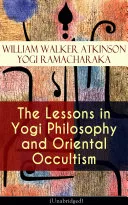
The Lessons in Yogi Philosophy and Oriental Occultism (Unabridged)
 83
83

The Lessons in Yogi Philosophy and Oriental Occultism (Unabridged)
William Walker Atkinson, under the guise of Yogi Ramacharaka, delivers a comprehensive overview of yogic and Oriental occult concepts that remains remarkably accessible. The strength of "The Lessons in Yogi Philosophy and Oriental Occultism" lies in its structured approach, dissecting intricate ideas like "Thought Dynamics" and the "Human Aura" into digestible components. Atkinson’s ability to translate these traditions for a Western readership, particularly evident in his discussion of "Mental Principles," is commendable. However, the work occasionally leans into the speculative language common of its era, which might require a discerning reader to separate established philosophical tenets from more unverified claims regarding psychic phenomena. A particularly illustrative section is "Telepathy and Clairvoyance," where the author attempts to provide a framework for understanding extrasensory perception within a broader occult system. Ultimately, this unabridged volume serves as a valuable, albeit period-specific, introduction to a wide array of Eastern esoteric thought.
📝 Description
83
### What It Is This unabridged edition of "The Lessons in Yogi Philosophy and Oriental Occultism" presents a foundational text in comparative occult studies. Authored collaboratively by William Walker Atkinson and attributed to Yogi Ramacharaka, it systematically breaks down complex Eastern spiritual concepts for a Western audience. The work covers a broad spectrum, from the fundamental principles of mind and spirit to practical applications like thought dynamics, telepathy, and psychic influence.
### Who It's For This book is intended for serious students of comparative religion, esoteric philosophy, and occult sciences. It appeals to those seeking to understand the underlying principles of Yogi philosophy and its connection to broader Oriental occult traditions. Readers interested in the mechanics of consciousness, mental powers, and subtle energies will find substantial material here.
### Historical Context The early 20th century saw a surge of interest in Eastern philosophies in the West, partly fueled by figures like Helena Blavatsky and the Theosophical Society. William Walker Atkinson, writing under various pseudonyms including Yogi Ramacharaka, was a prolific author during this period, contributing significantly to the popularization of New Thought, mental science, and Eastern spiritual concepts. His works often appeared alongside those of contemporaries exploring similar themes, such as Swami Vivekananda, who lectured in the US in the late 1890s.
### Key Concepts The text explores the "Three Principles" of existence, mental and spiritual laws governing the universe, and the nature of the human aura. It details "Thought Dynamics," the power of focused intention, and delves into phenomena such as telepathy, clairvoyance, and human magnetism. The book also addresses "Occult Therapeutics," the application of psychic principles for healing, and explores the "Astral World" and "Spiritual Evolution."
💡 Why Read This Book?
• Gain practical knowledge of "Thought Dynamics," learning how to harness mental focus and intention as outlined in Atkinson's system, offering techniques distinct from modern self-help. • Understand the concept of the "Human Aura" as described in early 20th-century occult literature, providing a specific esoteric framework for subtle energy bodies not commonly found in contemporary wellness guides. • Explore the "Yogi Path of Attainment" as presented by Ramacharaka, offering a structured, philosophical approach to spiritual development that predates and informs many current meditative practices.
⭐ Reader Reviews
Honest opinions from readers who have explored this book.
❓ Frequently Asked Questions
What is the primary focus of "The Lessons in Yogi Philosophy and Oriental Occultism"?
The book primarily focuses on explaining Yogi philosophy and Oriental occultism for a Western audience. It covers mental principles, spiritual evolution, thought dynamics, telepathy, and the human aura, offering insights into Eastern esoteric traditions.
Who is Yogi Ramacharaka, and what is his connection to William Walker Atkinson?
Yogi Ramacharaka is a pseudonym used by William Walker Atkinson, a prolific writer on New Thought, the occult, and Eastern philosophies. Atkinson authored numerous books under this and other pen names, including "The Lessons in Yogi Philosophy."
What does the book say about the "Human Aura"?
The work describes the "Human Aura" as a subtle energetic field surrounding the physical body, influenced by thoughts and emotions. It suggests that understanding and potentially manipulating this aura is key to psychic development and well-being.
Is "The Lessons in Yogi Philosophy and Oriental Occultism" suitable for beginners?
Yes, the book is structured to introduce complex topics systematically. While it delves into advanced concepts, its clear explanations of "Mental Principles" and "Spiritual Cause and Effect" make it accessible to earnest beginners in esoteric studies.
What is "Thought Dynamics" as discussed in the book?
"Thought Dynamics" refers to the principles and practices of controlling and directing one's thoughts to influence reality and achieve desired outcomes. It's presented as a fundamental aspect of mental power and spiritual attainment.
When was "The Lessons in Yogi Philosophy and Oriental Occultism" originally published?
The original publication date for "The Lessons in Yogi Philosophy and Oriental Occultism" is listed as February 6, 2016, for this specific ebook edition, but the content originates from earlier works by William Walker Atkinson.
🔮 Key Themes & Symbolism
Mental and Spiritual Principles
The book systematically outlines fundamental laws governing both the mental and spiritual realms, drawing parallels between yogic philosophy and broader occult understanding. It posits that understanding these "Three Principles" is crucial for grasping the mechanics of the universe and one's place within it. Concepts like "Spiritual Cause and Effect" are explored, suggesting a deterministic yet understandable flow of energy and consequence that influences individual lives and cosmic progression.
Subtle Energies and Psychic Phenomena
A significant portion of the text is dedicated to exploring subtle energies and their manifestations. This includes the "Human Aura," described as an energetic envelope, and phenomena like "Telepathy and Clairvoyance." The work attempts to provide a rational, albeit occult, framework for understanding these abilities, presenting them not as mystical anomalies but as extensions of natural laws accessible through focused practice and development.
The Path of Attainment
The "Yogi Path of Attainment" is presented as a structured approach to spiritual growth and self-realization. This involves disciplines such as "Mantrams and Meditations," designed to quiet the mind and elevate consciousness. The book emphasizes the importance of consistent practice and the application of yogic principles to daily life, guiding the reader towards a higher state of being and understanding.
Consciousness and Thought Control
"Thought Dynamics" is a core concept, highlighting the power of directed thought in shaping one's reality and influencing others. The book details methods for cultivating mental discipline, focusing intention, and utilizing "Human Magnetism"—a form of personal energetic influence. This focus on the active role of consciousness underscores the potential for individual transformation through mental mastery.
💬 Memorable Quotes
“The mind is the creator of conditions.”
— This concise statement emphasizes the book's core tenet that our internal mental state directly shapes our external reality. It suggests that by mastering our thoughts, we gain control over the circumstances we experience.
“The human aura is the radiating energy of the individual.”
— This highlights the concept of the aura as a tangible, energetic emanation from a person. It implies that this field is a reflection of one's physical, mental, and spiritual state, and potentially observable or influential.
“Meditation stills the mind, preparing it for higher truths.”
— This interpretation underscores the purpose of meditation within the yogic framework presented. It's not merely relaxation but a rigorous practice designed to achieve mental quietude, making the consciousness receptive to profound spiritual insights.
“Telepathy is the silent communication of thought.”
— This defines telepathy as a direct, non-verbal transmission of thoughts between individuals. The work explores this as a natural, though often undeveloped, human faculty that can be understood through occult principles.
“Spiritual evolution is the unfolding of the divine within.”
— This suggests that spiritual growth is an inherent process of development, akin to a seed growing into a plant. It frames evolution not as an external acquisition but as an internal realization of potential.
🌙 Esoteric Significance
Tradition
This work sits firmly within the Western esoteric tradition, particularly influenced by Theosophy and New Thought, while attempting to synthesize these with yogic philosophy and Oriental occultism. It departs from strict adherence to specific lineages by presenting a syncretic view, aiming to extract universal principles applicable across traditions. It acts as a bridge, translating concepts often considered esoteric into a more digestible format for Western practitioners seeking spiritual understanding.
Symbolism
The book frequently references the "Lotus" as a symbol of spiritual unfolding and purity, representing the opening of consciousness. The "Aura" functions as a symbolic representation of the individual's energetic and psychic state, visible or perceptible to those with developed faculties. "Mantrams" are presented not just as words but as symbolic sonic keys designed to unlock specific states of consciousness or invoke particular energies.
Modern Relevance
Contemporary practices in mindfulness, energy healing, and consciousness studies often echo the principles discussed by Atkinson. Thinkers and practitioners in fields like transpersonal psychology and modern yoga philosophy, even if unaware of the specific pseudonym "Yogi Ramacharaka," engage with concepts such as "Thought Dynamics" and the exploration of subtle energies that Atkinson helped popularize in the early 20th century.
👥 Who Should Read This Book
['• Students of comparative religion seeking to understand the intersection of Western occultism and Eastern yogic traditions, particularly those interested in how these ideas were disseminated in the early 20th century.', '• Practitioners of mental science and New Thought who wish to explore the yogic underpinnings of consciousness control and "Thought Dynamics."', '• Individuals interested in the historical development of esoteric thought in the West, specifically how Oriental philosophies were interpreted and adapted for a Western audience.']
📜 Historical Context
William Walker Atkinson's "The Lessons in Yogi Philosophy and Oriental Occultism," published under the pseudonym Yogi Ramacharaka, emerged during a period of intense Western fascination with Eastern spirituality, particularly in the late 19th and early 20th centuries. This era saw figures like Swami Vivekananda introduce Vedanta and Yoga to American audiences, while Helena Blavatsky's Theosophical Society popularized concepts from Hinduism and Buddhism. Atkinson’s work was part of a larger "New Thought" movement, which emphasized mental healing and the power of positive thinking, often blending these ideas with interpretations of Eastern philosophies. His accessible style aimed to demystify complex yogic and occult doctrines for a broader readership, positioning him as a key popularizer. This period also saw other authors like Annie Besant engaging with similar themes, creating a vibrant intellectual landscape where Eastern ideas were increasingly integrated into Western esoteric thought, sometimes leading to debates about authenticity and interpretation.
📔 Journal Prompts
Reflect on the "Three Principles" and their potential application to your current life situation.
Analyze your own "Thought Dynamics" by journaling recurring mental patterns observed over a week.
Consider the concept of the "Human Aura" and how it might reflect your emotional and energetic state.
Explore the potential of "Mantrams" by selecting one and meditating on its perceived meaning or effect.
Examine the principle of "Spiritual Cause and Effect" in relation to a past decision or event.
🗂️ Glossary
Human Aura
An energetic field or emanation surrounding the physical body, believed to reflect an individual's physical, mental, emotional, and spiritual state. It is considered by some occultists to be sensitive to thought and emotion.
Thought Dynamics
The study and practice of controlling and directing one's thoughts to influence one's own mind, body, and external circumstances, as well as potentially influencing others.
Telepathy
The purported direct communication of thoughts or ideas from one mind to another without the use of the senses; mind-to-mind communication.
Clairvoyance
The alleged psychic ability to perceive objects, events, or information not accessible to the senses, often involving seeing things at a distance or in the future.
Astral World
In esoteric traditions, a non-physical plane of existence believed to be inhabited by subtle bodies and energies, often associated with dreams, out-of-body experiences, and the afterlife.
Mantram
A sacred word, phrase, or syllable, often from Sanskrit, used in meditation or ritual to invoke spiritual power, focus the mind, or achieve a specific state of consciousness.
Spiritual Evolution
The concept that consciousness and the soul progress through various stages of development over time, often across multiple lifetimes, towards greater wisdom, understanding, and spiritual realization.