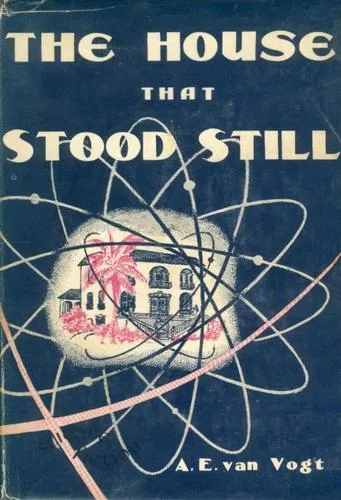
The House that Stood Still
 81
81

The House that Stood Still
A. E. van Vogt's "The House that Stood Still" is less a narrative to be followed and more a conceptual landscape to be traversed. The central premise – a dwelling existing outside conventional spacetime – is potent, offering a fertile ground for exploring the fragility of identity when confronted with the absolute. Van Vogt masterfully uses the unusual setting to dissect his characters' psyches, particularly in the passages where protagonists struggle to reconcile their experiences within the House with their memories of the outside world. The book's primary strength lies in this psychological excavation, posing questions about selfhood that remain relevant. However, the plot mechanics can feel somewhat arbitrary, occasionally hindering the philosophical weight. The resolution, while aiming for cosmic resonance, sometimes feels less earned than imposed. Nevertheless, for its audacious exploration of temporal paradox and consciousness, "The House that Stood Still" remains a curious and valuable artifact of mid-20th-century speculative thought.
📝 Description
81
A. E. van Vogt's "The House that Stood Still" was first serialized in 1952.
This 1952 novel centers on a house existing outside normal time and space, a structure that draws individuals into its influence. Van Vogt uses this premise to examine existential and philosophical questions. The narrative unfolds deliberately, focusing on the psychological effects of the central enigma. It asks readers to consider the nature of reality, consciousness, and humanity's position in a vast cosmos.
It is recommended for readers who prefer science fiction that emphasizes philosophical inquiry and psychological depth over action. Those interested in temporal displacement, alternate realities, and reactions to the alien will find it appealing. The book prompts contemplation, offering an experience beyond a simple story.
Published during a time of scientific advancement and Cold War anxieties, van Vogt's work incorporated psychology, parapsychology, and philosophical paradoxes. This approach distinguished it from the more hard-SF authors of the era.
Van Vogt's work often touched on parapsychological concepts and philosophical paradoxes. "The House that Stood Still" fits within a tradition of speculative fiction that uses otherworldly phenomena to explore the nature of consciousness and reality. This includes ideas found in early 20th-century metaphysical movements and the burgeoning interest in the mind's potential beyond conventional scientific understanding.
💡 Why Read This Book?
• You will explore the philosophical implications of a reality unbound by linear time, a concept central to the "House" itself, gaining a new perspective on causality. • You will confront the nature of individual identity when faced with altered perceptions and potential temporal displacement, as characters grapple with their sense of self within the narrative's unique setting. • You will engage with early explorations of existential themes in science fiction, particularly how the 1952 context influenced narratives about human consciousness confronting the incomprehensible.
⭐ Reader Reviews
Honest opinions from readers who have explored this book.
❓ Frequently Asked Questions
What is the primary philosophical concept explored in 'The House that Stood Still'?
The novel primarily explores existentialism and the nature of consciousness when confronted with realities that defy linear time and space, as exemplified by the titular 'House'.
When was 'The House that Stood Still' first published?
A. E. van Vogt's 'The House that Stood Still' was first published in 1952, a period marked by significant developments in both science and speculative literature.
How does the 'House' function in the narrative?
The 'House' is depicted as a structure that exists outside of conventional spacetime, acting as a nexus for unusual events and influencing the perceptions and identities of those who encounter it.
What kind of science fiction does 'The House that Stood Still' represent?
It represents a more philosophical and psychological strain of science fiction, focusing on internal character struggles and existential questions rather than hard science or space opera tropes.
Are there specific characters who embody the novel's themes?
Yes, the protagonists' experiences within the House, their struggles with memory and identity, directly embody the novel's exploration of consciousness under extreme existential pressure.
What makes this novel different from other 1950s science fiction?
Unlike many contemporaries focusing on technological progress, van Vogt delves into abstract concepts like temporal paradox and the subjective experience of reality, particularly through the 'House's' influence.
🔮 Key Themes & Symbolism
Temporal Displacement and Reality
The narrative fundamentally questions the stability of perceived reality through its central conceit: a 'House' that exists outside of linear time. This allows van Vogt to explore how temporal displacement affects human consciousness and identity. Characters find their memories and sense of self challenged when exposed to environments where causality is not a fixed law. The concept of stasis, as embodied by the House, becomes a point of philosophical inquiry, contrasting with the human drive for progression and understanding, offering a unique lens on existence beyond sequential experience.
The Nature of Identity
Within the context of the House's temporal anomaly, the very definition of individual identity comes under scrutiny. Characters grapple with fragmented memories, altered perceptions, and the possibility of existing in multiple states simultaneously. Van Vogt uses this to probe whether identity is a fixed construct or a fluid response to environmental and existential pressures. The struggle to maintain a coherent sense of self when confronted with the inexplicable becomes a primary driver of the narrative, pushing readers to consider what truly constitutes the 'self' when external anchors of time and space are removed.
Humanity's Place in the Cosmos
The novel implicitly addresses humanity's relationship with the vast, unknown universe by positing phenomena that dwarf human comprehension. The 'House' represents an intelligence or a state of being so alien that it forces characters to confront their own limitations and the potential for realities far beyond human experience. This theme encourages a contemplation of humanity's significance (or insignificance) when faced with cosmic structures that operate on principles entirely foreign to our own, fostering a sense of awe and existential reflection.
Perception vs. Objective Reality
Van Vogt masterfully blurs the lines between what is perceived and what objectively exists, particularly through the effects of the House. The subjective experiences of the characters—their altered senses, distorted memories, and fragmented understanding—become the primary mode of engaging with the narrative's central mystery. This focus on subjective perception challenges the reader to question their own assumptions about reality and how much of our world is constructed by our minds, rather than being an inherent, external truth.
💬 Memorable Quotes
Direct passages from the work, attributed to the author.
“Stasis was not emptiness, but a different kind of fullness.”
— This interpretation suggests the novel's view on a state of being outside of linear progression, proposing that 'stasis' as embodied by the House is not merely an absence of activity but a complex, perhaps even conscious, state.
“To the House, their linear progression was meaningless.”
— This conveys the alien nature of the House's 'perspective,' highlighting its indifference to human concepts of time and causality, emphasizing the vast difference in existential frameworks.
💡 Key Ideas
Editorial paraphrase of the work's core concepts — not direct quotes.
The house existed in a dimension that was not time.
This line directly introduces the core speculative element of the novel, establishing the 'House' as a construct that defies conventional physics and temporal progression, setting the stage for explorations of altered reality.
His memories were like a collection of unrelated photographs.
This paraphrase captures the psychological impact on characters within the House, illustrating how their sense of self and past becomes fragmented and disassociated due to the temporal anomalies they experience.
He questioned the reality of the world he remembered.
This paraphrase reflects the existential crisis characters face, where their past experiences and perceived reality become unstable, prompting profound doubt about the nature of existence itself.
🌙 Esoteric Significance
Tradition
While not explicitly aligned with a single esoteric tradition like Theosophy or Kabbalah, "The House that Stood Still" engages with themes common in Gnostic and Hermetic thought. The concept of a reality veiled from ordinary perception, the questioning of material existence, and the struggle for true self-knowledge against illusory forces echo Gnostic ideas of a flawed demiurge and a transcendent true reality. The 'House' itself can be seen as a symbolic 'other' realm, akin to the Hermetic 'Above and Below' or a conceptual space where higher principles are at play, challenging the limitations of the mundane world.
Symbolism
The titular 'House' is the primary symbol, representing not a physical dwelling but a state of being or a dimensional nexus outside of conventional spacetime. It symbolizes the limitations of human perception and the existence of realities beyond our immediate grasp. The characters' fragmented memories and shifting identities within the House symbolize the illusory nature of the ego when detached from temporal and spatial anchors, a concept explored in various mystical traditions concerning the dissolution of the false self to find true essence.
Modern Relevance
Contemporary writers exploring the fluidity of consciousness, the simulation hypothesis, and the nature of reality in an increasingly digital age can find conceptual precursors in van Vogt's work. Thinkers and practitioners in fields like transpersonal psychology or those interested in the philosophical implications of quantum physics often engage with narratives that question objective reality. The novel's exploration of identity in non-standard states of awareness also finds echoes in modern discussions surrounding virtual reality, artificial intelligence, and altered states of consciousness.
👥 Who Should Read This Book
• Students of existential science fiction: Those interested in how mid-20th-century authors grappled with themes of identity, reality, and consciousness will find "The House that Stood Still" a valuable case study. • Readers fascinated by temporal paradoxes: Individuals drawn to speculative narratives that play with time, causality, and alternate realities will appreciate the novel's core premise and its exploration of the 'House.' • Explorers of philosophical concepts in fiction: Readers who seek stories that pose deep questions about existence, perception, and the human condition, rather than straightforward adventure, will find intellectual engagement here.
📜 Historical Context
Published in 1952, "The House that Stood Still" emerged in a vibrant, yet often divergent, science fiction landscape. The Golden Age was in full swing, with authors like Isaac Asimov and Robert A. Heinlein often focusing on technological marvels and societal structures. Van Vogt, however, consistently pushed towards more psychological and philosophical territory, a path less trodden. This period was also marked by growing interest in existentialist thought, influenced by thinkers like Jean-Paul Sartre, and a pervasive undercurrent of anxiety stemming from the Cold War and the atomic age. Van Vogt's exploration of reality distortion and identity crisis in "The House that Stood Still" resonated with these broader cultural currents, offering a speculative counterpoint to more deterministic narratives. While not met with widespread critical acclaim in the academic sense, its unconventional approach distinguished it from more mainstream genre fare and engaged readers seeking deeper thematic explorations.
📔 Journal Prompts
The House's existence outside of time: How does this concept challenge your understanding of personal history?
The fragmentation of memory: Reflect on a time your recollection of an event differed significantly from others'.
Identity in stasis: Consider what defines your 'self' when external markers of progress are removed.
Perception of the 'House': How might an entity utterly alien to linear time perceive human existence?
The 'unrelated photographs' of memory: Explore a personal memory that feels disconnected from your current self.
🗂️ Glossary
The House
A narrative construct representing a location or state of being that exists outside of conventional spacetime, challenging linear causality and influencing the perceptions of those who encounter it.
Stasis
In the context of the novel, 'stasis' refers to a state of existence not bound by linear progression or temporal flow, presented as a complex condition rather than mere inactivity.
Temporal Displacement
The experience or effect of being moved or existing outside of normal chronological order, leading to altered perceptions of past, present, and future.
Identity Fragmentation
The breakdown or distortion of an individual's sense of self, often resulting from exposure to paradoxical realities or altered states of consciousness, as depicted in the novel.
Causality
The relationship between cause and effect. The novel explores scenarios where conventional causality is disrupted or non-existent, particularly within the 'House'.
Perceptual Shift
A fundamental change in how an individual perceives reality, often triggered by extraordinary circumstances or exposure to phenomena that defy normal understanding.
Existential Doubt
A state of questioning the fundamental nature of existence, meaning, and self, often provoked by encounters with the inexplicable or the vastness of the unknown.
🔮 Readers Also Liked
Browse all →









More by A. E. van Vogt
All books →
More Free Occult Philosophy Books
View all →