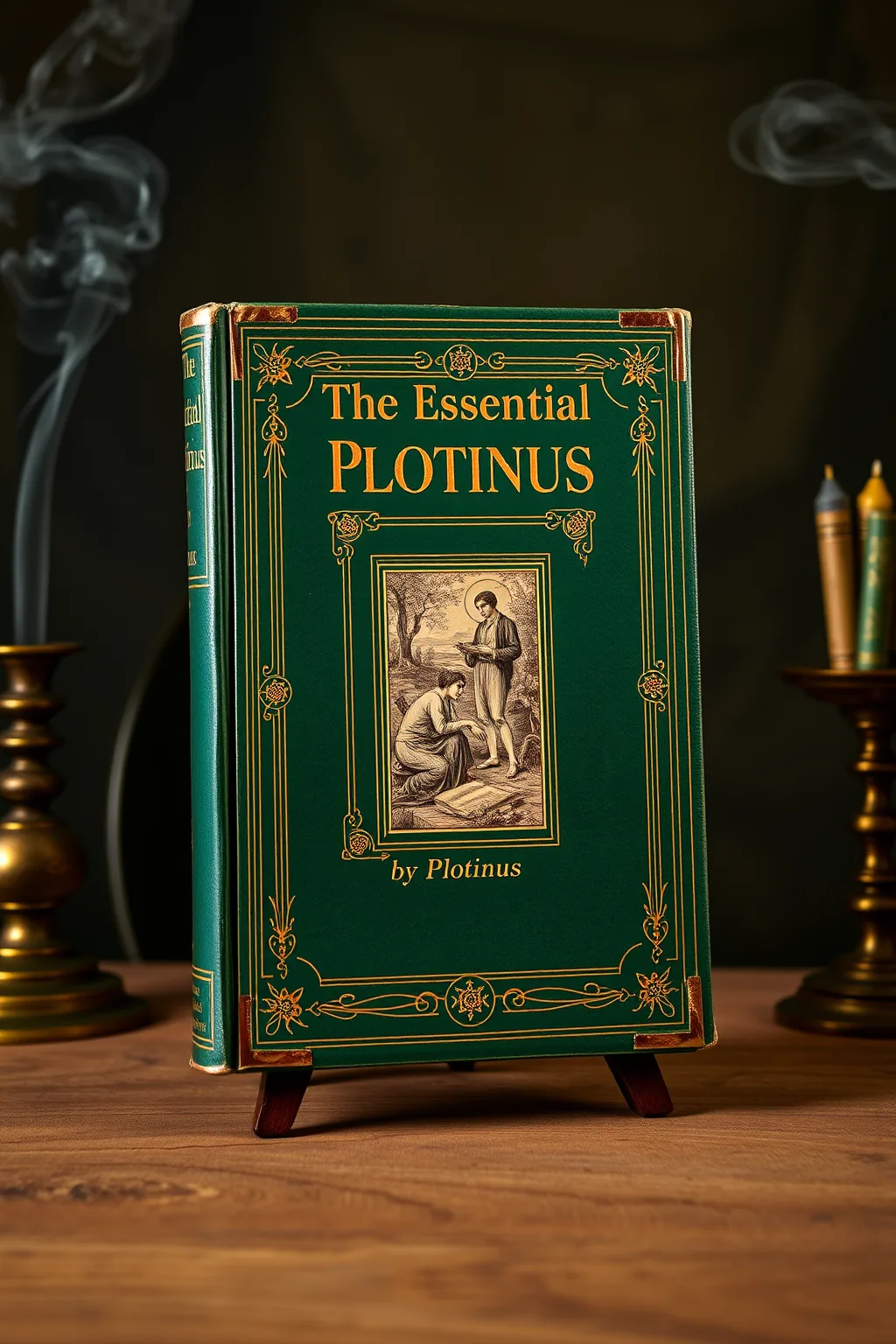
The essential Plotinus
 72
72

The essential Plotinus
Plotinus's Enneads are a cornerstone of Western esoteric thought, and this abridged "Essential" edition attempts to provide a digestible entry point. The selection here effectively highlights Plotinus's core emanative cosmology, moving from the ineffable One through Intellect and Soul down to the material world. The clarity of the translation chosen for this edition is commendable, particularly in passages describing the soul’s journey towards The One. However, the necessary brevity means that some of the intricate dialectical arguments and the full scope of Plotinus's engagement with specific philosophical problems, like the nature of evil, are necessarily truncated. While the focus on the ascent to The One is strong, the philosophical rigor behind that ascent sometimes feels less developed than in more complete translations. It serves as a useful primer, but readers will likely need to consult the full Enneads for a comprehensive understanding.
📝 Description
72
### What It Is
The Essential Plotinus offers a curated selection from the Enneads, the collected philosophical writings of the Neoplatonist thinker Plotinus, compiled and edited by his student Porphyry. This volume aims to present the core tenets of Plotinus's metaphysics and mystical philosophy in a more accessible format than the complete corpus. It distills complex arguments concerning the nature of reality, the divine, and the human soul's ascent toward the One.
### Who It's For
This edition is designed for students and scholars of ancient philosophy, Western esotericism, and comparative religion. It is particularly suited for those encountering Plotinus for the first time, offering a structured entry point into his intricate system. Readers interested in the historical development of mystical thought and its influence on subsequent traditions will find it valuable.
### Historical Context
Plotinus (c. 204/5 – 270 CE) lived and taught in Rome during a period of intense philosophical and religious ferment in the Roman Empire. His work synthesized Platonic thought with Aristotelian and Stoic elements, forming the bedrock of Neoplatonism. This school of thought profoundly influenced early Christian theology, Gnosticism, and later Renaissance Hermeticism, positioning Plotinus as a pivotal figure bridging classical antiquity and medieval philosophy. His ideas were a significant counterpoint to the burgeoning Gnostic movements of his era.
### Key Concepts
The text elaborates on Plotinus's hierarchical view of reality, originating from an ineffable, transcendent source known as 'The One'. Emanating from The One are Intellect (Nous), which contains the Platonic Forms, and Soul, which animates the material world. The human soul, possessing a divine spark, can achieve union with The One through philosophical contemplation and ecstatic ascent, a process often described as an 'unfolding' or 'return'. The concept of 'henosis' – mystical union – is central.
💡 Why Read This Book?
• Gain an understanding of the Neoplatonic concept of emanation, tracing the descent of reality from the ineffable One to the material world, as detailed in Plotinus's metaphysical framework. • Explore the Plotinian path of the soul's ascent, learning about the stages of purification and contemplation necessary for achieving henosis, or union with the divine. • Grasp the historical significance of Plotinus's philosophy, understanding its foundational role in shaping Western esoteric traditions and its impact on thinkers from Augustine to the Renaissance.
⭐ Reader Reviews
Honest opinions from readers who have explored this book.
❓ Frequently Asked Questions
What is the primary philosophical system associated with Plotinus?
Plotinus is the principal figure of Neoplatonism, a philosophical school that synthesized Platonic ideas with other traditions. His work, compiled by Porphyry, forms the foundational text for understanding this influential system of thought.
What is "The One" in Plotinian philosophy?
In Plotinus's metaphysics, "The One" is the ultimate, ineffable principle of all existence. It is beyond being and description, serving as the transcendent source from which all reality emanates, including Intellect and Soul.
What does Plotinus mean by the 'emanation' of reality?
Emanation describes the process by which reality flows necessarily and passively from The One, without diminishing it. This hierarchical unfolding produces Intellect (Nous), Soul, and finally the material world.
What is the goal of the soul's journey according to Plotinus?
The ultimate goal is 'henosis,' a mystical union or ecstatic return of the individual soul to its divine source, The One. This is achieved through philosophical contemplation and purification.
Who was Porphyry and what is his relation to Plotinus's work?
Porphyry was a student and biographer of Plotinus. He is credited with compiling and organizing Plotinus's lectures and writings into the six books of the Enneads, thereby preserving his teacher's philosophy.
When did Plotinus live and teach?
Plotinus lived and taught in the 3rd century CE, roughly from 204/205 to 270 CE. He established his philosophical school in Rome during this period.
🔮 Key Themes & Symbolism
The One and Emanation
This work centers on Plotinus's concept of The One, the ultimate, transcendent, and ineffable source of all reality. Unlike a creator god, The One 'emits' existence in a hierarchical outflow. This emanation proceeds through Intellect (Nous), which contains the Platonic Forms, and then to Soul. The material world is the furthest emanation, furthest from the source. Understanding this cosmology is key to grasping Plotinus's view of the structure of the universe and the divine.
The Soul's Ascent to The One
A core theme is the human soul's innate connection to the divine and its potential for 'henosis' – mystical union with The One. The text outlines a path of philosophical inquiry, ethical purification, and contemplative practice. This journey involves turning away from the distractions of the material world and recollecting the soul's own divine origins, ultimately leading to an ecstatic, non-discursive apprehension of the ultimate reality.
Forms and the Intellect (Nous)
Plotinus reinterprets Plato's theory of Forms, locating them within the divine Intellect (Nous). Nous is the first emanation from The One and is characterized by intellectual contemplation of these eternal archetypes. The text explores how these Forms serve as the blueprints for existence and how the human intellect participates in this divine Mind, bridging the gap between the transcendent and the immanent.
The Nature of Evil
While not always the primary focus of selections, the problem of evil is addressed within Plotinus's system as a privation of good or a consequence of the soul's 'descent' into materiality. Evil arises not from The One, but from the furthest remove from it, where the principle of 'otherness' and deficiency takes hold. Understanding evil is intrinsically linked to understanding the soul's orientation towards or away from the Good.
💬 Memorable Quotes
“The soul has descended into the body, but it has not become wholly body.”
— This highlights the dual nature of the human being in Plotinian thought. Even when embodied, the soul retains its connection to the higher, spiritual realms, possessing an inherent divine essence that transcends its material vessel.
“All things are turned towards The One.”
— This encapsulates the fundamental orientation of Plotinian cosmology. Every entity, from the highest Intellect to the lowest material form, inherently seeks or reflects its origin in The One, its ultimate source and sustainer.
“The Intellect is the first principle after The One.”
— This statement defines the position of Nous (Intellect) in Plotinus's hierarchical metaphysics. It is the immediate emanation from the ineffable One, serving as the realm of the Platonic Forms and pure thought.
“To see is the aim of the eye; to be is the aim of the soul.”
— This paraphrase suggests that just as sight is the natural function of the eye, the fundamental drive or purpose of the soul is its own existence and its inherent connection to the divine, rather than merely perceiving external phenomena.
“Beauty is not in the object, but in the perception of the object.”
— This reflects Plotinus's view that true beauty is apprehended by the soul's inner faculty, not inherent in the physical form itself. It points towards an aesthetic experience rooted in the soul's recognition of higher, intelligible realities.
🌙 Esoteric Significance
Tradition
Plotinus is the foundational figure of Neoplatonism, a philosophical and mystical tradition that stands as a primary pillar of Western esotericism. While rooted in Platonic philosophy, Plotinus infused it with a pronounced mystical and ecstatic dimension, focusing on the soul's direct apprehension of the divine. His work provided the speculative framework for many later esoteric movements, including Hermeticism, Gnosticism (which he critically engaged with), and Renaissance magical philosophies.
Symbolism
The primary symbolic motif is the hierarchical structure of reality itself, emanating from the ineffable One. The 'descent' of the soul into the material world is a key symbolic narrative, representing alienation from the divine source. Conversely, the 'ascent' symbolizes the soul's journey of purification and recollection, aiming for 'henosis' or union. The concept of light and darkness is also implicitly symbolic, representing presence and absence of The One.
Modern Relevance
Contemporary esoteric practitioners, philosophers of religion, and scholars of mysticism continue to draw heavily from Plotinus. His ideas on consciousness, the nature of reality, and the possibility of direct spiritual experience inform modern interpretations of meditation, contemplative prayer, and psychological integration. Thinkers in fields ranging from phenomenology to process philosophy find resonance in his metaphysics of being and becoming.
👥 Who Should Read This Book
• Students of Western Esotericism: Those seeking to understand the philosophical underpinnings of mystical traditions, as Plotinus's Neoplatonism is a direct precursor to many later esoteric schools. • Philosophy undergraduates and graduates: Readers interested in the evolution of Platonic thought and its metaphysical elaborations, particularly concerning the nature of the One and the structure of reality. • Aspiring mystics and contemplatives: Individuals exploring paths toward direct spiritual experience and seeking a sophisticated philosophical framework to understand concepts like henosis and the soul's divine origin.
📜 Historical Context
Plotinus (c. 204/5 – 270 CE) taught in Rome during the tumultuous 3rd century, a period marked by political instability and the flourishing of diverse philosophical and religious ideas. His development of Neoplatonism offered a sophisticated metaphysical system that synthesized Platonic philosophy with elements of Aristotelianism and Stoicism. This intellectual current provided a powerful alternative to the increasingly popular Gnostic movements of the era, offering a more ordered and unified vision of reality. Plotinus's rigorous philosophical approach and his emphasis on a transcendent, unified source of all being deeply influenced subsequent thinkers, most notably Augustine of Hippo, whose early works show clear engagement with Plotinian concepts. His ideas became a cornerstone for later Christian theology and Islamic philosophy, shaping Western thought for centuries.
📔 Journal Prompts
The soul's relationship to The One.
Plotinus's concept of Intellect (Nous) and its Forms.
The process of emanation and its implications for the material world.
The soul's journey from materiality back to its divine source.
The nature of the ineffable One and its unknowability.
🗂️ Glossary
The One
The ultimate, transcendent, and ineffable principle of reality in Plotinus's philosophy. It is the source from which all existence emanates but is itself beyond being and description.
Emanation
The process by which reality flows from The One in a hierarchical, non-diminishing outpouring. This includes Intellect (Nous), Soul, and the material world.
Intellect (Nous)
The first emanation from The One. It is the realm of the eternal Platonic Forms and pure thought, containing the archetypes of all existence.
Soul
The third principle in Plotinus's hierarchy, emanating from Intellect. It animates the material world and possesses a divine spark, capable of ascending back to The One.
Henosis
The ultimate goal of the soul's journey in Plotinian philosophy: mystical union or ecstatic communion with The One.
Forms
The eternal, perfect archetypes of all things, located within the divine Intellect (Nous) in Plotinus's system.
Material World
The furthest realm of emanation from The One, characterized by multiplicity, change, and a lesser degree of reality or 'goodness'.