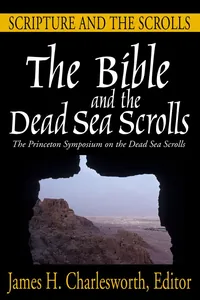
The Bible and the Dead Sea Scrolls: Vol 2

 77
77

The Bible and the Dead Sea Scrolls: Vol 2
James H. Charlesworth's "The Bible and the Dead Sea Scrolls: Vol 2" offers a rigorous, if sometimes dense, exploration of the intricate relationship between the Qumran discoveries and biblical texts. The strength of this volume lies in its meticulous attention to textual detail, particularly its engagement with manuscript variants and the linguistic nuances that connect the scrolls to the broader biblical tradition. Charlesworth masterfully synthesizes complex scholarly debates, providing readers with a clear overview of critical issues. However, the book’s academic focus, while a virtue for specialists, can present a barrier to entry for those less versed in the intricacies of textual criticism and ancient Hebrew. A particularly illuminating section discusses the scribal practices evidenced in the scrolls, offering concrete examples of how ancient copyists interacted with sacred texts. While dense, the work ultimately provides an indispensable resource for understanding the textual genesis of scripture. It stands as a significant contribution to the ongoing dialogue surrounding the Dead Sea Scrolls.
📝 Description
77
### What It Is This volume, the second in a series by James H. Charlesworth, offers a scholarly examination of the Dead Sea Scrolls in relation to the biblical text. It scrutinizes the textual variants, theological echoes, and historical milieu shared by these ancient Jewish documents and the scriptures that would later form the Christian canon. The work aims to illuminate the complex environment from which early biblical interpretations emerged, providing a detailed analysis of manuscript fragments and their scholarly interpretations. It functions as a critical resource for understanding the textual lineage and interpretive frameworks of ancient Judaism and early Christianity.
### Who It's For This book is primarily intended for advanced students, academics, and serious researchers in biblical studies, early Judaism, and the history of Christianity. It is also of significant interest to paleographers, textual critics, and anyone engaged in the meticulous study of ancient Near Eastern texts. Readers should possess a foundational understanding of biblical languages and historical research methodologies to fully appreciate the detailed arguments and textual evidence presented. It is not an introductory text but rather a deep dive into specialized scholarship.
### Historical Context The publication of the Dead Sea Scrolls, beginning in 1947, revolutionized the understanding of Second Temple Judaism and the origins of Christianity. The period between the discovery and the early 2000s saw intense scholarly debate regarding the scrolls' dating, authorship, and relationship to various Jewish sects, particularly the Essenes. Charlesworth's work, first published in 2006, emerged within this context of ongoing discovery and re-evaluation. It engaged with the vast body of scholarship that had developed since the initial finds, seeking to synthesize findings and offer new perspectives on the scrolls' connection to biblical texts, building upon the foundational work of scholars like Roland de Vaux and Yigael Yadin.
### Key Concepts The book explores critical concepts such as textual criticism, the Septuagint's role in textual transmission, the Qumran community's unique interpretive methods, and the development of early Christian exegesis. It examines how the scrolls challenge or confirm existing understandings of biblical canonization and theological evolution. Specific focus is given to the linguistic and thematic parallels between the scrolls and canonical biblical books, as well as apocryphal and pseudepigraphical texts. The work also delves into the historical circumstances surrounding the scrolls' creation and preservation, offering insights into the religious and political landscape of Judea during the Second Temple period.
💡 Why Read This Book?
• Learn about specific textual variants found in manuscripts like 4QJer2, which shed light on the transmission history of the book of Jeremiah, offering a perspective unavailable in standard biblical editions. • Understand the scholarly consensus and debates surrounding the Qumran sect's interpretation of biblical law, providing concrete examples of how their legal traditions differed from or influenced later rabbinic interpretations. • Grasp the significance of the Septuagint's textual tradition as illuminated by the scrolls, illustrating how ancient Greek translations were informed by Hebrew textual families distinct from those that eventually formed the Masoretic Text.
⭐ Reader Reviews
Honest opinions from readers who have explored this book.
❓ Frequently Asked Questions
What is the primary focus of "The Bible and the Dead Sea Scrolls: Vol 2"?
This volume focuses on the scholarly analysis of the Dead Sea Scrolls and their direct relationship to biblical texts, examining textual variants, theological connections, and the historical environment of their creation.
Who is James H. Charlesworth, and what is his expertise?
James H. Charlesworth is a distinguished scholar in biblical studies and the history of early Judaism. He is known for his extensive work on the Dead Sea Scrolls and the historical Jesus, bringing decades of academic research to this field.
How does this volume differ from Volume 1?
While both volumes explore the Dead Sea Scrolls and the Bible, Volume 2 typically delves into more specific textual or thematic analyses, building upon the broader introduction provided in the first volume, focusing on particular books or concepts.
Are the Dead Sea Scrolls considered part of the biblical canon?
The Dead Sea Scrolls are not part of the biblical canon for most traditions. They are ancient Jewish documents that predate or are contemporary with the formation of the biblical canon and offer crucial insight into the texts considered scripture at the time.
What does "textual criticism" mean in the context of this book?
Textual criticism, as applied here, is the scholarly discipline of comparing different ancient manuscript versions of a text to determine the most likely original wording and understand how the text evolved over time.
Can this book help understand the origins of Christianity?
Yes, by illuminating the Jewish religious and textual landscape of the Second Temple period (roughly 516 BCE to 70 CE), the book provides essential context for understanding the environment in which Christianity emerged.
🔮 Key Themes & Symbolism
Textual Variants and Transmission
This volume meticulously examines variations found across different manuscript copies of biblical books discovered at Qumran. Charlesworth highlights how these variants, such as those in the book of Jeremiah, challenge the notion of a single, stable text. The work details the painstaking process of textual criticism, comparing fragments like the Masoretic Text, the Septuagint, and the readings found in the scrolls to reconstruct the textual history and understand the evolution of scripture before standardization. This offers a concrete look at how ancient scribes copied and sometimes altered sacred writings.
Qumran Community's Hermeneutics
A central theme is the unique interpretive methods (hermeneutics) employed by the Qumran community. The book explores how this group read and understood the Hebrew Bible, often applying prophetic texts to their own community and historical circumstances. Charlesworth analyzes specific commentaries found among the scrolls, such as pesharim, which reveal the community's eschatological outlook and their self-perception as the true inheritors of the biblical covenant. This provides insight into a distinct, influential school of biblical interpretation from the Second Temple period.
Second Temple Judaism Milieu
Charlesworth situates the scrolls within the vibrant and often contentious religious landscape of Second Temple Judaism. The work emphasizes the diversity of thought and practice during this era, demonstrating that the Qumran sect was one of several significant movements. By comparing the scrolls' theology and practices with other contemporary Jewish groups and the emerging Christian movement, the book clarifies the specific historical and intellectual environment that shaped both late Judaism and early Christianity, moving beyond simplistic narratives.
Linguistic and Theological Echoes
The volume investigates the profound linguistic and theological connections between the Dead Sea Scrolls and the biblical writings. Charlesworth analyzes shared vocabulary, grammatical structures, and recurring motifs that underscore the scrolls' deep engagement with biblical tradition. This includes exploring how concepts such as covenant, law, and messianism were understood and debated within the Qumran community. The book reveals a complex dialogue between the biblical text and its interpreters in the centuries leading up to and during the time of Jesus.
💬 Memorable Quotes
“The scrolls reveal a Judaism far more diverse than previously imagined, with numerous interpretive schools.”
— This interpretation highlights that the Dead Sea Scrolls, discovered starting in 1947, demonstrated that ancient Judaism was not monolithic. Instead, it was a dynamic period with varied theological viewpoints and distinct communities, challenging earlier scholarly assumptions.
“Textual variants in manuscripts like 4QJer2 necessitate careful comparison with the Septuagint and Masoretic Text.”
— This concept emphasizes the importance of textual criticism. It means that when examining ancient biblical manuscripts, such as a specific Jeremiah scroll from Qumran (4QJer2), scholars must compare its readings against the main ancient Greek translation (Septuagint) and the later Hebrew text (Masoretic Text) to understand its textual lineage.
“The Qumran community’s exegesis often projected their own experiences and eschatological hopes onto biblical prophecy.”
— This interpretation points to how the Essene-associated sect at Qumran interpreted biblical texts, especially prophetic ones. They frequently saw these ancient prophecies as directly relevant to their own time, community, and their belief in an imminent end times.
“Understanding the scribal practices of the Second Temple period is crucial for assessing biblical text integrity.”
— This idea stresses that the methods ancient scribes used to copy and transmit texts are vital for modern scholars. By studying how texts were handled in the Second Temple period (c. 516 BCE - 70 CE), one can better evaluate the reliability and variations within biblical manuscripts.
“The scrolls provide a crucial window into the theological landscape that gave rise to both Rabbinic Judaism and Christianity.”
— This concept underscores the Dead Sea Scrolls' significance. They offer direct evidence of the religious ideas and debates present in Judea during a pivotal era, illuminating the shared roots and divergent paths of the two major monotheistic traditions that emerged from that context.
🌙 Esoteric Significance
Tradition
This work engages with the broad tradition of biblical interpretation that underpins Western esotericism, particularly Hermeticism and Gnosticism, which often sought hidden meanings within scripture. While Charlesworth’s approach is strictly academic and historical, his findings on textual variations and community interpretations provide raw material for esoteric readings. The scrolls' emphasis on purity, hidden knowledge, and eschatological fulfillment aligns with themes often explored in esoteric circles seeking direct communion with the divine or uncovering secret divine plans.
Symbolism
Key symbols explored implicitly through the scrolls' content include the 'Sons of Light' versus 'Sons of Darkness,' representing a dualistic worldview often found in esoteric traditions. The meticulous adherence to the Law (Torah) within the Qumran community can be seen as a form of practical Kabbalah or ritualistic magic, emphasizing divine order. The scrolls' own cryptic nature and the quest to decipher them mirrors the esoteric pursuit of hidden knowledge and esoteric symbolism within seemingly mundane texts.
Modern Relevance
Contemporary esoteric practitioners and scholars of comparative religion continue to draw on the Dead Sea Scrolls research. Movements interested in early Christian origins, Jewish mysticism, and the historical Jesus often consult works like Charlesworth's for accurate textual data and historical context. Thinkers exploring ancient dualistic philosophies or the evolution of apocalyptic thought find the scrolls indispensable. The ongoing academic study ensures that the scrolls remain a vital reference point for understanding the spiritual and intellectual currents that shaped Western esoteric thought.
👥 Who Should Read This Book
• Scholars of biblical studies and ancient Near Eastern history seeking detailed analysis of manuscript evidence and textual criticism. • Students of early Judaism and Christian origins needing to understand the complex religious landscape of the Second Temple period. • Advanced researchers interested in the Qumran community's unique interpretations of scripture and their theological development.
📜 Historical Context
The discovery of the Dead Sea Scrolls, commencing in 1947 near Qumran, fundamentally altered the academic study of the Bible and Second Temple Judaism. The period following these finds was marked by intense scholarly activity and debate throughout the latter half of the 20th century. Scholars like Eleazar Sukenik and later Yigael Yadin were among the first to recognize the immense significance of these texts, which offered firsthand documentation of Jewish life and thought from roughly the 3rd century BCE to the 1st century CE. Charlesworth's work, published in 2006, enters a field already rich with competing theories regarding the scrolls' authorship (e.g., Essenes, Sadducees, or a diverse collection) and their precise relationship to canonical texts and emerging Christian doctrines. The reception of the scrolls was initially slow due to political instability and access issues, but by the 1990s, they had become a central focus, eclipsing some earlier, more speculative works on Jewish mysticism. Charlesworth’s scholarship engages directly with the vast corpus of secondary literature that had accumulated, particularly concerning textual criticism and comparative theology.
📔 Journal Prompts
The Qumran community's interpretation of biblical prophecy.
The significance of textual variants found in scrolls like 4QJer2.
Comparing the 'Sons of Light' dualism with other esoteric traditions.
The role of scribal practices in the Second Temple period.
The historical context of the Septuagint's development as evidenced by the scrolls.
🗂️ Glossary
Dead Sea Scrolls
A collection of ancient Jewish manuscripts discovered between 1947 and 1956 in caves near the Dead Sea. They include the oldest known copies of biblical books and other religious writings from the Second Temple period.
Masoretic Text (MT)
The authoritative Hebrew text of the Jewish Bible (Tanakh), established by the Masoretes between the 6th and 10th centuries CE. It is the basis for most modern translations of the Old Testament.
Septuagint (LXX)
The ancient Greek translation of the Hebrew Bible, created in Egypt during the Ptolemaic period (from the 3rd century BCE onward). It represents a different textual tradition than the Masoretic Text.
Textual Criticism
The scholarly discipline of comparing ancient manuscripts to determine the most accurate and original wording of a text and to understand its transmission history.
Second Temple Period
The era of Jewish history from the rebuilding of the Second Temple in Jerusalem around 516 BCE until its destruction by the Romans in 70 CE.
Qumran Community
The sect, widely believed to be Essenes, that inhabited the settlement at Qumran and produced or collected the Dead Sea Scrolls. They had a distinct theological outlook and way of life.
Pesharim
A specific type of interpretive commentary found among the Dead Sea Scrolls, which applies biblical prophecies directly to the history and beliefs of the Qumran community.