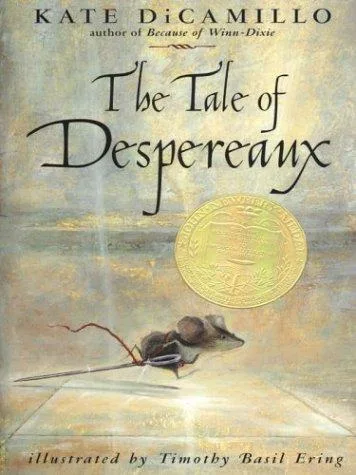
Tale of Despereaux
 73
73

Tale of Despereaux
Kate DiCamillo’s "The Tale of Despereaux" presents a remarkably tender portrait of a mouse defined by his differences. The novel's strength lies in its exquisite prose and its unflinching examination of bravery in the face of overwhelming odds. Despereaux, with his large ears and even larger heart, is a compelling protagonist whose journey from a fearful existence to one of courageous action is handled with grace. However, the narrative occasionally falters in its pacing, particularly in the middle sections where the dual storylines of Despereaux and the serving girl Miggery Sow feel somewhat disconnected from the central emotional arc concerning the Princess. The scene where Despereaux must descend into the rat's kingdom to rescue Princess Pea is a masterclass in building suspense and illustrating his profound courage. This work is a quietly powerful exploration of what it means to be alive and to choose hope.
📝 Description
73
Kate DiCamillo published 'The Tale of Despereaux' in 2003, a story about a mouse who loves music and stories.
The narrative follows Despereaux Tilling, a mouse whose small size and distinctive ears set him apart from his kin. While other mice focus on survival and crumbs, Despereaux is drawn to music, stories, and the presence of Princess Pea. His life unfolds within the castle walls, a setting of grand rooms and hidden spaces. Here, he encounters both the gentle nature of the princess and the darker intentions of the rat Roscuro.
This book is not a simple children's tale. It will appeal to readers who value carefully crafted prose, characters with depth, and ideas about hope, despair, and courage. Those who enjoy allegorical stories and narratives that examine a character's inner world will find much to consider. It speaks to the idea that even the smallest creatures can hold great bravery.
Published in 2003, 'The Tale of Despereaux' draws from a storytelling tradition that emphasizes moral substance and emotional complexity. Unlike much contemporary children's literature, DiCamillo's work recalls the more detailed, allegorical style of earlier literary eras. The story's structure and themes echo classic fables, where animals often represent human virtues and flaws, a technique seen in Aesop's fables or medieval allegories.
💡 Why Read This Book?
• Learn about the power of narrative and storytelling, as seen in Despereaux's own love for stories and his ability to find hope within them, a concept central to the book's structure. • Experience the nuanced exploration of light and darkness, not just as physical states but as internal struggles, exemplified by the contrast between the castle's brightness and the rat's kingdom. • Understand the nature of courage as a choice, not an absence of fear, demonstrated by Despereaux's actions despite his physical limitations and the dangers he faces.
⭐ Reader Reviews
Honest opinions from readers who have explored this book.
❓ Frequently Asked Questions
When was Kate DiCamillo's 'The Tale of Despereaux' first published?
Kate DiCamillo's 'The Tale of Despereaux' was first published in 2003, not 2016 as some sources might suggest. This 2003 publication date places it within a specific era of contemporary children's literature.
What is the central conflict in 'The Tale of Despereaux'?
The central conflict involves Despereaux, a mouse who defies mouse conventions, and his quest to save Princess Pea from the darkness of the rat's kingdom, facing both external dangers and internal doubts.
Who are the main characters in 'The Tale of Despereaux'?
The primary characters are Despereaux Tilling, a small mouse with large ears and a brave heart; Princess Pea, the object of Despereaux's affection and the catalyst for his bravery; and Roscuro, a rat drawn to the light of the human world but ultimately consumed by darkness.
What makes Despereaux a unique protagonist?
Despereaux is unique because he is a mouse who cannot be a mouse; he loves music, stories, and the light, and he possesses a deep capacity for love and courage, setting him apart from his fellow rodents.
What themes are explored in 'The Tale of Despereaux'?
The book explores themes of hope versus despair, light versus darkness, love, courage, forgiveness, and the significance of individual actions, particularly how small acts can have profound consequences.
Is 'The Tale of Despereaux' based on any specific literary tradition?
While not directly based on a single work, 'The Tale of Despereaux' draws from the tradition of classic fables and fairy tales, using animal characters to explore complex human emotions and moral dilemmas.
🔮 Key Themes & Symbolism
Light and Darkness
The narrative frequently contrasts the illuminated world of the castle, particularly Princess Pea's presence, with the subterranean darkness of the rat's kingdom. This duality serves as a powerful metaphor for hope and despair, joy and suffering, and the human capacity for both good and evil. Despereaux's journey is one of moving from shadowed existence towards embracing the light, even when it is dangerous. Roscuro's arc, conversely, illustrates how fascination with light can paradoxically lead one back into deeper darkness when corrupted by envy or despair.
The Nature of Courage
Fundamentally, the story is an exploration of courage, particularly the courage of the small and the overlooked. Despereaux, a mouse who is physically frail and socially ostracized for his unusual nature, embodies this theme. His bravery is not an absence of fear, but a deliberate choice to act despite it, driven by love for Princess Pea and a desire to do what is right. This challenges the conventional notion that strength is purely physical, suggesting true courage lies in the heart and will.
The Power of Story
The book itself is a evidence of the power of stories to shape perception, offer solace, and inspire action. Despereaux finds meaning and escape in stories, and his own life becomes a narrative that defies expectations. The act of storytelling becomes a way to process difficult experiences and to construct a more hopeful reality. The framing narrative, with the narrator guiding the reader through Despereaux's life, emphasizes how stories help us understand ourselves and the world.
Individuality vs. Conformity
Despereaux's struggle is largely one of embracing his individuality in a world that demands conformity. As a mouse, he is expected to live in darkness, eat scraps, and fear humans. His refusal to adhere to these norms, his love for music and the Princess, makes him an anomaly. The story champions the value of being true to oneself, even when it means standing apart from one's community, suggesting that genuine fulfillment comes from embracing one's unique nature.
💬 Memorable Quotes
Direct passages from the work, attributed to the author.
“Once upon a time, there was a mouse who was not like other mice.”
— This opening line immediately establishes the central premise of the story and the unique nature of the protagonist, Despereaux, setting the stage for his extraordinary journey.
“Reader, I am going to tell you a story about a mouse.”
— This direct address to the reader by the narrator creates an intimate connection, framing the entire narrative as a deliberate act of storytelling and inviting the audience into Despereaux's world.
“Darkness and soup. Light and soup. It was all the same to Roscuro.”
— This interpretation of Roscuro's mindset reveals his internal conflict and eventual descent into despair, where the allure of light becomes corrupted, blurring the lines between desire and darkness.
“He lived in a world of darkness and fear, and he was afraid.”
— This description of Roscuro, the rat, expresses his tragic existence and the internal torment that drives his actions. It highlights the theme of despair and the pervasive nature of fear.
💡 Key Ideas
Editorial paraphrase of the work's core concepts — not direct quotes.
He was in love with a princess and a bowl of soup.
This quote humorously captures Despereaux's dual affections: his noble love for Princess Pea and his simple, perhaps equally profound, desire for a bowl of soup, highlighting his complex yet relatable character.
🌙 Esoteric Significance
Tradition
While not explicitly aligning with a specific esoteric tradition, "The Tale of Despereaux" speaks to themes found in Gnostic and Hermetic thought, particularly concerning the journey of the soul from darkness into light and the inherent spark of the divine within the seemingly insignificant. Despereaux’s exceptional nature and his quest for meaning and connection echo the Gnostic concept of the *pneuma*, the divine spark trapped in the material world, striving for liberation and return to the source.
Symbolism
The most potent symbol is the contrast between **light** and **darkness**. Light represents knowledge, love, hope, and the divine, while darkness signifies ignorance, despair, fear, and the material limitations of existence. The **soup** serves as a symbol of simple, earthly desires and comforts, which Roscuro perverts, and which Despereaux, despite his noble pursuits, also understands as a basic need. The **castle** itself symbolizes the structured, ordered world, while the **underworld** represents the hidden, primal forces and the unconscious.
Modern Relevance
The work's exploration of individual consciousness, the struggle against imposed limitations, and the search for meaning in a complex world continues to be relevant. Contemporary thinkers and spiritual practitioners focused on mindfulness, inner resilience, and the power of positive intention can draw parallels to Despereaux's unwavering spirit. The narrative's emphasis on finding light within darkness also aligns with modern therapeutic approaches and philosophical explorations of existentialism and hope.
👥 Who Should Read This Book
• Aspiring storytellers and writers who wish to study intricate narrative structure and character archetypes, learning how to imbue simple characters with profound thematic weight. • Young adults and adults interested in allegorical literature and philosophical explorations of hope, despair, and courage, particularly those drawn to tales with animal protagonists. • Readers seeking a beautifully written, emotionally resonant story that champions individuality and the transformative power of love and bravery, offering a counterpoint to cynicism.
📜 Historical Context
Kate DiCamillo's "The Tale of Despereaux," published in 2003, emerged in an era of children's literature that often favored straightforward narratives and clear moral lessons. DiCamillo's work, however, harks back to a more traditional, allegorical style reminiscent of E.B. White's "Charlotte's Web" (1952) or even earlier fairy tales, where animal protagonists are used to explore complex human emotions and philosophical themes. The book achieved significant critical acclaim, winning the Newbery Medal in 2004, a prestigious award recognizing distinguished contribution to American children's literature. This reception underscored a growing appreciation for literary depth and intricate storytelling within the children's market, pushing against trends that might have favored simpler, more commercially driven plots. DiCamillo's contemporaries, such as Lemony Snicket (Daniel Handler) with his "A Series of Unfortunate Events" (begun 1999), also explored darker, more complex themes for young readers, though often with a distinctly different, more cynical tone.
📔 Journal Prompts
The contrast between Despereaux’s love for stories and Roscuro’s descent into despair.
The significance of the rat’s kingdom as a symbol of the unconscious or shadowed self.
Princess Pea's role as a clear source of light and goodness in the narrative.
The concept of bravery as depicted through Despereaux's physical and emotional journey.
The narrator's voice and its effect on the reader's perception of the tale.
🗂️ Glossary
Despereaux Tilling
The titular character, a small mouse with unusually large ears, who possesses a brave heart and a love for stories, music, and Princess Pea, defying the typical nature of mice.
Roscuro
A rat who lives in the darkness of the castle's kitchen but is drawn to the light and the human world, representing a complex struggle between desire and despair.
Princess Pea
The kind and beautiful princess of the castle, whose presence and suffering become the central focus of Despereaux's courageous quest.
The Rat's Kingdom
The dark, subterranean world beneath the castle where the rats reside, symbolizing a field of despair, fear, and primal instincts.
Newbery Medal
An annual award given by the Association for Library Service to Children, a division of the American Library Association, to the author of the most distinguished contribution to American literature for children published in the preceding year.
Allegory
A story, poem, or picture that can be interpreted to reveal a hidden meaning, typically a moral or political one. Characters and events represent abstract ideas or principles.
Miggery Sow
A serving girl in the castle who is prone to exaggeration and has a complicated relationship with the rats and the castle's inhabitants.
🔮 Readers Also Liked
Browse all →








More by Kate DiCamillo
All books →




More Free Occult Philosophy Books
View all →