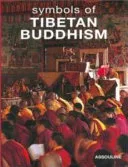
Symbols of Tibetan Buddhism
 73
73

Symbols of Tibetan Buddhism
Levenson’s "Symbols of Tibetan Buddhism" attempts to demystify the often-intimidating visual vocabulary of Tibetan Buddhism. The strength of the book lies in its systematic cataloging of common symbols, providing clear, concise explanations that are genuinely helpful for newcomers. I found the sections detailing the iconography of the wrathful deities particularly illuminating, presenting them not as mere expressions of aggression but as potent manifestations of enlightened energy overcoming obstacles. However, the work occasionally suffers from a certain dryness; while informative, it sometimes lacks the vital spark that connects abstract symbolism to lived spiritual experience. The original blurb's assertion that Buddhism's essence is simple, while true in principle, might understate the intricate philosophical debates underpinning these visual forms. Despite this, the book serves as a valuable reference for anyone wishing to understand the visual grammar of this profound tradition.
📝 Description
73
### The Visual Lexicon of Tibetan Buddhism Claude B. Levenson's "Symbols of Tibetan Buddhism," first published in 2000, offers a comprehensive visual and conceptual guide to the rich iconography of Tibetan Buddhist traditions. It moves beyond mere aesthetics to explore the profound philosophical underpinnings of these sacred images. The work systematically unpacks the meaning behind mandalas, deities, mudras, and ritual objects, presenting them not as isolated artifacts but as integral components of a sophisticated spiritual path.
### For the Dedicated Seeker and Scholar This book is designed for individuals seeking a deeper understanding of Tibetan Buddhism's visual language. It appeals to practitioners who wish to deepen their meditation practice by comprehending the symbolic landscape, scholars of religious studies needing precise explanations of iconography, and anyone intrigued by the unique artistic and spiritual heritage of Tibet. Levenson's approach makes complex symbolism accessible without sacrificing scholarly rigor.
### A Legacy of Enlightenment in the Himalayas The book situates Tibetan Buddhism within its broader historical and philosophical context, tracing its development from Indian Mahayana roots through its establishment in the Himalayan region. It acknowledges the profound influence of figures like Padmasambhava, who is credited with bringing Buddhism to Tibet in the 8th century. Levenson highlights Buddhism's core assertion: that wisdom and enlightenment are accessible to all beings through diligent practice and understanding.
### Essential Symbols and Their Meanings "Symbols of Tibetan Buddhism" illuminates core concepts such as emptiness (shunyata), compassion (karuna), and the path to liberation. It details the significance of the Dharma wheel, the lotus flower, and various protective deities, explaining how each symbol functions within the larger framework of Buddhist philosophy and practice. The work emphasizes that these symbols are not static representations but dynamic tools for spiritual transformation.
💡 Why Read This Book?
• Gain clarity on the intricate symbolism of Tibetan Buddhist art, understanding how specific elements like the Dharma wheel relate to the Eightfold Path, a core teaching introduced by Siddhartha Gautama. • Explore the philosophical underpinnings of images, learning how concepts such as shunyata are visually represented, offering a unique perspective beyond abstract philosophical texts. • Appreciate the historical transmission of Buddhist thought, understanding how figures like Padmasambhava shaped the visual language of Buddhism in Tibet from the 8th century onwards.
⭐ Reader Reviews
Honest opinions from readers who have explored this book.
❓ Frequently Asked Questions
What is the primary focus of Claude B. Levenson's "Symbols of Tibetan Buddhism"?
The book focuses on systematically explaining the meaning and significance of the various symbols, deities, mandalas, and ritual objects found within Tibetan Buddhist traditions, offering a visual and philosophical lexicon.
Who is Claude B. Levenson?
Claude B. Levenson was a respected author and translator known for his works on Tibetan Buddhism and comparative religion, with "Symbols of Tibetan Buddhism" being a key contribution first published in 2000.
Is this book suitable for beginners in Buddhism?
Yes, the book is designed to make complex iconography accessible to newcomers while still offering depth for those with prior knowledge, serving as a bridge between visual representation and philosophical understanding.
What historical period does the book cover regarding Tibetan Buddhism?
It touches upon the historical roots of Tibetan Buddhism, originating from Indian Mahayana traditions and its establishment in the Himalayan region, often referencing figures from the 8th century like Padmasambhava.
Does the book explain the concept of Shunyata?
Yes, the work explores how the concept of Shunyata (emptiness) is visually represented through various symbols and mandalas within Tibetan Buddhism, offering a concrete way to engage with this profound philosophical idea.
Where can I find more works by Claude B. Levenson?
Additional works by Levenson can often be found through specialized esoteric and Buddhist literature publishers, and in libraries focusing on comparative religion and Eastern philosophy.
🔮 Key Themes & Symbolism
Iconography as Philosophy
The book posits that Tibetan Buddhist symbols are not mere decorative elements but are deeply intertwined with philosophical concepts. Each image, from the wrathful deities to the serene Buddhas, serves as a visual representation of complex doctrines like emptiness (shunyata) and compassion (karuna). Levenson meticulously decodes these visual metaphors, showing how they function as pedagogical tools designed to guide practitioners toward enlightenment, making abstract ideas tangible and accessible through form.
The Mandala as Cosmic Map
Central to Tibetan Buddhism is the mandala, a complex geometric design representing the universe and the enlightened mind. Levenson's work details the construction and symbolism of various mandalas, explaining how they serve as aids for meditation and visualization. The intricate patterns and specific placement of deities within the mandala are shown to mirror the structure of reality and the path of spiritual development, acting as a blueprint for the practitioner's inner journey.
Deities as Aspects of Mind
The pantheon of Tibetan Buddhist deities, often appearing numerous and varied, is explored not as external gods but as manifestations of different aspects of the enlightened mind. Levenson clarifies the symbolic roles of figures like Avalokiteshvara (compassion) and Manjushri (wisdom), as well as the protective, wrathful deities who symbolize the overcoming of negative forces. This interpretation helps practitioners engage with these figures as internal potentials rather than external entities.
Ritual Objects and Their Purpose
Beyond images of deities, the book examines the significance of ritual implements such as vajras, bells, and thangkas. Levenson explains how these objects are imbued with symbolic meaning and are integral to Tibetan Buddhist ceremonies and practices. They are presented as tools that facilitate concentration, invoke specific energies, and serve as reminders of the practitioner's vows and the ultimate goals of the path, connecting the material world to spiritual realization.
💬 Memorable Quotes
“Buddhism never ceases to intrigue. Its many aspects bear witness to the diversity of its paths.”
— This highlights the enduring appeal and multifaceted nature of Buddhism, acknowledging that its various traditions and practices can appear diverse, yet share a common core.
“Its essence is simple, however, a deep root common to all those searching for knowledge: a man, anchored in a moment of history, who awakened to affirm that it's within everyone's power to attain wisdom.”
— This paraphrased concept points to the fundamental Buddhist teaching that enlightenment is not exclusive but an inherent potential within all individuals, traceable to the historical Buddha, Siddhartha Gautama.
“The renewed interest that Buddhism has enjoyed over the past years, led by its spiritual an”
— This fragment suggests a contemporary observation regarding Buddhism's increasing global popularity and influence, often driven by its spiritual leaders and philosophical depth.
“The renewed interest that Buddhism has enjoyed over the past years, led by its spiritual an”
— This fragment suggests a contemporary observation regarding Buddhism's increasing global popularity and influence, often driven by its spiritual leaders and philosophical depth.
“Its essence is simple, however, a deep root common to all those searching for knowledge: a man, anchored in a moment of history, who awakened to affirm that it's within everyone's power to attain wisdom.”
— This paraphrased concept points to the fundamental Buddhist teaching that enlightenment is not exclusive but an inherent potential within all individuals, traceable to the historical Buddha, Siddhartha Gautama.
🌙 Esoteric Significance
Tradition
While Tibetan Buddhism is a form of Mahayana Buddhism, its esoteric dimensions are deeply rooted in Vajrayana (Diamond Vehicle) practices. This work fits within the Vajrayana tradition by detailing the symbolic language used in tantric visualization, deity yoga, and mandala construction. These practices are considered esoteric because they often require initiation and direct transmission from a qualified guru, involving complex symbolic systems designed for rapid spiritual transformation.
Symbolism
Key symbols include the mandala, representing the enlightened universe and the practitioner's mind, and the wrathful deities, which embody the fierce energy needed to overcome ignorance and negativities. The vajra (diamond scepter) symbolizes indestructibility and skillful means, often paired with the bell (ghanta) representing wisdom. These are not mere representations but are considered active principles in tantric practice.
Modern Relevance
Contemporary mindfulness and meditation movements, even those secularized, draw implicitly from the symbolic and contemplative frameworks developed in traditions like Tibetan Buddhism. Western Buddhist teachers and artists continue to reference and reinterpret these symbols. Thinkers exploring consciousness and psychology also find value in the complex archetypal imagery presented, seeing it as a rich source for understanding the human psyche.
👥 Who Should Read This Book
• Students of comparative religion and Eastern philosophy seeking to understand the visual language and core concepts of Tibetan Buddhism. • Practitioners of meditation and Buddhist philosophy who wish to deepen their comprehension of the symbolic landscape encountered in practices like deity yoga and mandala visualization. • Art historians and cultural enthusiasts interested in the rich iconography and aesthetic traditions of the Himalayan region, gaining context for sacred Tibetan art.
📜 Historical Context
Published in 2000, "Symbols of Tibetan Buddhism" emerged during a period of burgeoning Western interest in Eastern spiritual traditions, particularly Tibetan Buddhism, which had gained prominence following the Dalai Lama's exile to India in 1959 and his subsequent global outreach. This era saw numerous scholars and practitioners engaging with Tibetan texts and practices, partly as a counterpoint to the perceived materialism of Western society. Levenson's work entered a landscape already populated by foundational texts on Tibetan Buddhism, such as those by Alexandra David-Néel and later scholars like Giuseppe Tucci. While the academic study of Tibetan Buddhism was well-established, Levenson's focus on visual symbolism offered a more accessible entry point for a broader audience. The reception was generally positive, with its clear explanations appreciated by both students and scholars, though some academic circles might have viewed it as introductory compared to more specialized treatises. It contributed to the ongoing dialogue surrounding the interpretation of Buddhist iconography outside its original cultural context.
📔 Journal Prompts
The visual representation of Shunyata within mandalas.
How the symbolism of wrathful deities can be interpreted as overcoming inner obstacles.
The role of the Dharma wheel as a symbol of Buddhist teachings.
Personal reflections on the potential of accessible iconography to aid spiritual understanding.
Connecting the symbolic meaning of the lotus flower to concepts of purity and enlightenment.
🗂️ Glossary
Mandala
A complex geometric diagram, often circular, used in Tibetan Buddhism as a tool for meditation, representing the universe, a deity's palace, or the enlightened mind.
Shunyata
A central concept in Mahayana Buddhism, often translated as emptiness or voidness, referring to the lack of inherent existence in all phenomena.
Dharma Wheel (Dharmachakra)
A symbol representing the Buddha's teachings and the path to enlightenment, typically depicted with eight spokes representing the Noble Eightfold Path.
Vajra
A ritual object symbolizing indestructibility, diamond-like wisdom, and skillful means in Tibetan Buddhism, often translated as thunderbolt or scepter.
Wrathful Deities
Iconographic representations of Buddhist figures, often fierce in appearance, symbolizing the power of enlightened mind to overcome obstacles and negative emotions.
Karuna
The Sanskrit term for compassion, a fundamental quality in Buddhist practice, representing the wish for all sentient beings to be free from suffering.
Padmasambhava
An Indian Buddhist master, often referred to as the 'Lotus-Born', credited with establishing Buddhism in Tibet in the 8th century.