Superstitions
 76
76

Superstitions
Deborah Jane Murrell's "Superstitions" is a meticulously researched exploration that avoids the sensationalism often associated with its subject. The work's strength lies in its systematic approach, dissecting a wide array of beliefs with an anthropological lens. Murrell is particularly adept at illustrating how seemingly disparate superstitions often share common psychological roots, such as the desire to exert control over unpredictable events. For instance, her examination of various good luck charms reveals a shared human impulse to create tangible connections to abstract forces. A notable limitation, however, is the book's somewhat dry academic tone, which at times may alienate readers seeking a more narrative or anecdotal experience. While the 2008 publication date means it predates the full explosion of social media's influence on belief systems, its foundational analysis remains robust. It is a valuable, if sometimes dense, compendium for understanding the enduring power of belief.
📝 Description
76
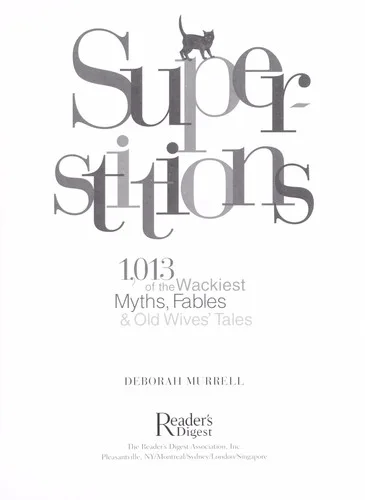
Deborah Jane Murrell's "Superstitions" (2011) examines why humans cling to irrational beliefs.
Deborah Jane Murrell's "Superstitions" offers a detailed look at popular beliefs and practices found across human history and cultures. The book does more than just list these customs; it investigates the psychological, social, and historical drivers behind their creation and persistence. Murrell highlights the human desire for order and meaning, especially when faced with uncertainty.
This work is suited for anyone interested in the psychology of belief, cultural anthropology, and the history of human thought. It will appeal to students of folklore, sociology, and comparative religion, as well as general readers curious about illogical customs in daily life. Those who study how societal norms originate and how communities maintain shared understandings will find it especially useful.
Murrell's study connects to a long history of scholarship on folklore and popular belief, a lineage that includes Sir James Frazer and his work on mythology and ritual. While Frazer's focus was broad, Murrell's "Superstitions" places these beliefs within specific psychological and social contexts. The book was published in an era of rapid digital communication, and it stands as an examination of long-standing traditions against the backdrop of fleeting online trends.
💡 Why Read This Book?
• You will learn how ancient concepts like sympathetic magic, first detailed by scholars like Sir James Frazer, continue to manifest in modern practices, offering insights into enduring human psychology. • Gain a concrete understanding of the social functions of superstitions, such as how rituals around luck serve to reduce anxiety and foster community cohesion, a key takeaway from Murrell's analysis. • Discover the historical roots of specific superstitions, exploring their origins and evolution through Murrell's examination of beliefs dating back centuries, providing context unavailable in general discussions.
⭐ Reader Reviews
Honest opinions from readers who have explored this book.
❓ Frequently Asked Questions
When was Deborah Jane Murrell's "Superstitions" first published?
Deborah Jane Murrell's "Superstitions" was first published in 2008. This publication year places it within a period of significant cultural and technological shifts impacting how beliefs are disseminated.
What academic disciplines does "Superstitions" by Murrell draw upon?
Murrell's "Superstitions" draws heavily on cultural anthropology, folklore studies, and social psychology. It examines beliefs through these lenses to understand their origins and societal roles.
Does the book discuss specific examples of superstitions from different cultures?
Yes, the book explores a wide range of superstitions from various cultures and historical periods, analyzing common threads and unique manifestations of human belief.
What is sympathetic magic as discussed in "Superstitions"?
Sympathetic magic, as explored in the book, is the belief that like produces like, or that a cause produces an effect that resembles it. This principle underpins many rituals and superstitions.
Is "Superstitions" by Deborah Jane Murrell considered an academic text?
Yes, the book is considered an academic text, offering a scholarly examination of superstitions. It is suitable for students and researchers in related fields, as well as curious general readers.
What historical context is relevant to understanding Murrell's "Superstitions"?
The book's 2008 publication is relevant, situated between earlier anthropological works like Frazer's and the rise of mass digital communication, offering a perspective on enduring beliefs in a changing world.
🔮 Key Themes & Symbolism
Psychology of Belief Formation
The work meticulously dissects the cognitive and emotional mechanisms that lead humans to adopt and maintain superstitious beliefs. It explores how our brains seek patterns and causality, even in random events, a concept central to understanding why superstitions persist. Murrell examines the role of anxiety reduction and the desire for control in solidifying these beliefs, presenting them not as irrationalities but as deeply ingrained psychological responses to uncertainty and the unknown.
Social and Cultural Functions
Beyond individual psychology, Murrell investigates how superstitions serve crucial social and cultural functions. These beliefs often reinforce group identity, establish social norms, and provide a shared framework for understanding the world. The book illustrates how rituals and taboos associated with superstitions can promote social cohesion and provide a sense of order within a community, acting as implicit guidelines for behavior and interaction.
Historical Evolution of Superstitions
Murrell traces the lineage of various superstitions, demonstrating how they have evolved over centuries and across different cultures. The book highlights the enduring nature of certain themes, such as luck, fate, and omens, while also showing how specific beliefs adapt to new contexts. This historical perspective reveals the deep roots of these practices in human history and their adaptability to changing societal landscapes.
Sympathetic Magic and Ritual
A significant focus is placed on sympathetic magic, the principle that 'like affects like.' Murrell analyzes how this ancient concept underpins many superstitious practices, from using effigies to influence individuals to employing charms for protection. The work examines the ritualistic actions people undertake, believing they can directly influence outcomes through magical means, connecting ancient practices to contemporary folk beliefs.
💬 Memorable Quotes
Direct passages from the work, attributed to the author.
“Rituals offer a tangible means to exert influence over abstract forces like luck.”
— This interpretation emphasizes how the book views superstitious rituals as more than mere actions; they are seen as psychological tools that provide individuals with a sense of agency and comfort in situations where direct control is impossible.
“Taboos function as social boundary markers, defining acceptable and unacceptable behavior.”
— This highlights the book's exploration of the sociological impact of superstitions, framing taboos as mechanisms for maintaining social order and group cohesion by establishing clear, albeit often unwritten, rules.
“The belief in omens reflects a deep-seated human desire to anticipate and prepare for the future.”
— This interpretation underscores the book's perspective on the psychological utility of superstitions, suggesting that beliefs in omens stem from a fundamental need for foresight and a reduction of existential uncertainty.
“Shared superstitions can foster a sense of collective identity and shared understanding.”
— This points to the book's analysis of the communal aspect of superstitions, suggesting that adherence to common beliefs and practices can strengthen social bonds and create a unified group consciousness.
💡 Key Ideas
Editorial paraphrase of the work's core concepts — not direct quotes.
The human mind's persistent search for causality often projects order onto randomness.
This paraphrased concept highlights the book's argument that superstitions arise not from inherent irrationality, but from a fundamental cognitive drive to understand and control one's environment, even when faced with unpredictable events.
🌙 Esoteric Significance
Tradition
While not explicitly aligning with a single esoteric lineage, "Superstitions" engages with themes common to Hermeticism and folk magic traditions. It examines the underlying principles of sympathetic magic, a concept central to many Western esoteric practices. The book's focus on hidden connections, causality, and the power of belief to influence reality aligns with the hermetic principle of 'As Above, So Below,' exploring how macrocosmic principles manifest in micro-level human behaviors and beliefs.
Symbolism
The book implicitly discusses the symbolism of various objects and actions used in superstitious practices. For instance, the symbolism of black cats, the number thirteen, or the act of knocking on wood are explored not just as isolated beliefs but as manifestations of deeper anxieties and desires. These symbols, Murrell suggests, act as focal points for psychological energy, representing concepts like misfortune, protection, or good fortune within a given cultural context.
Modern Relevance
Contemporary practitioners of folk magic, modern witchcraft, and even those interested in positive psychology and manifestation techniques can find value in Murrell's work. Her analysis of the power of belief and ritual offers a secularized understanding of concepts that esoteric traditions have long explored. Thinkers interested in the sociology of belief and the psychology of self-fulfilling prophecies, particularly within online communities or subcultures, can draw upon her foundational insights.
👥 Who Should Read This Book
• Students of folklore and cultural anthropology seeking a systematic analysis of belief systems and their societal roles. • Psychologists and sociology researchers interested in the cognitive and social underpinnings of irrational beliefs and ritualistic behavior. • General readers fascinated by the persistence of superstitions, looking for a scholarly yet accessible explanation of why these beliefs endure across time and cultures.
📜 Historical Context
Published in 2008, Deborah Jane Murrell's "Superstitions" entered a cultural landscape increasingly shaped by digital media, yet it grounded its analysis in enduring human tendencies. The work stands in dialogue with earlier, monumental studies like Sir James Frazer's "The Golden Bough" (first published 1890), which sought to catalogue and explain global myths and rituals. Unlike Frazer's more anthropological focus on primitive belief systems, Murrell's approach integrates psychological and sociological perspectives, examining how superstitions function within contemporary society. The book's emergence predates the full societal impact of widespread social media, offering a valuable perspective on deeply ingrained beliefs that persist despite rapid technological change. It engaged with a scholarly tradition that had long debated the rationality of belief, placing it alongside works that explored the psychology of irrationality and cognitive biases.
📔 Journal Prompts
Analyze the function of a personal superstition, considering its potential roots in sympathetic magic.
Reflect on how the concept of 'luck' is portrayed and utilized in the book's examples.
Consider a specific taboo mentioned in the text and its role in social order.
Examine the psychological drive for causality as discussed in Murrell's work.
Explore the symbolism of a common omen described in 'Superstitions'.
🗂️ Glossary
Sympathetic Magic
A form of magic based on the principle that like produces like. It involves using an object or action to influence something else, believing there's a direct connection or resemblance between them.
Omen
An event believed to be a sign or warning of future good or bad fortune, often interpreted as supernatural or divinely inspired.
Taboo
A social or religious custom prohibiting or restricting a particular practice or forbidding association with a particular person, place, or thing.
Causality
The relationship between cause and effect; the principle that every event has a cause.
Ritual
A sequence of activities involving gestures, words, actions, or objects, performed according to a set sequence, often for symbolic or religious purposes.
Folk Belief
Beliefs, customs, and traditions that are part of the shared heritage of a particular culture or community, often passed down orally.
Agency
The capacity of an individual to act independently and to make their own free choices; often contrasted with fate or external control.
🔮 Readers Also Liked
Browse all →









More Free Occult Philosophy Books
View all →