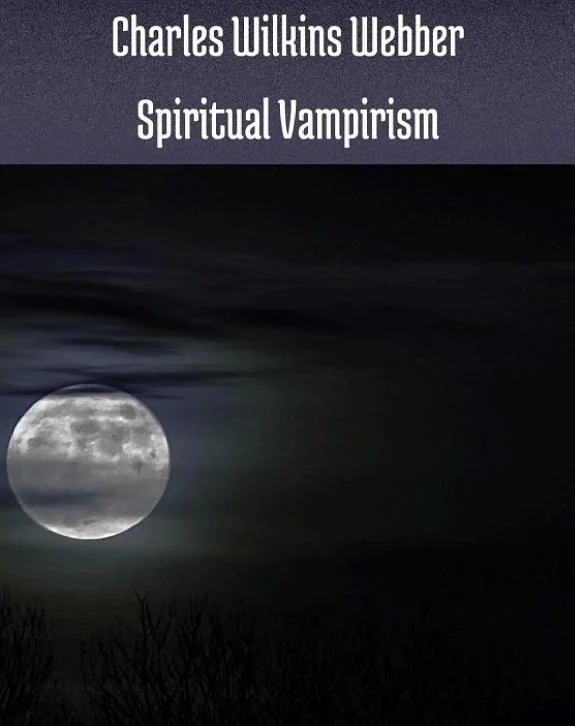
Spiritual vampirism
 82
82

Spiritual vampirism
Charles Wilkins Webber's "Spiritual Vampirism" is less a "discovery" and more a raw, almost feverish articulation of psychic predation. The blurb's "Eureka! Eureka!" cry, far from triumphant enlightenment, signals a descent into a disturbing "cannibalism of the soul." Webber presents a vision of spiritual energy exchange that is starkly predatory, where one entity's vitality is directly siphoned for another's "life." The strength of this work lies in its unflinching portrayal of this dark dynamic; it refuses to sanitize the concept of psychic consumption. However, its limitation is the lack of a developed theoretical framework beyond the initial shock value. The passage describing Etherial's "unutterable ferocity" and her gleeful anticipation of making "slaves" is particularly potent, illustrating the psychological allure and horror of such power. While disturbing, the text compels a confrontation with the shadow aspects of energetic interaction. It is a challenging, albeit uneven, glimpse into esoteric psychology.
📝 Description
82
Charles Wilkins Webber's 1859 novella 'Spiritual Vampirism' depicts psychic predation as soul cannibalism.
Charles Wilkins Webber's 'Spiritual Vampirism,' published posthumously, presents a stark vision of psychic predation. The narrative centers on Etherial, a figure who sustains herself by consuming the spiritual essence of others. This act is described as a form of 'cannibalism of the soul,' where one's vitality is siphoned, leaving the victim diminished and the predator empowered. The work delves into the mechanics of spiritual energy exchange, portraying a grim reality where psychic vitality can be stolen, leading to a state of mental and spiritual depletion for the victim. Webber eschews gentle metaphor, opting instead for direct and intense imagery to illustrate these power dynamics within a mystical framework. The text is characterized by its unflinching prose and its focus on the darker aspects of spiritual interaction.
This novella is suited for readers interested in the more unconventional and shadow-oriented dimensions of esoteric thought. It will appeal to those who seek direct engagement with themes of psychic energy and influence, and who are not averse to intense subject matter. Students of occult history, particularly those examining the evolution of concepts around consciousness and energetic exchange, will find material for study. The book's raw depiction of power and spiritual sustenance offers a challenging but potentially rewarding examination of esoteric themes.
Published posthumously, 'Spiritual Vampirism' originates from the late 19th century, a period marked by widespread fascination with spiritualism, the occult, and the hidden potentials of human consciousness. Webber was active during a time when movements like Theosophy were emerging, fostering interest in non-material realities. This era saw extensive exploration of how human awareness could interact with these unseen forces, often resulting in unsettling philosophical and fictional portrayals. The novella reflects a broader Victorian engagement with the uncanny and the darker aspects of human nature, viewed through the lens of esoteric philosophy.
💡 Why Read This Book?
• Gain a stark understanding of psychic predation, as explored through the concept of "cannibalism of the soul" described by Etherial, offering a unique perspective on energetic exchange beyond common notions of spiritual growth. • Examine the darker currents of occult thought through Webber's raw, direct prose, which eschews abstract theorizing for visceral imagery, providing insight into the late 19th-century fascination with the shadow psyche. • Understand the historical context of esoteric literature by encountering a work that reflects the period's engagement with spiritualism and the potential for psychic manipulation, distinct from more widely known Theosophical writings.
⭐ Reader Reviews
Honest opinions from readers who have explored this book.
❓ Frequently Asked Questions
What is the core concept of 'spiritual vampirism' in Webber's work?
Spiritual vampirism, as presented by Webber, is the act of psychically consuming another's vital spiritual energy or "soul" to sustain or strengthen oneself, akin to a "cannibalism of the soul."
When was Charles Wilkins Webber's 'Spiritual Vampirism' originally published?
While this edition is from 2022, the original publication date of Charles Wilkins Webber's work is not definitively established within this context, but the writing style suggests a late 19th-century origin.
Who is Etherial in the context of 'Spiritual Vampirism'?
Etherial is the central figure in Webber's narrative, depicted as the spiritual vampire who actively "feeds" on the strength of others, embodying the predatory force described in the text.
What historical period influenced the ideas in 'Spiritual Vampirism'?
The book is influenced by the late 19th-century milieu, a period rich with interest in spiritualism, the occult, and the exploration of hidden psychological and energetic forces.
Does 'Spiritual Vampirism' offer practical techniques for psychic defense?
The work focuses primarily on describing the phenomenon of spiritual vampirism rather than offering explicit techniques for defense. Its value lies in understanding the dynamics of psychic predation.
Is 'Spiritual Vampirism' a metaphorical or literal concept in the book?
Webber presents spiritual vampirism as a literal energetic transaction, a "cannibalism of the soul," rather than a purely metaphorical concept, emphasizing its tangible impact on spiritual vitality.
🔮 Key Themes & Symbolism
Psychic Predation
The central theme is the active siphoning of spiritual energy from one individual to another. Webber frames this as a form of "cannibalism of the soul," where the predator gains vitality at the expense of the victim's spiritual "life." This concept moves beyond mere psychological manipulation into a direct, albeit occult, energetic transfer, highlighting a predatory dynamic within esoteric interactions.
Spiritual Sustenance
The text explores the idea that spiritual energy can be consumed to achieve a form of "life" or power. The spiritual vampire "feeds on his strength-might grow strong on this cannibalism of the soul." This suggests a grim economy of spiritual forces, where existence is maintained through the exploitation of others, challenging conventional notions of spiritual development.
Power and Control
The narrative is driven by a desire for absolute power and control, encapsulated in the cry, "They shall all be my slaves!" This reflects an occult ambition to dominate and subjugate, fueled by a sense of grievance (being "born without a soul, with being underwitted"). It presents a dark manifestation of will, seeking to overcome perceived limitations through forceful psychic absorption.
The Shadow Self
Webber's work delves into the shadow aspects of the psyche, portraying a figure driven by "unutterable ferocity" and "joy." This represents an unrestrained id, embracing destructive impulses as a means of self-affirmation. The "spiritual vampire" embodies the primal urge to consume and dominate, unburdened by conventional morality or empathy.
💬 Memorable Quotes
“the spiritual vampire might feed on his strength-might grow strong on this cannibalism of the soul!”
— This is the core declaration of the book's central concept: the direct consumption of another's spiritual essence for personal gain, framed as a brutal, yet exhilarating, act of sustenance.
“and what of him if she dragged him down into idiocy? Served him right!”
— This reveals the utter lack of empathy and the perverse sense of justice held by the spiritual predator, viewing the victim's degradation not as a tragedy, but as a deserved consequence.
“Did Etherial care that his spiritual death must be her life?”
— This question starkly highlights the zero-sum nature of spiritual vampirism, where one entity's flourishing is inextricably linked to another's demise, emphasizing the parasitic relationship.
“She laughed and screamed with the joy of unutterable ferocity!”
— This vivid description captures the ecstatic, almost primal delight the spiritual vampire experiences in her predatory act, showcasing the dark allure and potent emotional charge of psychic consumption.
“I shall devour souls hereafter by the hundreds! I shall grow fat”
— This expresses the insatiable hunger and ambition of the spiritual vampire, envisioning a future of immense power and self-aggrandizement achieved through the continuous accumulation of stolen spiritual energy.
🌙 Esoteric Significance
Tradition
While not strictly aligned with a single esoteric lineage, "Spiritual Vampirism" taps into currents found in Gnosticism (the parasitic Archons feeding on human energy) and certain interpretations of Western occultism concerning energetic manipulation. It departs from the more constructive or evolutionary paths often emphasized in Hermeticism or Theosophy by focusing intensely on the destructive, predatory aspect of psychic interaction, presenting it as a primary mode of spiritual "sustenance."
Symbolism
The central symbol is the "spiritual vampire" itself, representing the parasitic entity that consumes vital force. The "cannibalism of the soul" is a potent, visceral metaphor for this energetic transfer, highlighting its destructive and consuming nature. Etherial's "joy of unutterable ferocity" symbolizes the unrestrained, primal drive behind such acts, a manifestation of the shadow self unbound by ethical considerations.
Modern Relevance
Contemporary discussions of psychic self-defense, energy vampires in popular psychology, and explorations of shadow work in modern occultism echo themes present in Webber's work. Thinkers and practitioners interested in the energetic dynamics of relationships, the potential for psychic manipulation, and the darker aspects of consciousness continue to find "Spiritual Vampirism" a disturbing, yet relevant, text for understanding these phenomena.
👥 Who Should Read This Book
• Advanced students of occultism seeking to explore the darker, more predatory aspects of energetic exchange and psychic interaction, moving beyond conventional spiritual development models. • Researchers of late 19th-century esoteric literature interested in works that deviate from mainstream Theosophy or spiritualism, offering a more visceral and less didactic perspective on occult concepts. • Individuals drawn to psychological thrillers with a metaphysical bent, who appreciate direct, confrontational prose that examines the shadow aspects of power and consumption.
📜 Historical Context
Charles Wilkins Webber's "Spiritual Vampirism," published posthumously, emerges from the fertile, often shadowy, ground of late 19th-century esoteric thought. This era teemed with spiritualist movements, the rise of Theosophy under Helena Blavatsky, and a general public fascination with the unseen forces of the universe and the human psyche. Webber's work, with its stark portrayal of psychic predation, stands apart from the more philosophical or evolutionary doctrines espoused by mainstream Theosophy. It aligns more with a darker, more primal exploration of occult energies, perhaps echoing earlier occult romances or gothic literature but framed within a pseudo-scientific occult lens. While specific contemporary reviews or direct engagement with named scholars are scarce for this particular work, its themes resonate with the broader Victorian and Edwardian interest in the uncanny, the subconscious, and the potential for psychic influence, a period that also saw figures like Arthur Conan Doyle exploring spiritualism.
📔 Journal Prompts
The "cannibalism of the soul" as a concept for spiritual sustenance.
Etherial's "joy of unutterable ferocity" in psychic predation.
The victim's "spiritual death" as the predator's "life."
Reflecting on the power dynamic described in "They shall all be my slaves!"
The portrayal of being "dragged down into idiocy" by a spiritual aggressor.
🗂️ Glossary
Spiritual Vampirism
The act or phenomenon of one entity psychically consuming the vital spiritual energy or "soul" of another for its own sustenance or growth.
Cannibalism of the soul
A visceral metaphor used by Webber to describe spiritual vampirism, emphasizing the destructive and consuming nature of the psychic energy transfer.
Etherial
The primary character in Webber's work, embodying the spiritual vampire who actively preys on the spiritual essence of others.
Spiritual death
The state of depletion or annihilation of one's vital spiritual energy or consciousness, resulting from psychic predation.
Spiritual strength
The vital life force or psychic energy that a spiritual vampire seeks to consume and absorb for its own power and existence.
Idiocy
In this context, refers to a state of profound mental and spiritual degradation resulting from the depletion of one's vital energies by a spiritual predator.
Unutterable ferocity
Describes the extreme, almost primal, intensity of the spiritual vampire's predatory drive and the savage joy derived from it.