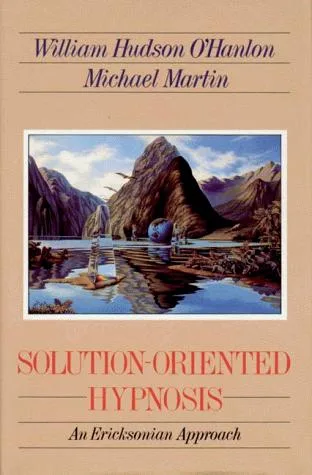
Solution-oriented hypnosis
 77
77

Solution-oriented hypnosis
William Hudson O'Hanlon’s "Solution-oriented hypnosis" offers a streamlined, practical approach to a field often perceived as arcane. The strength of this 1992 text lies in its directness; it eschews lengthy theoretical detours for immediate application. O'Hanlon’s emphasis on identifying and working towards concrete solutions, rather than dissecting past traumas, provides a refreshing perspective for both practitioners and clients. A limitation, however, is the book's brevity, which might leave some readers desiring deeper exploration of the underlying psychological mechanisms. The concept of "utilizing the client's own resources" is particularly well-articulated, empowering individuals by framing their existing capabilities as the primary engine for change. Ultimately, it serves as a concise guide for achieving tangible results through focused hypnotic suggestion.
📝 Description
77
### What It Is "Solution-oriented hypnosis" presents a practical framework for utilizing hypnotic techniques to address specific problems and achieve desired outcomes. Rather than focusing on abstract concepts or prolonged therapeutic processes, this approach centers on identifying the core issue and devising a direct, efficient path toward resolution.
### Who It's For This work is designed for practitioners seeking to integrate hypnosis into their existing therapeutic or coaching modalities, as well as for individuals interested in self-application for personal development. It appeals to those who prefer direct action and measurable results over lengthy theoretical explorations.
### Historical Context Published in 1992, William Hudson O'Hanlon's "Solution-oriented hypnosis" emerged during a period when brief therapy models were gaining significant traction. This era saw a shift from psychodynamic approaches towards more task-oriented and outcome-focused interventions. O'Hanlon's work contributed to this movement by offering a structured hypnotic method.
### Key Concepts The book introduces principles such as focusing on solutions rather than problems, utilizing the client's own resources, and employing specific, actionable language. It emphasizes that the hypnotic state is a tool to facilitate change, not an end in itself. The efficacy of the method relies on clear goal setting and strategic intervention.
💡 Why Read This Book?
• Learn to reframe problems into actionable solutions, a skill honed by O'Hanlon's direct approach that emphasizes outcome-driven hypnotic suggestion. • Discover how to leverage a client's inherent strengths and resources, a core tenet introduced in the book, fostering self-efficacy. • Gain practical techniques for goal-oriented hypnosis, moving beyond theoretical discussions to implement strategies first outlined in the 1992 publication.
⭐ Reader Reviews
Honest opinions from readers who have explored this book.
❓ Frequently Asked Questions
What makes 'Solution-oriented hypnosis' different from traditional hypnotic methods?
Unlike traditional approaches that might focus extensively on the origins of a problem, O'Hanlon's method, published in 1992, prioritizes identifying desired outcomes and utilizing the client's resources for direct resolution.
Is 'Solution-oriented hypnosis' suitable for beginners?
Yes, the book's direct and practical language makes its solution-focused framework accessible to those new to hypnosis, offering a clear path to application.
Can this book be used for self-improvement?
Absolutely. The principles of identifying goals and leveraging personal resources are directly applicable for self-guided hypnotic work and personal development.
What kind of problems can be addressed with this technique?
The solution-oriented framework is versatile and can be applied to a wide range of issues, from behavioral changes and stress management to achieving specific personal or professional goals.
Who is William Hudson O'Hanlon?
William Hudson O'Hanlon was an author and practitioner who focused on brief, solution-oriented therapeutic approaches, including hypnosis, with his notable work first appearing in 1992.
Does the book discuss the history of hypnosis?
While not its primary focus, the work situates itself within the broader context of brief therapy, a movement gaining momentum around the early 1990s.
🔮 Key Themes & Symbolism
Problem Reframing
The core of O'Hanlon's approach involves shifting the client's focus from the problem itself to the desired solution. This is not merely semantic; it's a strategic redirection of mental energy. By concentrating on what the client *wants* to achieve, rather than dwelling on what they *don't* want, the hypnotic process becomes inherently constructive. The book, first published in 1992, advocates for this shift as a primary mechanism for unlocking potential and facilitating change, moving away from exhaustive problem analysis towards immediate, actionable steps.
Resource Utilization
A fundamental principle is the belief that individuals possess the necessary internal resources to effect change. Solution-oriented hypnosis aims to identify and activate these latent capabilities. Rather than imposing external solutions, the practitioner guides the client to access their own strengths, experiences, and inner wisdom. This empowers the individual, fostering a sense of agency and self-reliance. The work stresses that the hypnotic state can be an effective tool for accessing these often-overlooked personal assets.
Goal-Directed Hypnosis
This book champions a pragmatic application of hypnosis. The therapeutic encounter is structured around clearly defined goals. Each hypnotic suggestion or intervention is designed to move the client closer to their stated objective. This goal-directedness ensures efficiency and provides a measurable benchmark for progress. Unlike more exploratory forms of hypnosis, this method prioritizes tangible results, making it particularly appealing for those seeking practical outcomes and measurable improvements in specific areas of their lives.
The Power of Language
O'Hanlon emphasizes the subtle yet potent influence of language in hypnosis. The choice of words, sentence structure, and framing are crucial for guiding the client's perception and facilitating desired shifts. Solution-oriented hypnosis utilizes precise, affirmative language that directs attention towards solutions and possibilities. This deliberate use of linguistic tools within the hypnotic state is presented as a key factor in the efficacy of the technique, encouraging a constructive and forward-looking mindset.
💬 Memorable Quotes
“Focus on the solution, not the problem.”
— This concise statement encapsulates the book's central thesis. It suggests that by directing mental energy and attention towards desired outcomes, individuals can more effectively overcome obstacles and achieve their goals.
“The client already has the resources they need.”
— This highlights the empowering philosophy behind solution-oriented hypnosis. It implies that therapeutic or self-improvement efforts should focus on uncovering and activating existing inner strengths rather than introducing external fixes.
“Hypnosis is a tool for change, not an end in itself.”
— This interpretation underscores the pragmatic nature of the approach. The hypnotic state is viewed instrumentally, as a means to facilitate practical adjustments and achieve specific, pre-defined objectives.
“Define the desired outcome clearly.”
— This emphasizes the importance of specific goal setting in the solution-oriented model. Clarity on the end-state is presented as a prerequisite for effective hypnotic intervention and progress tracking.
“What would be the first small step towards that solution?”
— This prompt illustrates the book's focus on actionable steps. It encourages breaking down the path to a solution into manageable components, making the overall goal seem more attainable.
🌙 Esoteric Significance
Tradition
While not overtly mystical, "Solution-oriented hypnosis" taps into the broader Hermetic principle of "As Above, So Below" by suggesting that internal mental states (the 'above') directly influence external reality and behavior (the 'below'). It aligns with practical Hermeticism's focus on mastering one's inner world to influence the outer. The emphasis on will, focused intention, and directed change echoes the active, agentic aspects found in many Western esoteric traditions, particularly those concerned with personal transformation and the directed use of consciousness.
Symbolism
The book doesn't rely on overt symbolic imagery but rather on the symbolic power of language and intention. The 'solution' itself can be seen as a symbolic representation of desired wholeness or equilibrium, a return to a state of balance. The 'client's resources' symbolize the inherent divine spark or inner magician, a concept present in various esoteric paths, suggesting that the power for transformation resides within. The act of 'focusing' can be interpreted as a form of meditative or magical concentration, a key element in many esoteric practices.
Modern Relevance
Contemporary coaching methodologies, particularly in areas like performance enhancement and positive psychology, frequently employ principles akin to solution-oriented hypnosis. Modern mindfulness-based stress reduction (MBSR) and acceptance and commitment therapy (ACT) also share the focus on present-moment awareness and acceptance of internal states, albeit with different techniques. The book’s pragmatic, outcome-focused approach continues to influence therapists and coaches seeking efficient, client-empowering interventions in a fast-paced world.
👥 Who Should Read This Book
• Therapists and counselors seeking to integrate brief, solution-focused techniques into their practice, particularly those interested in Ericksonian approaches. • Coaches aiming to enhance their ability to guide clients toward specific goals using focused hypnotic suggestion and resource activation. • Individuals interested in self-improvement who prefer direct, actionable methods over lengthy theoretical explorations of personal issues.
📜 Historical Context
William Hudson O'Hanlon's "Solution-oriented hypnosis," first published in 1992, arrived at a pivotal moment in psychotherapy. The late 20th century saw a marked shift away from lengthy, insight-oriented therapies toward briefer, more pragmatic models. This period was heavily influenced by figures like Milton H. Erickson, whose indirect hypnotic techniques and focus on client-centered solutions gained considerable attention. O'Hanlon’s work aligns with this trend, offering a structured, solution-focused application of hypnosis that stood in contrast to more traditional, problem-centric psychodynamic or even some earlier Ericksonian interpretations. The rise of cognitive-behavioral therapy (CBT) also contributed to an environment receptive to outcome-driven approaches. While not directly a part of the burgeoning NLP (Neuro-Linguistic Programming) movement, O'Hanlon’s emphasis on linguistic precision and reframing shares conceptual similarities with NLP principles developed by Richard Bandler and John Grinder. Reception was generally positive among practitioners seeking efficient methods, though some traditionalists might have viewed its brevity as superficial.
📔 Journal Prompts
The concept of 'resource utilization' in achieving solutions.
Identifying a desired outcome and the first small step towards it.
The difference between focusing on a problem versus a solution.
How precise language influences your perception of a challenge.
Applying the solution-oriented mindset to a current obstacle.
🗂️ Glossary
Solution-oriented
An approach that emphasizes identifying and achieving desired outcomes rather than solely analyzing the nature or origins of problems.
Resource Utilization
The principle of identifying and activating an individual's inherent strengths, skills, and inner capabilities to facilitate change.
Goal Setting
The process of defining specific, measurable, achievable, relevant, and time-bound objectives to guide therapeutic or personal development efforts.
Hypnotic Suggestion
Statements or ideas presented to a person in a hypnotic state, intended to influence their perceptions, feelings, thoughts, or behaviors.
Reframing
The technique of changing the way a situation or problem is perceived by altering the context or meaning attributed to it.
Outcome-Focused
An approach that prioritizes the end result or desired state, using it as the primary driver for interventions and strategies.
Pragmatic Approach
A method characterized by practicality and effectiveness, focusing on what works in real-world application rather than on theoretical purity.