Practical Mind Reading
 72
72

Practical Mind Reading
Atkinson's "Practical Mind Reading" offers a surprisingly structured approach to a subject often mired in vagueness. The strength of the work lies in its methodical breakdown of telepathy into trainable components like concentration and visualization, stripping away some of the more mystical connotations. However, the book's reliance on the speculative "etheric medium" as a transmission channel feels dated, lacking concrete empirical support even by contemporary standards. A particularly interesting section discusses the "Law of Mental Sympathy," which attempts to explain how individuals might unconsciously attune to each other's thoughts. While the practical exercises are clear, their efficacy remains subjective and unverified. The work is a valuable historical artifact, but its theoretical underpinnings require critical engagement.
📝 Description
72
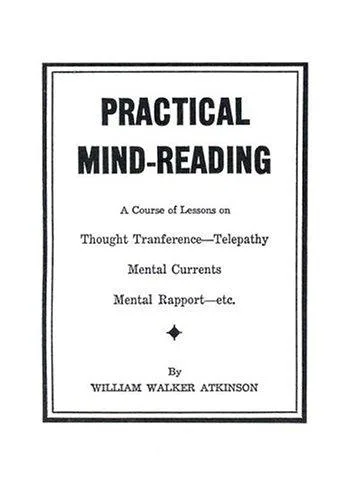
### What It Is William Walker Atkinson's "Practical Mind Reading" functions as a foundational text for understanding the principles and methods of telepathy and mental influence. Published in an era fascinated by psychic phenomena, this work demystifies concepts often shrouded in speculative language. Atkinson breaks down the supposed 'how' of mind reading, presenting it not as an innate, mystical talent, but as a skill that can be cultivated through specific mental disciplines and practices. The book aims to equip the reader with practical exercises designed to enhance their intuitive and perceptive abilities.
### Who It's For This book is intended for individuals interested in the mechanics of extrasensory perception, particularly telepathy. It appeals to those who approach esoteric subjects with a desire for systematic understanding and actionable techniques, rather than purely philosophical contemplation. Readers seeking to explore the boundaries of human consciousness, improve their interpersonal perception, or engage with the history of parapsychological investigation will find value here. It is suitable for both novice explorers of the mind sciences and those with prior exposure to similar literature.
### Historical Context "Practical Mind Reading" emerged from the vibrant intellectual climate of the late 19th and early 20th centuries, a period marked by widespread public and academic interest in spiritualism, psychical research, and the potential of the human mind. Societies like the Society for Psychical Research, founded in 1882, were actively investigating phenomena like telepathy, often employing scientific methodologies. Atkinson, a prolific writer under various pseudonyms, contributed significantly to this wave of interest, popularizing complex philosophical and psychological ideas for a broad audience. His work often intersected with movements like New Thought, which emphasized the power of the mind to shape reality.
### Key Concepts The core of Atkinson's work revolves around the idea that thought is a form of energy that can be transmitted and received. He introduces concepts such as "mental projection" and "reception," positing that focused intention and a receptive mental state are crucial for successful mind reading. The book details methods for developing "concentration," "visualization," and "empathetic resonance." Atkinson also touches upon the "etheric medium" as a hypothetical channel for these mental transmissions, a concept common in the scientific and spiritualist discourse of his time. The objective is to train the mind to perceive subtle psychic impressions.
💡 Why Read This Book?
• Gain practical exercises for developing mental focus and visualization techniques, directly applicable from Atkinson's instructions on "Concentration." • Understand the historical perspective on telepathy from the early 20th century, contrasting it with modern parapsychology through the book's discussion of the "etheric medium." • Explore the concept of "mental projection" and "reception" as described by Atkinson, to analyze your own intuitive communication abilities.
⭐ Reader Reviews
Honest opinions from readers who have explored this book.
❓ Frequently Asked Questions
What is the primary goal of William Walker Atkinson's "Practical Mind Reading"?
The primary goal is to provide readers with systematic methods and exercises to understand and develop the ability of telepathy, or mind reading, by treating thought as a transmittable energy.
When was "Practical Mind Reading" first published?
While this edition is from 2016, William Walker Atkinson's original works on these subjects were published in the early 20th century, reflecting the era's interest in psychic phenomena.
Does the book require any special equipment to practice its techniques?
No, the book focuses entirely on mental disciplines. The "equipment" required is the reader's own focused mind, concentration, and willingness to practice the described visualization and projection exercises.
Is "Practical Mind Reading" based on scientific principles?
The book draws on principles of psychology and a speculative understanding of energy transmission prevalent in early 20th-century esoteric thought, rather than strictly empirical, modern scientific methodologies.
Who was William Walker Atkinson?
William Walker Atkinson (1862-1932) was a prolific author and occultist who wrote extensively on New Thought, the power of the mind, and metaphysics, often under pseudonyms like Yogi Ramacharaka.
Can this book help improve communication skills?
Indirectly, by enhancing your ability to perceive subtle cues and understand mental states, as explored through concepts like 'empathetic resonance', it may foster a deeper level of interpersonal understanding.
🔮 Key Themes & Symbolism
Thought as Energy
Atkinson posits that thoughts are not mere abstract concepts but possess an energetic quality, capable of being projected and received across distances. This perspective frames mind reading not as magic, but as a natural, albeit subtle, energetic interaction. The book details how to harness this 'mental energy' through focused intention and disciplined practice, suggesting that the mind itself is a transmitter and receiver.
Mental Discipline and Practice
Central to the book's approach is the idea that telepathic abilities are cultivated, not innate. Atkinson outlines specific mental disciplines, including rigorous concentration exercises, visualization techniques, and the cultivation of a receptive mental state. These practices are presented as pathways to attuning one's mind to perceive subtle impressions, moving beyond passive observation to active engagement with psychic phenomena.
The Etheric Medium
Reflecting the scientific discourse of his time, Atkinson references the concept of an 'etheric medium' as the hypothetical substance or field through which mental energies are transmitted. While not a scientifically validated concept today, it served as a framework for understanding how thoughts might travel. This concept situates the book within the historical context of early 20th-century parapsychological theories.
Law of Mental Sympathy
This theme explores the principle that minds attuned to each other through shared interests, emotions, or relationships are more likely to achieve telepathic connection. Atkinson suggests that a degree of unconscious rapport or 'sympathy' facilitates the transmission and reception of thoughts, making certain individuals naturally more receptive to each other's mental states.
💬 Memorable Quotes
“The ability to read the minds of others is not an occult mystery, but a natural faculty of the mind.”
— This statement frames mind reading as an inherent human capacity rather than a supernatural gift, suggesting it can be understood and developed through natural means and practice.
“Concentration is the key that unlocks the door of the mind.”
— This emphasizes the foundational importance of focused attention in accessing deeper mental states and potentially developing extrasensory perception, positioning it as the primary tool for mental exploration.
“The mind projects thoughts as the sun projects light.”
— This analogy illustrates Atkinson's view of thought as an active, radiating energy, suggesting that mental projection is a natural, outward-flowing process comparable to physical phenomena.
“Develop your receptive faculties as much as your projecting ones.”
— This highlights the dual nature of telepathy, emphasizing that just as important as sending thoughts is the ability to quietly and clearly receive them.
“Thought travels along the lines of least resistance.”
— This suggests that mental transmissions are influenced by existing connections or affinities, implying that understanding these 'lines' can enhance the success of mind reading.
🌙 Esoteric Significance
Tradition
Atkinson's work fits broadly within the Western Esoteric Tradition, particularly drawing from Hermeticism and the New Thought movement. While not strictly Kabbalistic or Gnostic, it shares with these traditions an emphasis on inner exploration and the power of consciousness to influence the material world. His focus on mind as a force aligns with Hermetic principles like "Mentalism" (The All is Mind). Unlike more ritualistic traditions, Atkinson's approach is highly psychological and practical, aiming to demystify psychic abilities through systematic mental training.
Symbolism
While "Practical Mind Reading" is less symbolic than some esoteric texts, the concept of 'light' is often used metaphorically to represent thought and consciousness, as in "the sun projects light." The 'door of the mind' serves as a potent symbol for hidden potentials that can be unlocked through discipline. The idea of 'lines of resistance' can symbolize the pathways or connections through which mental energy flows, implying an underlying structure to psychic interaction.
Modern Relevance
Atkinson's work continues to inform contemporary discussions on consciousness, intuition, and mental influence. Modern practitioners of mindfulness, neuro-linguistic programming (NLP), and even certain fields of positive psychology echo his emphasis on focused intention and visualization. His systematic approach to developing mental faculties resonates with self-help and personal development spheres, demonstrating a lasting interest in understanding and enhancing cognitive and potentially extrasensory abilities.
👥 Who Should Read This Book
• Aspiring students of early 20th-century metaphysics and psychology seeking to understand the historical roots of mind-power literature. • Individuals interested in practical techniques for enhancing mental focus, concentration, and visualization, as detailed in Atkinson's exercises. • Researchers and enthusiasts of parapsychology and the history of esoteric thought who wish to examine foundational texts on telepathy.
📜 Historical Context
William Walker Atkinson's "Practical Mind Reading" emerged in the fertile intellectual soil of the late 19th and early 20th centuries, a period characterized by intense public fascination with psychical phenomena and the untapped potential of the human mind. This era saw the rise of movements like Spiritualism and Theosophy, alongside formal investigations by organizations such as the Society for Psychical Research (founded 1882). Atkinson, a prolific writer who also published as Yogi Ramacharaka, contributed significantly to the popularization of metaphysical and psychological concepts, often aligning with the principles of New Thought. His work sought to present these ideas in a systematic, accessible manner, differentiating itself from purely mystical or religious interpretations. While competing schools of thought focused on divine inspiration or mediumship, Atkinson's approach emphasized personal development and practical application of mental powers, placing him within a lineage of thinkers exploring the mind's influence on reality.
📔 Journal Prompts
The concept of "thought as energy": How might you perceive subtle energetic exchanges in your daily interactions?
Atkinson's emphasis on "concentration": Describe a specific practice you could implement to strengthen your mental focus.
The "Law of Mental Sympathy": Reflect on individuals with whom you feel a natural mental connection and why.
The idea of the "etheric medium": How does this historical concept influence your understanding of consciousness and communication?
Developing "receptive faculties": What steps can you take to become more open to subtle impressions from your environment?
🗂️ Glossary
Telepathy
The supposed communication of thoughts or ideas by means other than the known senses; mind reading.
Mental Projection
The act of directing one's thoughts or mental energy towards another person or object with the intention of influencing or communicating.
Mental Reception
The ability to perceive or become aware of thoughts or mental energy projected by another individual.
Concentration
The act or power of focusing all one's attention on a particular object or activity; a key mental discipline for developing psychic abilities.
Visualization
The practice of forming mental images or scenes, used as a technique to direct mental energy and enhance psychic perception.
Etheric Medium
A hypothetical, all-pervading substance or field proposed in late 19th and early 20th-century esoteric and scientific thought, believed to transmit subtle energies, including thoughts.
Law of Mental Sympathy
A principle suggesting that minds attuned through shared interests or emotions are more susceptible to telepathic influence or connection.