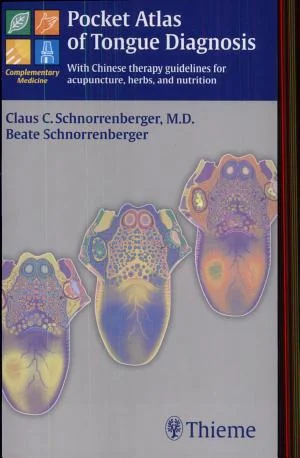
Pocket Atlas of Tongue Diagnosis
 75
75

Pocket Atlas of Tongue Diagnosis
The Pocket Atlas of Tongue Diagnosis presents a clear, if somewhat utilitarian, approach to a visually complex diagnostic art. Schnorrenberger and Schnorrenberger have curated a collection of images that, when paired with their concise explanations, offer a valuable quick reference. The strength lies in its directness; it avoids lengthy theoretical disquisitions, focusing instead on the practicalities of observation. The second half, dedicated to case studies, is particularly effective, demonstrating how individual signs coalesce into a coherent diagnostic picture. However, the atlas’s conciseness can also be its limitation. For those unfamiliar with the foundational principles of TCM organ theory, the leap from visual cue to systemic diagnosis might still feel significant. The section on 'Red Tongue' is a good example of clarity, detailing how different shades and locations of redness correlate with specific patterns, but a deeper dive into the *why* behind these correlations would have enhanced its utility for advanced students. It is a competent tool for identification, less so for deep theoretical integration. Ultimately, it serves well as a focused field guide for the discerning TCM practitioner.
📝 Description
75
### What It Is
The Pocket Atlas of Tongue Diagnosis by Claus C. Schnorrenberger and Beate Schnorrenberger serves as a focused guide to a crucial diagnostic technique within Traditional Chinese Medicine (TCM). Published initially in 2005, this atlas bridges theory and practice by detailing individual tongue characteristics and their diagnostic implications. It systematically maps the visual cues of the tongue—color, shape, coating, and moisture—to internal physiological states, offering a visual lexicon for practitioners and students.
### Who It's For
This work is primarily intended for students and practitioners of Traditional Chinese Medicine who require a concise and visually rich reference for tongue diagnosis. It will also benefit acupuncturists, herbalists, and other holistic health professionals seeking to integrate this diagnostic modality into their practice. Furthermore, individuals with a keen interest in esoteric diagnostic systems and comparative medicine will find value in its detailed approach.
### Historical Context
Tongue diagnosis has been a cornerstone of medical practice in China for millennia, with its principles documented in ancient texts like the *Huangdi Neijing* (Yellow Emperor's Inner Canon). The Schnorrenbergers' atlas, published in 2005, arrives in an era where TCM is increasingly studied and integrated globally, often alongside Western biomedical approaches. Its concise format reflects a modern pedagogical approach to complex traditional knowledge, aiming to make intricate diagnostic patterns accessible to a wider audience.
### Key Concepts
The atlas introduces fundamental TCM concepts such as the relationship between the tongue's appearance and the state of the Zang-Fu organs. It meticulously categorizes observations: the color of the tongue body (pale, red, purple) indicating blood and heat patterns, the tongue's texture (swollen, thin, cracked) reflecting fluid balance and Qi, and the nature of the tongue coating (thin, thick, greasy, dry) pointing to digestive and pathogenic factors. Case studies then synthesize these elements to illustrate real-world diagnostic applications.
💡 Why Read This Book?
• Learn to identify specific tongue signs, such as a 'pale tongue' or a 'cracked tongue,' directly from high-quality color images, enabling precise observation skills that go beyond general descriptions. • Understand how combining distinct tongue characteristics, as demonstrated in the book's case studies, allows for a more nuanced Chinese medical diagnosis than solely relying on individual symptoms. • Gain practical diagnostic skills by referencing the atlas's clear explanations of tongue color, shape, and coating, directly applicable to assessing patient health as presented in the Schnorrenbergers' systematic approach.
⭐ Reader Reviews
Honest opinions from readers who have explored this book.
❓ Frequently Asked Questions
When was the Pocket Atlas of Tongue Diagnosis first published?
The Pocket Atlas of Tongue Diagnosis was first published in 2005, offering a contemporary yet grounded approach to an ancient diagnostic method.
What are the main components of tongue diagnosis discussed in the book?
The book details the observation of individual tongue characteristics such as color, shape, coating, and moisture, and then combines these in real case studies for comprehensive diagnosis.
Is this book suitable for beginners in Traditional Chinese Medicine?
Yes, its concise format and clear, high-quality images make it accessible for beginners, while the case studies offer depth for more advanced practitioners.
What is the historical basis for tongue diagnosis?
Tongue diagnosis is an integral part of Traditional Chinese Medicine (TCM), with a history stretching back thousands of years, forming a key diagnostic element alongside pulse-taking.
Does the book explain the meaning of different tongue colors?
Absolutely. The atlas systematically explains the diagnostic significance of various tongue colors, such as pale, red, and purple, correlating them with internal physiological states.
Are there practical examples or case studies in the atlas?
Yes, the second half of the book is dedicated to real case studies that combine individual tongue characteristics, deepening the reader's understanding through practical application.
🔮 Key Themes & Symbolism
Visual Lexicon of Health
The atlas functions as a visual lexicon, translating the subtle shifts on the surface of the tongue into a language of internal health. Each characteristic—from the vibrant red of heat to the pale hue of deficiency, or the thick, greasy coating indicative of dampness—serves as a direct indicator of the body's energetic and physiological state. This approach grounds esoteric diagnostic principles in observable phenomena, making the complex map of the tongue accessible and actionable for practitioners seeking to understand the root of imbalances.
Integrative Diagnostic Practice
By presenting tongue diagnosis as an integral part of a practitioner's 'examination,' alongside pulse-taking, the book emphasizes a holistic approach to assessment. It moves beyond isolated symptoms to advocate for a synthesis of information, where the tongue's appearance provides crucial context for understanding the overall pattern of disharmony. This integration is key to developing a comprehensive diagnostic strategy within the framework of Traditional Chinese Medicine.
Case-Based Learning
The atlas's structure, moving from individual characteristic analysis to integrated case studies, mirrors effective pedagogical methods. By showcasing how multiple tongue signs manifest simultaneously in real-world scenarios, readers learn to interpret the complex interplay of factors. This practical application is vital for translating theoretical knowledge into clinical competence, allowing practitioners to build confidence in their diagnostic abilities.
The Tongue as a Microcosm
Within esoteric traditions, the body is often viewed as a microcosm reflecting the macrocosm. The tongue, with its map-like divisions corresponding to organ systems, exemplifies this principle within TCM. Observing its color, coating, and texture is akin to reading a detailed chart of the internal landscape, revealing energetic blockages, excesses, or deficiencies that might otherwise remain hidden.
💬 Memorable Quotes
“Observing the tongue forms an integral part of the 'examination' needed for Chinese medical diagnosis.”
— This statement highlights the foundational role of tongue observation in TCM, positioning it as essential as pulse-taking for accurate diagnostic assessment.
“The first half explains individual tongue characteristics and the second half combines these characteristics in real case studies.”
— This structural approach emphasizes a systematic learning process, moving from foundational elements to practical application and synthesis of diagnostic information.
“The clearly written text is augmented by high-quality, full-color images.”
— This points to the atlas's commitment to visual clarity and accessibility, recognizing the importance of detailed imagery in mastering a visually-driven diagnostic technique.
“Together with taking the pulse, observing the tongue forms an integral part of the 'examination'.”
— This reiterates the dual importance of pulse and tongue in TCM diagnostics, suggesting they are complementary pillars of a complete patient assessment.
“This Color Atlas is concise and to the point.”
— This suggests the book prioritizes efficiency and directness, aiming to provide essential information without unnecessary theoretical elaboration, making it a practical reference tool.
🌙 Esoteric Significance
Tradition
While firmly rooted in Traditional Chinese Medicine, a system with ancient philosophical underpinnings, the approach to diagnosis presented in this atlas can be seen through an esoteric lens as a form of physiognomy. The body, particularly the tongue, is treated as a microcosm reflecting the state of the macrocosm (the individual's health and energetic balance). It aligns with Hermetic principles of 'As Above, So Below,' where visible signs are direct correspondences to unseen internal states.
Symbolism
The tongue itself is a potent symbol in TCM, representing the heart's outward manifestation and serving as a gateway to the digestive system. Its color (e.g., red symbolizing heat or inflammation, pale indicating deficiency) and texture (e.g., cracks suggesting dryness or trauma) are symbolic representations of underlying energetic patterns. The coating, varying in thickness and color, symbolizes the presence and nature of pathogenic factors or metabolic disturbances.
Modern Relevance
Contemporary practitioners of integrative medicine and holistic health often draw upon TCM diagnostic techniques, including tongue analysis. Thinkers and practitioners in fields such as functional medicine and naturopathy are increasingly incorporating these ancient methods to gain a more comprehensive understanding of patient health. The Schnorrenbergers' atlas provides a foundational visual resource for these modern approaches, facilitating the integration of traditional diagnostic wisdom into contemporary wellness practices.
👥 Who Should Read This Book
• Students of Traditional Chinese Medicine (TCM) seeking a clear, visual guide to mastering tongue diagnosis, essential for understanding energetic patterns and organ system imbalances. • Acupuncturists and herbalists looking to refine their diagnostic skills with high-quality imagery and concise explanations of tongue signs, directly applicable to patient assessment. • Holistic health practitioners interested in comparative medicine or integrating diverse diagnostic modalities into their practice, offering a systematic method for observing internal states.
📜 Historical Context
The early 21st century saw a surge in the global interest and academic study of Traditional Chinese Medicine (TCM), a field with roots stretching back millennia. Works like the Pocket Atlas of Tongue Diagnosis, first published in 2005, emerged within this context, seeking to codify and present complex traditional diagnostic methods in accessible formats for a Western audience. This era was marked by a growing dialogue between TCM practitioners and Western medical professionals, though often with differing theoretical frameworks. While ancient texts like the *Huangdi Neijing* laid the groundwork, modern atlases like Schnorrenbergers' aimed to bridge the gap between historical knowledge and contemporary clinical practice. Unlike purely theoretical treatises, this atlas focuses on the visual and practical aspects, making it a product of an age increasingly valuing empirical evidence and standardized training, even within esoteric disciplines.
📔 Journal Prompts
The pale tongue and its correlation with Qi and Blood deficiency.
Tongue coating variations and their reflection of digestive function.
Cracked tongue patterns and their association with Yin deficiency.
The significance of tongue color in identifying heat or cold patterns.
Synthesizing multiple tongue signs in case studies for a comprehensive diagnosis.
🗂️ Glossary
Tongue Body
Refers to the underlying muscle tissue of the tongue, observed for its color, shape, and texture (e.g., swollen, thin).
Tongue Coating
The layer of material covering the tongue, assessed for its thickness, color, moisture, and texture (e.g., thin white, thick yellow, greasy).
Pale Tongue
A tongue body that appears lighter than normal, often indicating deficiency of Qi or Blood, or Yang deficiency.
Red Tongue
A tongue body with a distinctly red color, typically signifying heat patterns within the body, which can be excess or deficient.
Purple Tongue
A tongue exhibiting a purplish hue, generally indicating blood stasis or significant heat accumulation.
Cracked Tongue
Tongues with visible fissures or cracks, often associated with Yin deficiency, dryness, or lingering heat.
Greasy Coating
A thick, sticky tongue coating that appears oily, commonly indicative of dampness and phlegm accumulation, often related to digestive issues.













![Serrano Miguel Adolf Hitler The Ultimate Avatar [ 2000]](/img/thumb/serrano-miguel-adolf-hitler-the-ultimate-avatar-2000.webp)