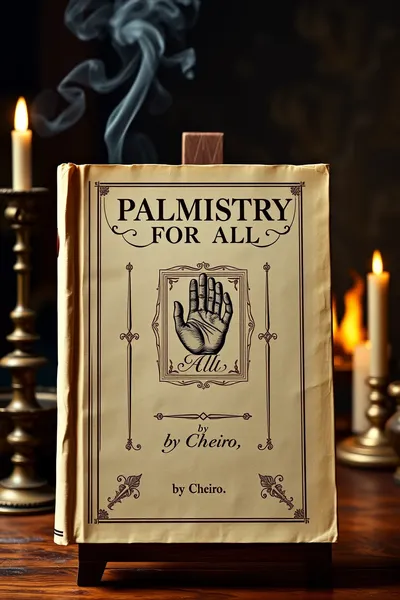
Palmistry for All

 72
72

Palmistry for All
Cheiro’s "Palmistry for All" presents a remarkably structured approach to a subject often mired in vagueness. Its strength lies in its systematic cataloging of hand features, offering clear diagrams and explanations for lines, mounts, and finger configurations. The early sections, particularly those detailing the basic hand shapes and their associated temperaments, are exceptionally well-laid out for the beginner. However, the work occasionally veers into deterministic pronouncements, which feel less like insightful observations and more like rigid pronouncements, particularly when discussing the implications of the Fate Line. A specific passage detailing the "forked" Head Line, explaining its potential for dual thinking or a tendency to spread oneself too thin, exemplifies the book's clarity but also hints at the potential for oversimplification. Ultimately, it functions as a solid, if somewhat dated, primer on classical palmistry.
Verdict: A practical, if occasionally rigid, introduction to the mechanics of palmistry.
📝 Description
72
Published in 1900, Cheiro's 'Palmistry for All' presents hand reading as a logical system.
Cheiro's 1900 text, 'Palmistry for All,' aims to demystify hand reading. It systematically breaks down the interpretation of palm lines, mounts, fingers, and hand shapes. The book argues that palmistry is a logical system for understanding character and potential, derived from physical markings. It covers the fundamental principles for anyone wanting to learn this practice.
This guide is for the aspiring palmist, the curious individual, or anyone looking for a practical way to interpret the hands. It suits those who seek clear instruction in esoteric subjects. Readers interested in self-understanding, character analysis, or the ancient practice of chiromancy will find its organized method useful. Cheiro's approach emphasizes how different hand features connect to form a complete picture.
Published in 1900, 'Palmistry for All' appeared during a period of widespread interest in spiritualism and occult studies in late Victorian and Edwardian England. This era saw many publications on esoteric subjects, with figures like Helena Blavatsky popularizing Eastern philosophies. Cheiro himself was a key figure in making palmistry accessible to a broad audience, building a reputation as a consultant to notable individuals.
💡 Why Read This Book?
• Gain a structured understanding of hand analysis by learning to identify and interpret the seven major mounts (Venus, Jupiter, Saturn, Apollo, Mercury, Mars) and their influence on personality, as detailed in Cheiro's systematic approach. • Decode the meaning of the four primary palm lines—Life, Head, Heart, and Fate—and their variations, enabling you to analyze character and predict potential life patterns as presented in the book's detailed diagrams. • Grasp the foundational principles of hand shape and finger analysis, understanding how the physical structure of the hand, as explained by Cheiro, correlates with innate tendencies and aptitudes.
⭐ Reader Reviews
Honest opinions from readers who have explored this book.
❓ Frequently Asked Questions
When was Cheiro's Palmistry for All first published?
Cheiro's 'Palmistry for All' was first published in 1900, making it a classic text from the golden age of palmistry and esoteric studies in late Victorian England.
What are the main palm lines discussed in Palmistry for All?
The book primarily focuses on the Life Line, Head Line, Heart Line, and Fate Line, explaining their formation and significance in character assessment.
Does Palmistry for All cover hand shapes?
Yes, 'Palmistry for All' categorizes and explains various hand shapes, correlating them with different elemental types and personality traits, such as the practical Earth hand or the intellectual Air hand.
Is Palmistry for All suitable for complete beginners?
Absolutely. The title 'Palmistry for All' reflects its intention to provide a clear, step-by-step introduction to palmistry principles for those with no prior knowledge.
Who was Cheiro?
Cheiro, born William John Warner in Ireland, was a renowned palmist and astrologer active in the late 19th and early 20th centuries, known for his consultations with notable figures.
Where can I find information on the mounts of the hand in this book?
Chapter 3 of 'Palmistry for All' is dedicated to the mounts of the hand, detailing the seven primary mounts—Venus, Jupiter, Saturn, Apollo, Mercury, Mars, and Luna—and their interpretations.
🔮 Key Themes & Symbolism
The Language of Lines
The core of 'Palmistry for All' lies in its detailed exposition of the major palm lines: the Life Line, Head Line, Heart Line, and Fate Line. Cheiro meticulously explains how variations in their depth, length, breaks, and curves offer insights into an individual's vitality, mental processes, emotional nature, and destiny. The book guides readers to observe not just the primary lines but also their subtle markings, such as islands or crosses, which modify their meaning, presenting a complex yet decipherable map of human experience etched onto the palm.
Mounts and Their Influence
Beyond the lines, 'Palmistry for All' emphasizes the significance of the mounts – fleshy pads at the base of fingers and palm. Cheiro details the seven primary mounts: Venus, Jupiter, Saturn, Apollo, Mercury, Mars, and Luna. Each mount is associated with specific planetary influences and human traits, such as passion (Venus), ambition (Jupiter), wisdom (Saturn), and communication (Mercury). The book teaches how the development and prominence of these mounts reflect an individual's innate characteristics and potential strengths or weaknesses.
Hand Shapes and Finger Anatomy
Cheiro's work systematically categorizes hand shapes, linking them to elemental types (Earth, Air, Fire, Water) and broad personality profiles. The practical Earth hand, the intellectual Air hand, the energetic Fire hand, and the sensitive Water hand are described with their associated characteristics. Furthermore, the book delves into the interpretation of finger lengths, shapes (spathetic, conic, square, etc.), and even the nails, presenting a holistic system where every physical aspect of the hand contributes to a comprehensive reading of the individual.
Chiromancy as a Character Science
A central theme in 'Palmistry for All' is the presentation of chiromancy as a scientific method for understanding character and potential, rather than mere fortune-telling. Cheiro frames palmistry as a tool for self-awareness and personal development, helping individuals understand their inherent strengths and challenges. The book advocates for using these insights to navigate life more effectively, suggesting that by understanding one's 'destiny' as written in the hand, one can better shape their future through conscious choices and actions.
💬 Memorable Quotes
“The hand is a living map of the individual.”
— This statement encapsulates the core philosophy of palmistry as presented by Cheiro. It suggests that the physical lines and features of the hand are not arbitrary but serve as a direct, dynamic representation of a person's life, character, and potential.
“The Life Line, when deep and clear, indicates great vitality.”
— This highlights Cheiro's focus on specific interpretations of palm lines. It posits a direct correlation between the physical appearance of the Life Line and an individual's inherent physical energy and longevity.
“A well-developed Mount of Jupiter signifies ambition and leadership qualities.”
— This quote illustrates the concept of planetary mounts in palmistry. Cheiro connects the prominence of the Mount of Jupiter to specific positive character traits like leadership and a drive for success.
“The Head Line reveals the quality and direction of thought.”
— This focuses on the interpretive power of the Head Line. Cheiro suggests that the characteristics of this line provide direct insight into a person's intellectual capacity, their way of thinking, and their mental focus.
“Hand reading is a science, not a mystical guessing game.”
— This paraphrased concept emphasizes Cheiro's approach to presenting palmistry as a logical, systematic discipline. It aims to demystify the practice and present it as a learnable skill based on observable patterns.
🌙 Esoteric Significance
Tradition
Palmistry for All fits within the Western esoteric tradition, specifically drawing from classical Greek and Roman ideas associated with Hermeticism and Pythagorean numerology, which often sought correspondences between the microcosm (man) and the macrocosm (universe). Cheiro's approach systematizes and popularizes ancient chiromantic practices, making them accessible. While not strictly Kabbalistic or Gnostic, it aligns with the Hermetic principle of "As Above, So Below," viewing the hand as a reflection of the individual's inner and outer world, influenced by celestial bodies.
Symbolism
The primary symbols in 'Palmistry for All' are the lines and mounts of the hand, each linked to planetary influences and human faculties. The Heart Line symbolizes emotional life and relationships, often associated with Venus or the Moon. The Head Line represents intellect and thought processes, linked to Mercury. The Life Line, relating to vitality and physical well-being, is connected to Venus or the Moon. The Mount of Jupiter, a prominent symbol, signifies leadership, ambition, and ego, reflecting the planetary Jupiter's domain.
Modern Relevance
Cheiro's work continues to influence contemporary palmistry practitioners and enthusiasts. Modern hand readers often reference his categorizations of hand shapes, lines, and mounts. While some interpretations are debated or updated, the fundamental framework he established for analyzing the palm remains a common starting point. His emphasis on palmistry as a tool for self-understanding and personal growth resonates with current trends in self-help and mindfulness practices, bridging ancient techniques with modern psychological perspectives.
👥 Who Should Read This Book
• Aspiring palmists: Those seeking a structured, foundational text to learn the systematic interpretation of palm lines, mounts, and hand shapes as taught by a renowned 20th-century chiromancer. • Students of esoteric history: Individuals interested in the late 19th and early 20th-century occult revival, particularly in how practices like palmistry were presented and popularized to a wider audience. • Self-awareness seekers: Readers looking for a practical, non-dogmatic method to explore character traits, potential strengths, and life patterns through the analysis of their own hands.
📜 Historical Context
Cheiro's "Palmistry for All," first published in 1900, arrived during a fervent period of occult revival and spiritual exploration in late Victorian and Edwardian Britain. This era saw a proliferation of interest in spiritualism, mesmerism, and Eastern philosophies, largely fueled by movements like Theosophy, founded by Helena Blavatsky. Cheiro (William John Warner) was a central figure in popularizing palmistry, presenting it as a practical science rather than mere superstition. His work gained significant traction among a public eager for self-knowledge and explanations of the unseen. He distinguished himself through his celebrity clientele, including figures like Oscar Wilde and Mark Twain, lending an air of credibility to his practice. "Palmistry for All" competed for attention with emerging psychological theories and other esoteric systems, yet its accessible format and systematic approach ensured its enduring appeal, making it a cornerstone text in the modern study of chiromancy.
📔 Journal Prompts
The Life Line's clarity and the Mount of Venus development: How do these two elements of your palm interact to describe your vitality and capacity for affection?
Compare the interpretation of a prominent Head Line in 'Palmistry for All' with your personal experience of intellectual focus.
Reflect on the description of the Fate Line and its potential for modification based on the book's teachings.
Analyze the balance of your hand's mounts: which planetary influences seem most pronounced, and how does this manifest in your daily life?
Consider the elemental classification of your hand shape as described by Cheiro. How accurately does it reflect your core personality traits?
🗂️ Glossary
Chiromancy
The practice of interpreting the lines, mounts, and other features of the human hand to understand character and predict future events; synonymous with palmistry.
Life Line
The curved line on the palm extending from below the thumb towards the wrist, traditionally interpreted as indicating vitality, physical health, and general life force.
Head Line
The horizontal line across the palm, typically below the Heart Line, which is analyzed to understand a person's mental faculties, intellect, and thought processes.
Heart Line
The uppermost horizontal line on the palm, running across the base of the fingers, interpreted as reflecting emotional nature, romantic inclinations, and heart health.
Fate Line
A vertical line, often starting near the wrist and extending upwards towards a finger, believed to represent career, destiny, and major life events.
Mounts
The fleshy, raised pads on the palm located at the base of each finger and below the thumb, each associated with a specific planet and corresponding human traits (e.g., Mount of Jupiter for ambition).
Hand Shapes
The overall form of the hand (e.g., Square, Spatulate, Conic, Philosophical), categorized to represent broad personality types often associated with the four elements: Earth, Air, Fire, and Water.