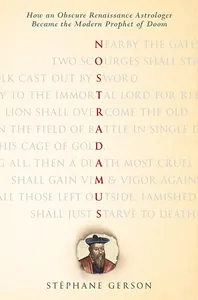
Nostradamus

 82
82

Nostradamus
Stéphane Gerson's "Nostradamus" provides a welcome antidote to the often-sensationalist treatments of the famous seer. The work's strength lies in its commitment to historical context, situating Michel de Nostredame not as a mystical oracle detached from time, but as a product of 16th-century France. Gerson adeptly navigates the complex milieu of Renaissance medicine, astrology, and religious upheaval, offering a grounded perspective on the composition of the *Centuries*. A particular merit is the exploration of the linguistic devices and astrological underpinnings of the quatrains, moving beyond simple prediction. However, the book occasionally leans towards a dense academic style, which might deter readers seeking a more narrative approach to Nostradamus's life. The section discussing the reception of the prophecies in the 20th century, while informative, feels somewhat less integrated than the earlier historical analysis. Gerson's "Nostradamus" offers a valuable, scholarly lens for understanding a figure often obscured by myth.
📝 Description
82
Stéphane Gerson's 2008 book examines Nostradamus's life and prophecies within their 16th-century context.
Stéphane Gerson's "Nostradamus" focuses on the life and prophecies attributed to the 16th-century French seer. The work places Michel de Nostredame within his historical setting, considering the intellectual and religious currents that influenced his outlook. Gerson scrutinizes the composition of his famous *Centuries*, the quatrains that have intrigued and puzzled readers for centuries.
The book is for those who study esotericism, history, and prophecy. It aims for a scholarly yet clear look at Nostradamus's legacy, moving past sensationalism to understand the context and possible meanings of his work. Readers interested in the history of divination, Renaissance thought, and the lasting appeal of prophecy will find considerable material here. Gerson's study is rooted in the turbulent 16th century, a time of the Reformation, early scientific thought, and common belief in astrology and occult practices. Nostradamus was a physician and scholar in a world where divine insight and practical observation were not always distinct.
This book engages with the tradition of prophecy and divination that flourished in Renaissance Europe. It examines how figures like Nostradamus operated within a worldview where astrological observation, medical practice, and a belief in divine or occult knowledge were intertwined. Gerson situates Nostradamus's work not just as prediction, but as a product of specific intellectual currents, including Hermeticism and Renaissance humanism, which sought to understand hidden patterns in the cosmos and human affairs.
💡 Why Read This Book?
• Gain a nuanced understanding of Nostradamus's quatrains by examining the specific historical and intellectual currents of 16th-century France, as detailed in the 'Historical Context' section. • Appreciate the linguistic and astrological frameworks employed by Nostradamus, moving beyond superficial interpretations of his prophecies as presented in the 'Key Concepts'. • Discover how the reception and interpretation of the *Centuries* have evolved over time, particularly focusing on the 20th-century analyses discussed within the book's analytical framework.
⭐ Reader Reviews
Honest opinions from readers who have explored this book.
❓ Frequently Asked Questions
When was Nostradamus's most famous work, the *Centuries*, first published?
The first edition of Nostradamus's *Centuries* was published in 1555, containing the first four centuries of quatrains. Subsequent editions expanded the collection.
What was Nostradamus's profession before becoming known for his prophecies?
Michel de Nostredame was a qualified physician and apothecary, trained in medicine at the University of Montpellier. He practiced medicine for many years before dedicating himself more fully to his prophetic writings.
Did Nostradamus predict specific future events?
The nature of Nostradamus's prophecies is highly debated. While many claim they predict specific events, their cryptic and allegorical language allows for diverse interpretations, often applied retrospectively.
How did the Reformation influence Nostradamus's work?
The religious turmoil of the Reformation likely influenced Nostradamus's cautious approach to prophecy and his use of veiled language, as well as contributing to the anxieties his verses addressed.
What is the primary language used in Nostradamus's prophecies?
Nostradamus's prophecies are written primarily in French, structured as quatrains (four-line stanzas). However, they often incorporate elements of Greek, Latin, and Occitan, alongside anagrams and astrological jargon.
Is Stéphane Gerson's "Nostradamus" a biography or an analysis?
Stéphane Gerson's "Nostradamus" is primarily an analytical work. While it provides historical context for Michel de Nostredame's life, its focus is on examining the composition, language, and interpretation of his prophecies.
🔮 Key Themes & Symbolism
The Art of Quatrain Composition
Gerson's work scrutinizes the structure and linguistic artistry of Nostradamus's quatrains, the core of his prophetic output. The book examines how these four-line verses, often employing anagrams, obscure references, and a blend of languages, were crafted to convey future visions. It moves beyond a simple catalog of predictions to explore the deliberate construction of ambiguity, allowing for multiple interpretations across centuries. This focus highlights the literary and intellectual skill involved in generating verses that would resonate with a specific audience while retaining an enigmatic quality.
Astrology and Determinism
A significant theme is the role of astrology in shaping Nostradamus's worldview and prophecies. Gerson explores how Michel de Nostredame, a practicing physician with knowledge of celestial movements, integrated astrological principles into his predictions. The work investigates the extent to which Nostradamus believed in astrological determinism—the idea that celestial configurations dictate earthly events. This analysis delves into the historical understanding of astrology in the Renaissance, showing how it was often intertwined with medicine and prophecy, providing a framework for understanding cosmic influences on human affairs.
Renaissance Intellectual Climate
The book firmly situates Nostradamus within the complex intellectual landscape of the 16th century. Gerson details the era's blend of burgeoning humanism, lingering medieval beliefs, and the seismic shifts brought by the Reformation. It examines how Nostradamus, as a physician and scholar, engaged with contemporary scientific thought, alchemy, and occult traditions. Understanding this context is crucial for interpreting his prophecies, which reflect the anxieties, hopes, and philosophical currents of a Europe undergoing profound change, far removed from a modern, secular perspective.
Reception and Reinterpretation
Gerson addresses the enduring legacy of Nostradamus's prophecies and how they have been received and reinterpreted throughout history. The work touches upon how different eras, particularly times of crisis or significant political change, have selectively interpreted the quatrains to fit contemporary events. This theme highlights the power of prophecy not just as prediction, but as a cultural phenomenon shaped by the needs and perspectives of successive generations of readers and interpreters.
💬 Memorable Quotes
“The quatrains employ a deliberate ambiguity, blending obscure historical references with astrological data.”
— This highlights Gerson's argument that Nostradamus's verses were not straightforward predictions but carefully constructed literary and symbolic works designed to be interpreted in multiple ways, often influenced by the reader's context.
“Nostradamus operated within a world where the lines between physician, astrologer, and prophet were often blurred.”
— This interpretation underscores the book's emphasis on historical context, showing how Nostradamus's multifaceted roles were typical of Renaissance intellectual pursuits, where science, magic, and spirituality were less compartmentalized.
“The *Centuries* reflect the anxieties of a Europe grappling with religious schism and political instability.”
— This paraphrased concept points to the book's exploration of how the socio-political climate of the 16th century directly influenced the content and reception of Nostradamus's prophecies, framing them as a response to contemporary fears.
“Astrological configurations served as a primary language for expressing perceived future events.”
— This interpretation emphasizes the integral role of astrology in Nostradamus's prophetic system, as analyzed by Gerson, suggesting that celestial alignments were not merely decorative but fundamental to the meaning of the quatrains.
“Interpretations of Nostradamus's prophecies often reveal more about the interpreter's era than about the seer's intent.”
— This concept suggests a critical approach to understanding prophecy, implying that the meaning assigned to Nostradamus's verses is frequently a projection of modern concerns and desires onto ancient, ambiguous texts.
🌙 Esoteric Significance
Tradition
Nostradamus's work is situated within the Western esoteric tradition, drawing heavily on Renaissance astrology and Neoplatonic ideas concerning divine inspiration and cosmic influence. While not strictly Hermetic or Gnostic, his prophecies echo a broader belief in hidden knowledge accessible through specific disciplines. The *Centuries* can be seen as an attempt to map future events through a lens informed by Neoplatonic cosmology and the astrological frameworks prevalent in the 16th century, fitting into a lineage of seers who claimed access to divine or cosmic foresight.
Symbolism
Key symbols in Nostradamus's work include astrological imagery (planets, constellations, eclipses) which he uses as a coded language for timing and influencing events. The concept of the 'Great King' or 'Antichrist' functions as an archetypal figure representing periods of immense upheaval and transformation. Furthermore, cryptic geographical references and allegorical figures (like animals or mythological beings) serve to obscure specific identities and locations, adding layers of symbolic meaning that invite varied interpretations.
Modern Relevance
Contemporary interest in Nostradamus, fueled by Gerson's analytical approach, continues to engage with themes of prophecy and historical interpretation. Modern esoteric practitioners and comparative religion scholars examine his work for insights into divination techniques and archetypal patterns of crisis and renewal. Thinkers in fields like cultural studies and the history of ideas revisit Nostradamus to understand the enduring human fascination with predicting the future and how such prophecies are adapted to contemporary anxieties, demonstrating their persistent cultural resonance.
👥 Who Should Read This Book
• Students of Renaissance history and intellectual currents seeking to understand the context of prophetic literature beyond mere prediction. • Esoteric practitioners interested in the history and methodology of Western divination, particularly astrological forecasting and symbolic interpretation. • Skeptical readers and historical researchers looking for a grounded, critical analysis that separates the historical figure from the myth surrounding his prophecies.
📜 Historical Context
Stéphane Gerson's "Nostradamus" emerges from a deep engagement with the 16th century, a period of profound upheaval in Europe. The work situates Michel de Nostredame (1503-1566) amidst the religious schisms of the Reformation and the burgeoning intellectual currents of Renaissance humanism. This era saw a complex interplay between established Catholic doctrine, emerging Protestant movements, and a persistent interest in esoteric knowledge, including astrology, alchemy, and divination. Physicians like Nostradamus often occupied a unique space, blending empirical medical practice with beliefs in celestial influences and divine inspiration. The publication of his *Centuries* began in 1555, a time when fears of apocalyptic events and political instability were widespread. While Nostradamus was not alone in producing prophetic works, his unique style and the sheer volume of his verses distinguished him. His contemporary, the astrologer and mathematician Luca Gaurico, also produced astrological forecasts, but Nostradamus's quatrains achieved a more enduring, albeit controversial, fame. The reception of his work was immediate, with some viewing him as a prophet and others as a charlatan or heretic, reflecting the era's polarized religious and intellectual climate.
📔 Journal Prompts
The blending of medical knowledge and prophetic verse in Nostradamus's practice.
The role of astrological configurations as a symbolic language for future events.
The enduring appeal of quatrains like those in the *Centuries* across different historical periods.
How the concept of 'divine inspiration' was understood and applied in the 16th century.
The deliberate ambiguity employed by Nostradamus and its effect on interpretation.
🗂️ Glossary
Quatrain
A stanza or poem consisting of four lines. Nostradamus's prophecies are famously composed of quatrains, often referred to as 'quatrains' or 'verses'.
The Centuries
The primary collection of Nostradamus's prophecies, organized into sets of 100 quatrains (centuries). The first edition appeared in 1555.
Michel de Nostredame
The full name of the 16th-century French physician and astrologer better known as Nostradamus, author of the *Centuries*.
Astrology
The study of the movements and relative positions of celestial bodies interpreted as having an influence on human affairs and the natural world. A key element in Nostradamus's prophetic framework.
Renaissance Humanism
An intellectual movement during the Renaissance that emphasized the study of classical antiquity, human potential, and reason, often alongside religious faith.
Reformation
The 16th-century religious, political, intellectual and cultural upheaval that splintered Catholic Europe, setting in place the structures and beliefs that would define the continent in the modern era.
Anagram
A word or phrase formed by rearranging the letters of a different word or phrase. Nostradamus is known to have used anagrams within his quatrains to obscure meanings.