Miscellanies upon Various Subjects

 71
71

Miscellanies upon Various Subjects
Aubrey's Miscellanies presents a peculiar charm, a scattering of observations that feel both intimate and encyclopedic. The strength lies in its unmediated glimpses into the minds and habits of figures like Thomas Hobbes, offering anecdotes that humanize even the most formidable thinkers. For instance, his account of Hobbes's childhood fear of witchcraft, while perhaps apocryphal, offers a vivid psychological portrait. However, the book's significant limitation is its sheer heterogeneity; the reader must sift through disparate entries on everything from animal behavior to astrological portents without much guiding structure. This lack of editorial curation, while authentic to Aubrey's method, can be a barrier to sustained engagement. The passage detailing Newton's alleged alchemical pursuits, for example, is fascinating but isolated. It's a collection best approached with patience, rewarding the diligent reader with unique historical fragments.
📝 Description
71
John Aubrey's Miscellanies upon Various Subjects, published in 1857, collects 17th-century observations on natural history and folklore.
Compiled by John Aubrey and first appearing in print in 1857, Miscellanies upon Various Subjects is a compilation of diverse writings. The book gathers observations, anecdotes, and biographical notes from the 17th century, covering a broad spectrum of subjects. These range from accounts of notable individuals to curious facts about natural history and enduring folklore.
Aubrey's work offers a unique perspective on the intellectual climate of his time. He was a keen observer, though sometimes his accounts lean towards the eccentric. Readers gain insight into a world where new scientific ideas coexisted with deeply held folk beliefs. The volume presents material that is unvarnished, making it a valuable resource for those interested in the less formal aspects of historical documentation.
The compilation reflects a period of significant intellectual activity in England. Aubrey corresponded with leading thinkers of his day, and his notes provide contemporary, if sometimes speculative, biographical details. This eclectic collection was made available to a wider Victorian audience interested in their intellectual past.
Aubrey's Miscellanies touches on subjects that were of interest to those exploring the boundaries of knowledge beyond established natural philosophy. His inclusion of folklore, superstitions, and curious natural phenomena reflects an engagement with what might be termed proto-esoteric interests. This was a time when the lines between empirical observation, belief, and the unexplained were still being drawn, and Aubrey's collection captures this liminal space. His work sits alongside other early modern compilations that sought to document the strange and the wondrous, often with an implicit questioning of the limits of rational explanation.
💡 Why Read This Book?
• Gain firsthand accounts of 17th-century English intellectual figures, such as the biographical details on Thomas Hobbes that reveal his personal interests beyond philosophy. • Understand the intersection of nascent scientific thought and lingering folklore by examining Aubrey's diverse entries on natural phenomena and popular beliefs. • Appreciate the early development of biographical writing through Aubrey's anecdotal style, providing a unique perspective on figures like Isaac Newton that differs from later, more formal biographies.
⭐ Reader Reviews
Honest opinions from readers who have explored this book.
❓ Frequently Asked Questions
When was John Aubrey's 'Miscellanies upon Various Subjects' originally published?
John Aubrey's 'Miscellanies upon Various Subjects' was first published in 1857, long after his death in 1697. This posthumous publication allowed Victorian readers access to his extensive notes.
What kind of topics does John Aubrey cover in his Miscellanies?
The Miscellanies cover a broad spectrum, including anecdotes about famous individuals like Isaac Newton and Thomas Hobbes, observations on natural history, folklore, superstitions, and curiosities of the time.
Who were some of John Aubrey's contemporaries mentioned or discussed in the book?
Aubrey's writings offer insights into contemporaries such as Thomas Hobbes, Isaac Newton, Robert Boyle, and Christopher Wren, often through personal anecdotes and recollections.
Is 'Miscellanies upon Various Subjects' considered a scientific text?
While Aubrey was interested in natural philosophy and corresponded with early scientists, the Miscellanies are not a formal scientific text. They blend empirical observation with folklore and superstition, reflecting the intellectual climate of the 17th century.
What is the primary value of reading John Aubrey's Miscellanies today?
The primary value lies in its unique, unvarnished glimpse into 17th-century English life, thought, and the personalities of its intellectual giants, offering a counterpoint to more structured historical accounts.
Does the book offer insights into 17th-century beliefs about magic or the supernatural?
Yes, the Miscellanies contain numerous entries on omens, witchcraft, apparitions, and other supernatural phenomena, providing a fascinating record of popular and elite beliefs of the era.
🔮 Key Themes & Symbolism
Anecdotal Biography
Aubrey excels at capturing the human element of his subjects, moving beyond dry historical facts to record personal habits, eccentricities, and memorable sayings. His accounts of figures like Thomas Hobbes, detailing his childhood fears or his relationship with his mother, offer a biographical texture often missing in more formal histories. This approach reveals the personalities behind the intellectual contributions, providing a more intimate understanding of individuals who shaped 17th-century thought.
Folklore and Superstition
The Miscellanies are replete with observations on popular beliefs, omens, witchcraft, and supernatural occurrences. Aubrey records these phenomena with a curious, observational stance, neither fully endorsing nor entirely dismissing them. Entries on dreams, portents, and spectral visitations provide valuable data on the prevailing worldview, where the line between the natural and the supernatural was often blurred for many in 17th-century England.
Natural Philosophy Curiosities
Interspersed with biographical sketches and folklore are Aubrey's notes on natural history and scientific curiosities. These range from observations on animal behavior to peculiar geological formations or atmospheric phenomena. While not presenting systematic scientific arguments, these entries reflect the burgeoning empirical interest of the era, showcasing an inquisitive mind attempting to document the wonders of the physical world.
Social and Cultural Observations
Beyond individual lives and beliefs, the Miscellanies offer a broad commentary on the social fabric of 17th-century England. Aubrey touches upon customs, manners, and the general atmosphere of the times, including periods of political upheaval like the Civil War. His recording of seemingly minor details contributes to a richer understanding of the lived experience of the era, providing context for the intellectual and cultural currents.
💬 Memorable Quotes
Direct passages from the work, attributed to the author.
“Hobbes was born at Malmesbury, and was of a good family.”
— This simple statement grounds the philosopher Thomas Hobbes in his specific place and lineage, emphasizing the importance of ancestry and origin in understanding an individual's life and potential influences.
“When he was about 40 yeares of age, his father would have him to goe to Oxford.”
— This refers to a central moment in Thomas Hobbes's life, highlighting the societal expectation and parental influence that guided educational paths during the 17th century, leading him towards academic pursuits.
“He had a great desire to be an ingenious man.”
— This reflects a personal ambition attributed to a historical figure, suggesting a drive for intellectual accomplishment and recognition that motivated individuals in the pursuit of knowledge and status.
“The Author saw a man that was struck blind with lightning.”
— This anecdote illustrates Aubrey's direct observation of unusual or catastrophic natural events, pointing to the raw, often dramatic, experiences that could occur and be recorded as curiosities of the natural world.
“He observed that the common people were much given to believe such tales.”
— This highlights Aubrey's awareness of the divergence between learned and popular beliefs, noting the prevalence of folklore and superstition among the general populace in his time.
🌙 Esoteric Significance
Tradition
Aubrey's work doesn't strictly adhere to a single esoteric lineage like Hermeticism or Kabbalah. Instead, it functions as a repository for beliefs and phenomena that existed at the fringes of established 17th-century thought. His meticulous recording of omens, apparitions, and folk remedies aligns with an earlier tradition of grimoires and compendia of natural magic, but presented through a more empirical, observational lens characteristic of the burgeoning scientific age.
Symbolism
While not overtly symbolic in a structured esoteric sense, Aubrey's collection frequently touches upon symbols of fate and divine intervention. Dreams are presented not just as psychological events but as potential omens, reflecting a worldview where the subconscious could communicate with unseen forces. The recurring motif of lightning strikes or unusual weather patterns can be interpreted as symbols of divine power or disruption, common in both folk belief and older cosmological systems.
Modern Relevance
Contemporary scholars of early modern history and culture find Aubrey's Miscellanies useful for understanding the popular mindset and the intellectual landscape beyond the formal academies. Researchers in folklore studies, the history of science, and biographical studies frequently cite Aubrey for his unique, unvarnished accounts. His work informs modern discussions on the persistence of belief systems and the complex interplay between empirical observation and ingrained superstition.
👥 Who Should Read This Book
• Students of 17th-century English history seeking primary source material on the era's intellectual figures and social customs, including detailed anecdotes on Thomas Hobbes. • Researchers interested in the history of folklore, superstition, and the occult, drawn to Aubrey's systematic collection of beliefs about witchcraft and apparitions. • Biographers and literary historians looking for unconventional insights into the lives and personalities of prominent figures like Isaac Newton, beyond their public achievements.
📜 Historical Context
John Aubrey’s life spanned a tumultuous period in English history, from the reign of Charles I through the English Civil War, the Commonwealth, and into the Restoration. He was an active participant in the intellectual circles of his day, corresponding with luminaries like Robert Boyle, the father of modern chemistry, and Christopher Wren, the celebrated architect. His observations on figures like Thomas Hobbes offer a contemporary, albeit informal, perspective that contrasts with later, more structured biographies. The intellectual currents of the time were marked by the rise of the Royal Society (founded 1660) and a growing emphasis on empirical investigation, yet alongside this, folk beliefs and an interest in the occult persisted, both of which Aubrey diligently recorded. His work sits within a broader trend of collecting antiquarian information and biographical fragments, a practice exemplified by contemporaries and predecessors interested in documenting England's past and its notable figures.
📔 Journal Prompts
Aubrey's observations on omens and portents: how do contemporary beliefs compare?
The anecdote concerning Thomas Hobbes's childhood fear of witchcraft: explore its psychological implications.
Reflections on the blend of natural philosophy and folklore in Aubrey's notes.
Compare Aubrey's biographical style with a modern biography of Isaac Newton.
Consider the recorded instances of apparitions: what do they reveal about 17th-century anxieties?
🗂️ Glossary
Omens
Signs or events believed to foreshadow future occurrences, often interpreted as supernatural or divine messages. Aubrey records various instances observed or reported by people in the 17th century.
Apparitions
The visible manifestation of a ghost or spirit. Aubrey includes numerous accounts of spectral sightings, reflecting the common belief in the afterlife and supernatural visitations during his time.
Natural Philosophy
The historical precursor to modern science, encompassing the study of nature and the physical universe. It explored questions about existence, the cosmos, and the fundamental laws governing reality.
Malmesbury
A market town in Wiltshire, England, notable as the birthplace of the philosopher Thomas Hobbes, who is frequently mentioned in Aubrey's Miscellanies.
Witchcraft
The practice of magic, typically involving the use of supernatural powers for malevolent purposes. Belief in witchcraft was widespread in 17th-century England, and Aubrey records associated fears and incidents.
Anecdote
A short, amusing, or interesting story about a real incident or person. Aubrey's Miscellanies are largely composed of such accounts, offering glimpses into the lives of historical figures.
Portents
A sign or warning that something momentous or calamitous is likely to happen. Similar to omens, portents were often interpreted through a lens of fate or divine will.
🔮 Readers Also Liked
Browse all →








More by John Aubrey
All books →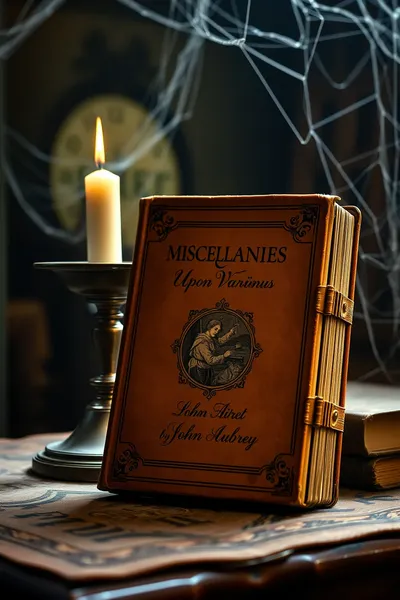


More Free Occult Philosophy Books
View all →