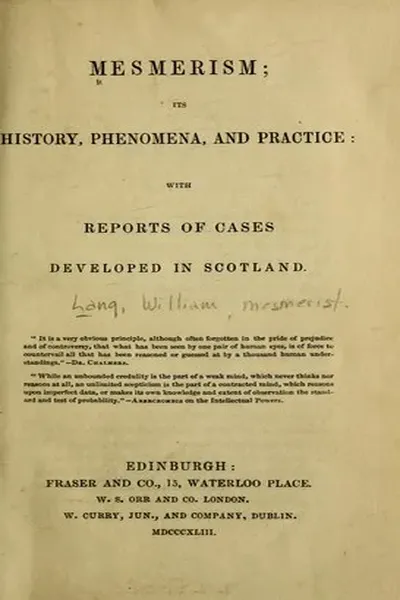
Mesmerism, its history, phenomena, and practice

 71
71

Mesmerism, its history, phenomena, and practice
William Lang’s 1843 treatise offers a sober, if somewhat dated, account of mesmerism, aiming to demystify rather than sensationalize the practice. Its strength lies in its detailed cataloging of phenomena observed during mesmeric states, providing a valuable historical snapshot of experiments conducted before the advent of hypnotism as a clinical tool. Lang’s methodical approach, particularly in describing the different stages of trance and the operator’s role, is commendable for its era. However, the work’s limitation is its inherent reliance on the theoretical framework of animal magnetism, a concept now superseded by neuroscientific understanding. A passage detailing the 'magnetic sleep' induced through sustained passes and vocal commands vividly illustrates the practical techniques, but the explanation remains couched in outdated terminology. Lang’s work serves as an important historical document, less as a guide to modern psychotherapeutic practice.
📝 Description
71
### What It Is This foundational text offers a comprehensive examination of mesmerism, a practice that predates modern psychology and explores the influence of one individual's will over another's. Published in 1843, it details the historical trajectory of what was then often termed 'animal magnetism.' The book dissects the observable phenomena associated with mesmeric states, moving beyond mere anecdotal accounts to analyze the underlying principles and potential mechanisms.
### Who It's For Scholars of early psychology, history of medicine, and occult studies will find this work invaluable. It is also intended for contemporary practitioners interested in the roots of therapeutic touch, energy work, and altered states of consciousness. Those curious about the historical reception of controversial sciences and the societal impact of new theories on the mind will also benefit.
### Historical Context William Lang's "Mesmerism, its history, phenomena, and practice" emerged during a fervent period of scientific and spiritual exploration in the mid-19th century. Mesmerism, named after Franz Mesmer, had gained significant traction following his influential theories on 'animal magnetism' in the late 18th century. This era saw a public fascination with phenomena that challenged conventional materialist explanations, including phrenology and spiritualism. The work engages with a scientific community increasingly divided between empirical skepticism and a desire to understand the non-material aspects of human experience.
### Key Concepts The book systematically breaks down the core tenets of mesmerism. It elaborates on the concepts of rapport, the magnetic fluid, and the different stages of the mesmeric trance. Lang differentiates between spontaneous and induced somnambulism, explaining the role of the operator's will and the patient's susceptibility. The text also addresses the ethical considerations and potential dangers associated with the practice, reflecting contemporary debates about its misuse.
💡 Why Read This Book?
• Gain an understanding of the historical development of mesmerism, as detailed in Lang's analysis of Franz Mesmer's theories and their subsequent evolution into distinct practices by the 1840s. • Learn about the specific phenomena associated with mesmeric states, such as somnambulism and rapport, as described in the book's empirical observations. • Appreciate the early ethical and practical considerations surrounding mesmerism, providing context for its societal reception and scientific scrutiny in the 19th century.
⭐ Reader Reviews
Honest opinions from readers who have explored this book.
❓ Frequently Asked Questions
What is "animal magnetism" as described in "Mesmerism, its history, phenomena, and practice"?
Animal magnetism, a central concept in the book, refers to an invisible natural force, akin to a fluid, that Franz Mesmer believed flowed between living beings and could be manipulated by a skilled operator to induce therapeutic effects or altered states.
Who was Franz Mesmer and why is he important to this book?
Franz Mesmer (1734-1815) was a German physician whose theories on animal magnetism laid the groundwork for mesmerism. William Lang extensively discusses Mesmer's work as the origin point for the phenomena and practices detailed in the 1843 text.
What are the different stages of mesmerism discussed by William Lang?
Lang outlines several stages, including initial relaxation, deeper trance states, and somnambulism. The book details observable changes in the subject's consciousness, responsiveness, and sensory perception as the mesmeric state progresses.
How did "Mesmerism" differ from modern hypnotism?
While related, mesmerism emphasized a supposed 'magnetic fluid' and the operator's will as primary agents. Modern hypnotism focuses more on suggestion, psychological suggestion, and neurological processes, moving away from the fluidic theory.
Was mesmerism considered a legitimate science in 1843?
Mesmerism was highly controversial in 1843. While popular with some segments of the public and certain practitioners, it faced significant skepticism and opposition from the established medical and scientific communities of the time.
What does "rapport" mean in the context of this book?
Rapport, as discussed by Lang, refers to a special connection or understanding established between the mesmerist and the subject. It is considered crucial for facilitating the mesmeric state and influencing the subject's perceptions and actions.
🔮 Key Themes & Symbolism
The Mesmeric Fluid
The text expounds on the theory of a 'magnetic fluid' or 'animal magnetism' as the fundamental medium through which mesmeric influence is exerted. Lang details how this invisible force was believed to be transmitted from the operator to the subject, affecting their nervous system and consciousness. This concept, central to Franz Mesmer's original theories, is examined for its role in inducing states of trance, sleep, and heightened suggestibility, distinguishing early mesmerism from later psychological interpretations of hypnosis.
Stages of Trance and Somnambulism
A significant portion of the book is dedicated to cataloging the observable stages of the mesmeric state. Lang meticulously describes the progression from initial relaxation and drowsiness to profound somnambulism, characterized by apparent loss of consciousness and responsiveness to the external world, yet heightened awareness to the operator's suggestions. The phenomena of lucidity, precognition, and the ability to perform complex actions while in this state are presented as evidence of the depth of the induced condition.
Operator's Will and Rapport
The crucial role of the mesmerist's intention and focused will is a recurring theme. Lang emphasizes that successful mesmerism relies not only on the subject's susceptibility but also on the operator's ability to project and direct their energy or will. The development of 'rapport'—a deep, intuitive connection between mesmerist and subject—is presented as essential for this energetic exchange and for maintaining control and coherence within the mesmeric session.
Therapeutic Applications and Ethical Concerns
Beyond mere curiosity, the book addresses the perceived therapeutic potential of mesmerism for various ailments, from nervous disorders to physical pain. However, Lang also confronts the ethical quandaries that arose, including the potential for manipulation, the blurring of personal boundaries, and the societal anxieties surrounding a practice that seemed to bypass rational control. This reflects ongoing debates about the responsible application of influential psychological techniques.
💬 Memorable Quotes
“The phenomena of somnambulism are of the most extraordinary character.”
— This statement highlights the author's astonishment at the profound alterations in consciousness observed during deep mesmeric states, where subjects exhibited abilities and perceptions far removed from their normal waking experience.
“The operator's will is a principal agent in the production of the magnetic state.”
— This emphasizes the active, intentional role of the mesmerist. It suggests that the process is not passive for the subject but requires directed energy or focus from the operator to initiate and maintain the mesmeric influence.
“A distinct rapport is often established between the magnetizer and the magnetized.”
— This paraphrased concept points to the vital connection formed between the person performing mesmerism and the subject. This link is described as fundamental for the successful transmission of influence and communication during the session.
“The sleep induced is not natural, but a peculiar condition of the nervous system.”
— This interpretation differentiates the mesmeric state from ordinary sleep. It frames the phenomenon as a distinct alteration of the nervous system's function, rather than a simple physiological rest.
“Public opinion was divided regarding the authenticity and utility of mesmerism.”
— This paraphrased concept reflects the societal context of the time, indicating that mesmerism was a subject of considerable debate, with both proponents and skeptics actively engaging with its claims and effects.
🌙 Esoteric Significance
Tradition
This work fits within the broader lineage of vitalist philosophies and early psychical research, which often bordered on esoteric inquiry during the 19th century. While not strictly Hermetic, Gnostic, or Kabbalistic, it shares an interest in hidden forces and the manipulation of consciousness that resonates with esoteric traditions. It explores the interaction of subtle energies, a concept common in many occult systems, and its focus on the operator's will aligns with practices involving directed intention.
Symbolism
The primary symbolic element is the "magnetic fluid" or "animal magnetism" itself, representing an unseen vital force connecting living beings, echoing concepts like Qi or Prana. The "mesmeric trance" can be seen as a symbolic journey inward, a temporary dissolution of the ego's ordinary boundaries to access deeper levels of awareness or subconscious material. The "operator's will" symbolizes focused intent and the power of directed consciousness.
Modern Relevance
Modern somatic therapies, energy healing modalities, and certain branches of psychotherapy that utilize guided imagery or altered states of consciousness can trace conceptual roots back to mesmerism. Thinkers exploring the placebo effect, the mind-body connection, and the therapeutic potential of suggestive states, even if they use different terminology, are indirectly engaging with the phenomena first systematically documented by Mesmer and his followers like Lang.
👥 Who Should Read This Book
• Students of the history of psychology and medicine interested in pre-Freudian concepts of the mind and therapeutic intervention. • Practitioners of alternative healing arts, such as Reiki or therapeutic touch, seeking to understand the historical precedents for subtle energy work. • Researchers of 19th-century occultism and spiritual movements looking for primary source material on a popular, yet controversial, phenomenon of the era.
📜 Historical Context
William Lang’s "Mesmerism, its history, phenomena, and practice" appeared in 1843, a period when the legacy of Franz Mesmer’s "animal magnetism" continued to provoke intense debate. The mid-19th century was an era ripe for exploring the unseen forces governing life and consciousness, a landscape populated by phrenology, spiritualism, and early investigations into psychic phenomena. Mesmerism itself had faced official scrutiny, notably from commissions appointed by the French King Louis XVI in the 1780s, which largely dismissed its claims as suggestibility and imagination, yet the practice persisted and evolved. Lang’s work engaged with this ongoing scientific and public fascination, attempting to provide a systematic account amidst a climate where scientific materialism vied with vitalist and spiritual explanations of existence. Contemporaries like the physician John Elliotson, who championed mesmerism in England, represent the medical establishment's divided reception, with many, like Lang, seeking to document its observable effects.
📔 Journal Prompts
The concept of the 'magnetic fluid' in relation to personal energy fields.
The distinction between natural sleep and the 'mesmeric sleep' described by Lang.
Reflect on the role of the operator's will in influencing another's state.
The phenomenon of 'rapport' and its implications for interpersonal connection.
Historical reception of mesmerism versus contemporary views on suggestion.
🗂️ Glossary
Animal Magnetism
A term coined by Franz Mesmer referring to an invisible natural force, often conceived as a fluid, believed to exist between animate objects and capable of being transmitted from one to another to produce specific effects.
Mesmerist
An individual who practices mesmerism, also known as a magnetizer, believed to possess the ability to manipulate animal magnetism to induce altered states of consciousness in others.
Somnambulism
A profound state of trance induced by mesmerism, characterized by apparent unconsciousness of the external world but heightened responsiveness to the mesmerist's suggestions, often accompanied by clairvoyant or telepathic-like faculties.
Rapport
A state of mutual understanding and connection established between the mesmerist and the subject, considered essential for the effective transmission of mesmeric influence and the induction of trance states.
Magnetic Passes
Gestures, typically hand movements made by the mesmerist, intended to direct and transmit the supposed animal magnetism to the subject, often used to induce relaxation and trance.
Lucidity
In the context of mesmeric somnambulism, this refers to a state where the subject exhibits extraordinary awareness, often claiming to perceive internal bodily conditions or distant events.
Nervous Fluid
A concept prevalent in 19th-century physiology, often conflated with animal magnetism, referring to the presumed medium of nerve transmission and consciousness.