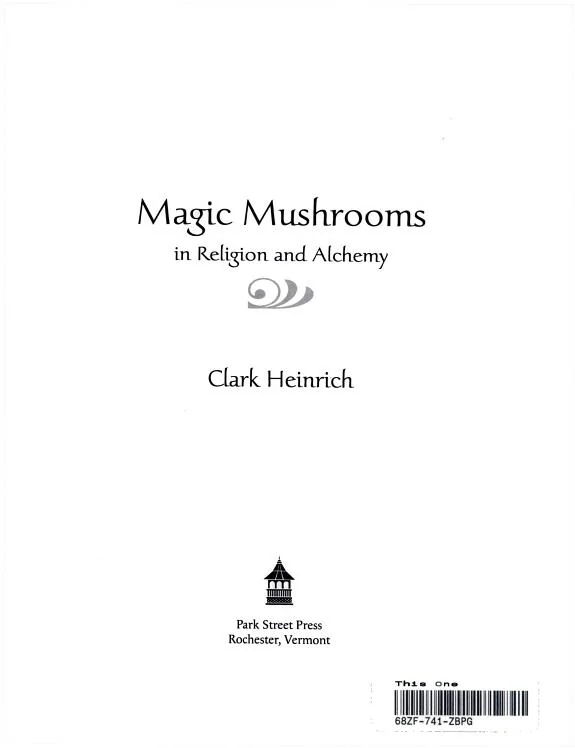
Magic Mushrooms in Religion and Alchemy
 82
82

Magic Mushrooms in Religion and Alchemy
Clark Heinrich's "Magic Mushrooms in Religion and Alchemy" is a dense, scholarly exploration that challenges conventional understandings of religious history and mystical experience. The book's strength lies in its ambitious synthesis of ethnobotany, religious studies, and alchemical symbolism, attempting to unify disparate historical threads under the banner of entheogenic influence. Heinrich skillfully draws parallels between Vedic Soma and Judeo-Christian traditions, extending Robert Gordon Wasson's controversial hypotheses into previously unexplored territories. However, the sheer scope of the argument can sometimes lead to speculative leaps; while the evidence presented is intriguing, certain connections feel more suggestive than definitively proven. A particularly compelling section details the potential alchemical interpretation of the philosopher's stone as a metaphor for psilocybin or other psychoactive compounds. Despite its academic rigor, the prose occasionally becomes dense, requiring careful attention from the reader. Ultimately, Heinrich offers a significant, albeit sometimes contentious, re-reading of spiritual history.
📝 Description
82
### What It Is Clark Heinrich's "Magic Mushrooms in Religion and Alchemy" presents a meticulously researched argument for the pervasive, yet often obscured, role of psychoactive fungi in spiritual traditions and esoteric practices. The book navigates historical texts and religious iconography, seeking evidence of their use as sacraments for divine communion. Heinrich posits that these substances were not mere recreational aids but integral to shamanic rituals and mystical experiences across diverse cultures, influencing the very fabric of religious belief and alchemical symbolism.
### Who It's For This work is for the serious student of comparative religion, anthropology, and esoteric history. It appeals to those interested in the historical use of entheogens, particularly the connection between visionary states and religious phenomena. Readers who are familiar with the work of R. Gordon Wasson and seek to extend his hypotheses into the realms of alchemy and Western religious sects will find particular value. It is also suited for scholars examining the origins of mystical experiences and altered states of consciousness.
### Historical Context Heinrich's research directly engages with the mid-20th century "ethnomycological revolution" spurred by R. Gordon Wasson, who famously proposed the use of *Amanita muscaria* in ancient Vedic rituals. This book emerges in the wake of that paradigm shift, seeking to demonstrate that the influence of psychoactive mushrooms extended far beyond the Siberian shamanism Wasson initially highlighted. It challenges established narratives by tracing potential mushroom cults through obscure Judeo-Christian sects and into the symbolic language of European alchemy, suggesting a continuous thread of entheogenic practice.
### Key Concepts The central thesis revolves around the concept of the "divine mushroom" as a universal sacrament, facilitating direct connection with the sacred. Heinrich explores the idea that the transformative properties of these fungi were perceived as divine intervention, leading to their veneration. He proposes that the alchemical quest for the "philosopher's stone"—the legendary substance for transmutation—was, in many instances, a metaphorical or even literal representation of the psychoactive mushroom itself, embodying its power to bring about profound internal change and gnosis.
💡 Why Read This Book?
• Understand the historical underpinnings of entheogenic use in comparative religion, learning how R. Gordon Wasson's theories are expanded upon regarding Vedic beliefs and obscure Judeo-Christian sects. • Explore the esoteric interpretation of alchemy, discovering how Heinrich contends the philosopher's stone may have symbolized the transformative power of psychoactive mushrooms. • Gain insight into the potential role of the fly agaric mushroom (*Amanita muscaria*) in generating religious visions, a concept confirmed and extended from early ethnobotanical research.
⭐ Reader Reviews
Honest opinions from readers who have explored this book.
❓ Frequently Asked Questions
What is the central argument of Clark Heinrich's book regarding magic mushrooms?
Clark Heinrich's "Magic Mushrooms in Religion and Alchemy" argues that psychoactive fungi were central to many ancient and medieval religious traditions and alchemical practices, serving as a means to connect with the divine and achieve transformative states.
How does the book connect mushrooms to alchemy?
The book proposes that the legendary philosopher's stone, a key element in alchemy, was often a metaphor or symbolic representation of psychoactive mushrooms and their capacity for profound inner transformation and spiritual insight.
Which specific mushroom is highlighted in the book's religious context?
The book specifically discusses the fly agaric mushroom (*Amanita muscaria*) and elaborates on Robert Gordon Wasson's hypothesis concerning its role in generating religious visions and ecstatic experiences in ancient cultures.
What historical religious parallels does the book draw?
Heinrich draws parallels between ancient Vedic beliefs, particularly concerning the ritual use of Soma, and various Judeo-Christian sects, suggesting a widespread, cross-cultural 'mushroom cult' influenced religious practices.
Is this book suitable for beginners in esotericism?
While accessible to dedicated students, the book is scholarly and dense. Beginners interested in the topic might benefit from starting with introductory works on ethnobotany or comparative religion before tackling Heinrich's detailed arguments.
What is the publication year of "Magic Mushrooms in Religion and Alchemy"?
The first publication of Clark Heinrich's "Magic Mushrooms in Religion and Alchemy" was in September 2002.
🔮 Key Themes & Symbolism
The Divine Mushroom Sacrament
This theme posits that psychoactive fungi served as a primary sacrament across diverse cultures, enabling direct communion with the divine. Heinrich argues that the visionary states induced by these mushrooms were interpreted as divine encounters, shaping religious dogma and ritual practices. The book traces this concept from ancient Vedic traditions, where Soma is implicated, through various esoteric sects, suggesting a universal human impulse to seek spiritual transcendence through these natural agents. The 'divine' aspect underscores the sacred perception of the mushroom's power to reveal hidden truths and alter consciousness.
Alchemy as Mushroom Metaphor
A central and provocative theme is the reinterpretation of alchemical pursuits through an entheogenic lens. Heinrich contends that the alchemist's ultimate goal, the philosopher's stone, was not solely a quest for material transmutation but frequently a symbolic or literal reference to the psychoactive mushroom. This interpretation suggests that the stone represented the mushroom's power to induce profound psychological and spiritual metamorphosis, granting gnosis and revealing the secrets of existence. The book explores alchemical texts for coded references to the mushroom's properties and effects.
Cross-Cultural Mushroom Cults
Heinrich investigates the evidence for a pervasive, yet often concealed, 'mushroom cult' that transcended geographical and cultural boundaries. By examining religious texts, iconography, and anthropological records, he seeks to demonstrate connections between seemingly disparate belief systems, from ancient India to early European Christianity. The work extends R. Gordon Wasson's initial hypotheses, proposing that the influence of specific psychoactive fungi, particularly *Amanita muscaria*, played a significant, unifying role in the development of global religious consciousness and mystical traditions.
Visionary States and Religious Experience
This theme focuses on the direct correlation between the use of psychoactive mushrooms and the generation of religious visions and mystical experiences. The book delves into how altered states of consciousness, induced by entheogens, were interpreted as divine revelations or shamanic journeys. Heinrich explores the neurological and psychological effects of these fungi and how their predictable outcomes could be integrated into religious frameworks, providing a tangible source for spiritual phenomena that scholars have often attributed solely to divine inspiration or psychological predisposition.
💬 Memorable Quotes
“The philosopher's stone of the alchemist was a metaphor for the mushroom.”
— This statement encapsulates Heinrich's bold reinterpretation of alchemy. It suggests that the legendary substance sought by alchemists, capable of transmutation, may have symbolically represented the profound internal changes and spiritual revelations brought about by psychoactive fungi.
“A mushroom cult that crossed cultural boundaries.”
— This phrase highlights the book's central thesis regarding the widespread, yet often hidden, influence of psychoactive mushrooms. It proposes a unifying element in human religious history, linking diverse traditions through shared entheogenic practices and beliefs.
“Psychoactive mushrooms to connect with the divine.”
— This concisely summarizes the functional role attributed to these fungi within religious contexts. It frames them not merely as substances, but as sacred tools or sacraments facilitating direct spiritual experience and communion with higher powers.
“Confirms and extends Robert Gordon Wasson's hypothesis.”
— This points to the scholarly lineage of the work, situating it within the field of ethnomycology. It indicates that Heinrich builds upon the foundational research of Wasson, particularly concerning the religious significance of mushrooms like *Amanita muscaria*.
“Parallels between Vedic beliefs and Judeo-Christian sects.”
— This highlights the comparative scope of the research. It suggests that the book explores deep, cross-cultural connections in religious thought and practice, linking seemingly distant traditions through the potential influence of entheogenic substances.
🌙 Esoteric Significance
Tradition
This work significantly contributes to the lineage of esoteric thought that seeks to uncover hidden, often suppressed, knowledge within established religious and mystical traditions. It aligns with Gnostic and Hermetic impulses to find deeper, initiatory truths obscured by exoteric doctrines. By positing a continuous thread of entheogenic practice, Heinrich connects with traditions that emphasize direct experience of the divine over dogma, challenging orthodox interpretations of religious history from an esoteric perspective.
Symbolism
Key symbols explored include the Fly Agaric mushroom (*Amanita muscaria*), representing divine revelation and shamanic power, and the Philosopher's Stone, reinterpreted not just as a alchemical agent but as a potent metaphor for the transformative consciousness induced by entheogens. The book also examines alchemical apparatus and diagrams for potential coded references to mushroom cultivation or preparation, viewing them as symbolic maps of inner spiritual journeys.
Modern Relevance
Contemporary thinkers in fields like psychedelic studies, comparative mythology, and consciousness research draw upon Heinrich's work. His synthesis provides a historical framework for understanding the ongoing exploration of entheogens in therapeutic, spiritual, and creative contexts. Modern practitioners of Neo-Paganism, Shamanism, and various forms of Western Esotericism find validation and historical depth in his arguments regarding the ancient use of these substances for spiritual purposes.
👥 Who Should Read This Book
• Students of comparative religion and anthropology: Gain a novel perspective on the origins and cross-cultural transmission of religious ideas, specifically regarding the role of entheogens. • Practitioners and scholars of Western Esotericism and Alchemy: Discover a provocative reinterpretation of alchemical symbolism, particularly the philosopher's stone, linking it to psychoactive substances. • Researchers interested in ethnobotany and the history of consciousness: Explore detailed arguments extending R. Gordon Wasson's hypotheses about the religious use of mushrooms beyond previously studied cultures.
📜 Historical Context
Published in 2002, Clark Heinrich's "Magic Mushrooms in Religion and Alchemy" emerged during a period of renewed academic interest in the history of consciousness and religious practices, particularly concerning entheogens. It directly engaged with the legacy of ethnobotanist R. Gordon Wasson, whose work in the mid-20th century, particularly his 1957 Life magazine article on the Mazatec mushroom ceremony and his later theories on Vedic Soma, had already stirred considerable debate. Heinrich's book sought to broaden Wasson's thesis, extending the hypothesized influence of psychoactive fungi beyond Siberian shamanism and ancient India into Western esotericism and alchemy. While scholars like Wasson had laid groundwork, Heinrich's specific focus on alchemical symbolism and obscure Judeo-Christian sects represented a more ambitious synthesis. The work implicitly challenged prevailing religious historical narratives that often overlooked or marginalized the role of altered states of consciousness and psychoactive substances in shaping spiritual traditions.
📔 Journal Prompts
The concept of the 'divine mushroom' as a universal sacrament.
Alchemical interpretations of the philosopher's stone.
Connections between Vedic Soma and other religious traditions.
The role of *Amanita muscaria* in generating religious visions.
Evidence for cross-cultural mushroom cults.
🗂️ Glossary
Entheogen
A psychoactive substance used in a religious or shamanic context to achieve spiritual or shamanic states of consciousness. The term derives from Greek, meaning 'god within'.
Soma
A ritual drink mentioned in ancient Vedic Sanskrit texts of the Rigveda. Its exact botanical identity has been debated, with Clark Heinrich and others suggesting it may have been derived from psychoactive mushrooms.
Fly Agaric
The mushroom species *Amanita muscaria*, known for its distinctive red cap with white spots. It contains psychoactive compounds and has a long history of use in shamanic traditions, particularly in Siberia and Northern Europe.
Philosopher's Stone
A legendary alchemical substance said to be capable of turning base metals into gold or silver. In Heinrich's interpretation, it also symbolizes the profound transformative power of entheogenic experiences.
Gnosis
Knowledge, particularly spiritual knowledge, attained through direct experience or intuition. In esoteric traditions, gnosis often refers to salvific knowledge that leads to liberation.
Ethnomycology
The study of the historical and current use of fungi by human cultures, including their role in religion, medicine, and folklore. R. Gordon Wasson is a key figure in this field.
Mushroom Cult
A hypothetical religious or spiritual tradition centered around the veneration and ritual use of psychoactive mushrooms, as proposed by Heinrich to explain similarities across diverse ancient cultures.