Light on the Yoga Sutras of Patanjali

 80
80

Light on the Yoga Sutras of Patanjali
Iyengar's meticulous dissection of Patanjali's Yoga Sutras offers a clarity that is both admirable and, at times, daunting. His 2016 publication emphasizes the philosophical underpinnings of yoga, moving far beyond mere physical postures to explore the ethical and mental disciplines required for inner transformation. The strength lies in his granular breakdown of each sutra, revealing layers of meaning often overlooked in popular yoga discourse. However, the sheer density of commentary can be overwhelming for the uninitiated, requiring dedicated study rather than casual perusal. A particularly striking section details the *citta vritti* (fluctuations of the mind), illustrating how the Sutras provide a diagnostic tool for understanding our internal landscape. While not a light read, it serves as an indispensable reference for serious yogic scholars.
📝 Description
80
B. K. S. Iyengar's 2016 commentary illuminates Patanjali's Yoga Sutras.
First published in 2016, Light on the Yoga Sutras of Patanjali provides B. K. S. Iyengar's detailed interpretation of Patanjali's key text for yoga philosophy. This book focuses on the aphorisms that form the basis of classical yoga, offering commentary rather than a guide to physical postures. It aims to explain the philosophical and ethical structure that supports the yogic path.
This work is suited for dedicated students of yoga philosophy, individuals practicing meditation who want a deeper grasp of yogic principles, and academics studying Eastern thought. Those curious about the psychological and spiritual aspects of yoga, beyond the physical poses, will find significant content. It is especially helpful for readers with some background in yoga concepts who seek a thorough engagement with the original source material.
Iyengar's interpretation of the Yoga Sutras follows a long history of yogic scholars who aimed to make Patanjali's brief verses accessible to contemporary practitioners. The Sutras themselves come from ancient times, but Iyengar's approach, presented in this 2016 book, is informed by his extensive personal practice and teaching. His work appeared during a time of growing worldwide interest in yoga, offering a structured philosophical perspective that contrasts with purely physical approaches to the practice.
💡 Why Read This Book?
• Gain a precise understanding of the philosophical underpinnings of yoga, including the eight limbs (*ashtanga*) as detailed by Patanjali, which offers a structured path to self-awareness. • Explore the concept of *citta vritti* (modifications of consciousness) as explained by Iyengar, providing tools to observe and manage mental states beyond simple relaxation techniques. • Grasp the ethical framework of *yama* and *niyama* as presented in this 2016 work, offering practical guidance for cultivating inner discipline and harmonious living.
⭐ Reader Reviews
Honest opinions from readers who have explored this book.
❓ Frequently Asked Questions
What is the primary focus of Light on the Yoga Sutras of Patanjali?
The book's primary focus is on the philosophical and ethical teachings of Patanjali's Yoga Sutras, offering detailed commentary on the aphorisms that form the basis of classical yoga philosophy.
Who is B. K. S. Iyengar and why is his interpretation significant?
B. K. S. Iyengar (1918-2014) was a globally renowned yoga teacher and author. His interpretation is significant due to his lifelong dedication to yoga practice and his systematic, rigorous approach to its philosophical texts.
When was Light on the Yoga Sutras of Patanjali first published?
This specific edition of Light on the Yoga Sutras of Patanjali was first published in 2016, building on decades of Iyengar's teaching and scholarship.
Does this book teach yoga postures (asanas)?
While asana is discussed as one of the eight limbs of yoga, the book's main emphasis is on the philosophical, psychological, and ethical dimensions, not on detailed instructions for performing physical postures.
Is this book suitable for beginners in yoga?
It is best suited for intermediate to advanced students of yoga philosophy or those with a dedicated interest in the subject, as it delves deeply into complex concepts.
What are the 'Yoga Sutras'?
The Yoga Sutras are an ancient Sanskrit text compiled by the sage Patanjali, considered the foundational scripture of classical yoga, outlining its theory and practice.
🔮 Key Themes & Symbolism
The Eight Limbs of Yoga
The book meticulously details Patanjali's eight-limbed path (*ashtanga*), from the ethical observances of *yama* and *niyama* to the internal practices of *pratyahara*, *dharana*, *dhyana*, and the ultimate goal of *samadhi*. Iyengar illuminates how each limb builds upon the previous, creating a holistic system for spiritual development. This structured approach provides a clear roadmap for practitioners aiming for inner mastery and self-realization, moving beyond a superficial understanding of yoga as merely physical exercise.
Mind and Consciousness
Central to Iyengar's commentary is the exploration of *citta vritti*—the fluctuations and modifications of the mind. The Sutras are presented as a diagnostic tool for understanding the patterns of consciousness, identifying the obstacles to mental stillness and clarity. The text offers clear insights into how the mind operates, the nature of perception, and the techniques for quieting mental disturbances to achieve a state of focused awareness and equanimity.
Ethical Foundations
Iyengar places significant emphasis on the *yama* (ethical restraints) and *niyama* (observances) as the essential groundwork for any serious yogic practice. These principles, such as non-violence (*ahimsa*), truthfulness (*satya*), and self-discipline (*tapas*), are not presented as abstract ideals but as practical, actionable guidelines for living. The book demonstrates how cultivating these virtues is crucial for purifying the mind and preparing the practitioner for deeper meditative states.
The Nature of Reality
Through commentary on concepts like *purusha* (consciousness) and *prakriti* (matter), the book explores the classical Indian philosophical distinction between the seer and the seen. Iyengar elucidates Patanjali's view on the illusory nature of the material world and the path to recognizing the true, unchanging self. This metaphysical exploration is key to understanding the ultimate aim of yoga: liberation from suffering and the attainment of discriminative discernment (*viveka*).
💬 Memorable Quotes
Direct passages from the work, attributed to the author.
“The mind is like a mirror. When it is covered with dust, it cannot reflect properly.”
— This analogy highlights the Sutras' emphasis on mental purification. Iyengar uses this to illustrate how external distractions and internal impurities obscure our true nature, making clarity and self-knowledge impossible without diligent practice.
“Yoga is the cessation of the fluctuations of consciousness.”
— This is the second sutra, defining the essence of yoga. Iyengar's commentary expands on what 'cessation' truly means, not as annihilation, but as a state of profound stillness and non-disturbance.
“The obstacles are disease, dullness, doubt, carelessness, laziness, indulgence, delusion, failure to reach a stage, and instability.”
— This interpretation of Patanjali's list of hindrances (*kleshas*) shows the practical, psychological depth of yoga. Iyengar's explanation makes these ancient concepts directly relevant to modern challenges in spiritual practice.
“By cultivating friendliness, compassion, joy, and indifference, the mind becomes clear.”
— This refers to specific attitudes (*maitri, karuna, mudita, upeksha*) that Patanjali suggests for calming the mind. Iyengar explains how these emotional states are cultivated to create a stable and peaceful mental environment.
“When one is firmly established in *asana*, the interplay of dualities ceases.”
— Iyengar interprets *asana* here not just as physical posture, but as a stable, comfortable seat that leads to mastery over opposing forces. This establishes the role of posture in achieving mental and spiritual equilibrium.
🌙 Esoteric Significance
Tradition
This work is firmly rooted in the classical Yoga tradition, a major philosophical school within Hinduism. While distinct from Vedanta, it shares many metaphysical assumptions. Iyengar's interpretation aligns with the Samkhya-Yoga philosophical system, which posits a dualistic worldview of spirit (*Purusha*) and matter (*Prakriti*). It fits within the broader Indian esoteric landscape by offering a systematic path to liberation (*moksha*) through disciplined self-awareness and mental control, distinct from devotional or ritualistic approaches.
Symbolism
Key symbols include *Dharma* (cosmic order and righteousness), which serves as the foundation for ethical practice, and *Samadhi* (absorption or meditative consciousness), the ultimate goal representing union with the divine or pure awareness. The concept of *Vritti* (mental modifications) can be seen metaphorically as ripples on water, obscuring the clarity of the underlying lake, which represents the pure consciousness (*Purusha*). The eight limbs themselves form a symbolic structure guiding the practitioner's journey.
Modern Relevance
Iyengar's detailed exegesis remains highly relevant for contemporary yoga practitioners, therapists, and scholars seeking to understand the philosophical depth of yoga. Modern mindfulness movements, cognitive behavioral therapies, and various contemplative practices indirectly draw from the principles of mental discipline and self-observation codified in the Sutras and illuminated by Iyengar. His work is a crucial reference for those exploring the intersection of psychology, philosophy, and embodied spiritual practice in the 21st century.
👥 Who Should Read This Book
• Dedicated yoga practitioners seeking to deepen their philosophical understanding beyond physical postures, gaining insight into the ethical and mental disciplines required for self-mastery. • Students of comparative religion and Eastern philosophy interested in the foundational texts and principles of classical yoga as a spiritual system. • Meditators and mindfulness practitioners looking for a structured, ancient framework to understand and manage the workings of the mind and consciousness.
📜 Historical Context
Patanjali's Yoga Sutras, believed to have been compiled between 200 BCE and 400 CE, represent a systematization of existing yogic thought. B. K. S. Iyengar's 2016 commentary, Light on the Yoga Sutras, emerged in an era where yoga had gained immense global popularity, often in forms divorced from its philosophical roots. Iyengar, a student of T. Krishnamacharya, stood in contrast to proponents of purely physical or overtly mystical interpretations. His work provided a rigorous, scholarly, and practice-informed exposition that grounded modern yoga in its classical textual tradition. While figures like Swami Vivekananda had earlier introduced Indian philosophy, including yoga, to the West in the late 19th century, Iyengar's approach offered a detailed, systematic engagement with the Sutras themselves, emphasizing the ethical and psychological disciplines as integral to the path. His meticulous scholarship aimed to correct misconceptions and guide practitioners toward a deeper, more authentic understanding of yogic philosophy.
📔 Journal Prompts
The *yama* of *ahimsa*: How does non-violence manifest in your daily interactions and internal dialogue?
Reflections on *citta vritti*: Identify three recurring thought patterns that disturb your mental peace.
The practice of *dharana*: What is your current capacity for sustained concentration on a single point?
Examining *niyama*: How do you approach self-study (*svadhyaya*) and discipline (*tapas*) in your life?
The concept of *Samadhi*: What are your present aspirations for mental stillness and absorption?
🗂️ Glossary
Sutra
A concise aphorism or thread of text in Sanskrit literature, often requiring extensive commentary for full understanding. Patanjali's Yoga Sutras are a prime example.
Citta Vritti
Literally 'modifications of the mind' or 'fluctuations of consciousness.' These are the mental states, thoughts, and emotions that constantly arise and subside.
Ashtanga Yoga
The 'eight-limbed yoga' as outlined by Patanjali, comprising *yama*, *niyama*, *asana*, *pranayama*, *pratyahara*, *dharana*, *dhyana*, and *samadhi*.
Yama
The first limb of Ashtanga Yoga, encompassing ethical restraints or moral disciplines such as non-violence (*ahimsa*), truthfulness (*satya*), and non-stealing (*asteya*).
Niyama
The second limb of Ashtanga Yoga, consisting of observances or personal disciplines like purity (*saucha*), contentment (*santosha*), and self-study (*svadhyaya*).
Samadhi
The eighth and final limb of Ashtanga Yoga, referring to a state of profound meditative absorption, stillness, or union with the object of meditation.
Purusha
In Samkhya-Yoga philosophy, the pure consciousness, the self, or the spirit, distinct from matter and mind. It is the witness consciousness.
🔮 Readers Also Liked
Browse all →









More by B. K. S. Iyengar
All books →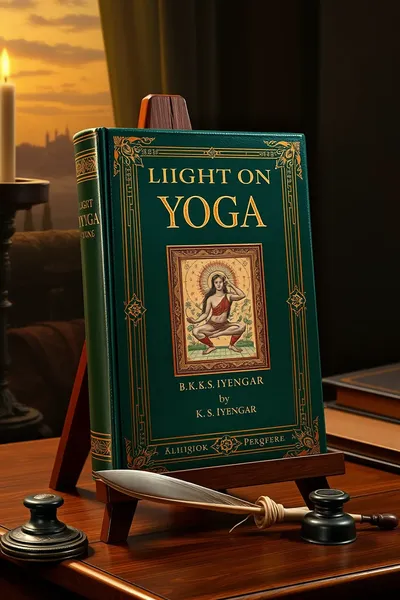





More Free Occult Philosophy Books
View all →