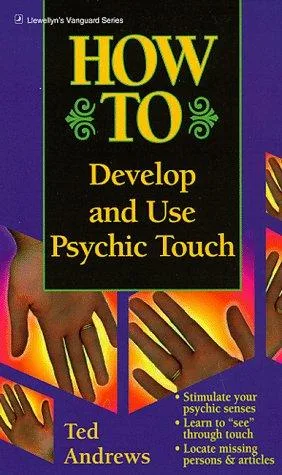
How to develop and use psychic touch
 82
82

How to develop and use psychic touch
Andrews' 1997 text, "How to Develop and Use Psychic Touch," presents a refreshingly direct approach to tactile intuition. Unlike many works that skirt the edges of the subject, Andrews offers concrete exercises. His chapter on 'Reading Objects' provides a clear framework for beginners, detailing how to approach an item and what types of impressions to expect. However, the book occasionally feels somewhat dated in its explanations of energy, sometimes relying on concepts that have been refined in later esoteric discourse. A notable strength is the consistent focus on practical application, ensuring readers are not left with theory alone. The limited exploration of the ethical implications of such a sensitive ability is a missed opportunity. Nevertheless, it remains a solid, if not groundbreaking, manual for developing a specific intuitive skill.
📝 Description
82
### What It Is Ted Andrews' "How to Develop and Use Psychic Touch," first published in 1997, offers a practical guide to enhancing and applying intuitive physical perception. This work moves beyond theoretical discussions to provide actionable techniques for sensing energy fields and subtle vibrations. It aims to equip readers with the ability to interpret these energetic impressions for personal insight and interaction with the environment.
### Who It's For This book is suited for individuals interested in exploring the tangible aspects of psychic phenomena. It targets those who wish to cultivate a more direct, sensory experience of their intuition, rather than relying solely on mental impressions or visions. Readers seeking to understand and develop a specific modality of intuitive awareness, often referred to as psychometry or tactile intuition, will find value here.
### Historical Context Published in 1997, "How to Develop and Use Psychic Touch" emerged during a period of renewed interest in parapsychology and esoteric practices, following the more speculative New Age movements of the preceding decades. Andrews' approach offered a grounded, instructional methodology that contrasted with some of the more abstract or purely spiritual texts of the era. The work can be seen as contributing to a lineage of practical occult instruction, reminiscent of earlier guides but updated for a contemporary audience.
### Key Concepts The central concepts revolve around the idea that the physical body itself can act as a sophisticated instrument for perceiving subtle energies. Andrews emphasizes training the hands and body to become more sensitive to energetic signatures left on objects or emanating from people and places. This involves exercises designed to calibrate and amplify one's innate tactile sensitivity, allowing for the interpretation of information through touch.
💡 Why Read This Book?
• Learn specific, tactile exercises to perceive subtle energies, moving beyond abstract concepts to a sensory understanding of intuition, as detailed in the object-reading techniques. • Understand how to calibrate your hands and body as instruments for intuitive sensing, a core principle explained through practical drills. • Gain actionable methods for interpreting energetic impressions received through touch, offering a concrete skill applicable to personal insight and environmental awareness.
⭐ Reader Reviews
Honest opinions from readers who have explored this book.
❓ Frequently Asked Questions
What is psychic touch according to Ted Andrews?
Ted Andrews defines psychic touch as the ability to perceive subtle energies and information through physical contact, essentially using the hands and body as intuitive sensing tools to gather impressions from objects or people.
When was 'How to Develop and Use Psychic Touch' first published?
The book 'How to Develop and Use Psychic Touch' by Ted Andrews was first published in 1997.
Are the techniques in the book suitable for beginners?
Yes, Andrews structures the book with progressive exercises, making the techniques accessible to beginners who are interested in developing their tactile intuition.
What kind of information can be gained through psychic touch?
Through psychic touch, one can potentially gain insights into the history of an object, the emotional state of a person, or the energetic atmosphere of a place.
Does the book discuss psychometry?
Yes, the principles and exercises in 'How to Develop and Use Psychic Touch' are directly applicable to developing psychometry, the practice of sensing the history of an object through touch.
What is the primary focus of the book's exercises?
The primary focus of the book's exercises is to enhance the sensitivity of the hands and body to subtle energetic vibrations and impressions.
🔮 Key Themes & Symbolism
Tactile Intuition Development
The core of Andrews' work lies in cultivating intuition through the sense of touch. He posits that the hands are not merely for manipulation but are highly sensitive organs capable of 'reading' energetic signatures. The book provides step-by-step exercises designed to heighten this tactile awareness, moving readers from basic sensitivity to the interpretation of complex energetic data. This focus differentiates it from visually or audibly-oriented intuitive modalities, offering a distinct pathway for those who naturally process information physically.
Energy Field Perception
Andrews explains how to perceive the subtle energy fields that surround and emanate from living beings, objects, and places. This involves learning to differentiate between various energetic vibrations and understanding how these energies carry information. The book guides the reader in recognizing these fields through touch, offering practical applications for assessing personal energy, the aura, and the residual impressions left on physical items, contributing to a deeper understanding of energetic interconnections.
Object Reading and Psychometry
A significant portion of the book is dedicated to the practice of psychometry, or object reading. Andrews provides methods for approaching an object with the intention of receiving its energetic history or imprint. This includes techniques for holding, warming, and interacting with an item to unlock the information it holds. By developing psychic touch, readers are empowered to connect with the past or inherent qualities of objects, offering a unique lens through which to view the world and its contents.
Practical Application of Intuition
Beyond mere theory, 'How to Develop and Use Psychic Touch' emphasizes the practical application of developed intuitive abilities. Andrews demonstrates how enhanced tactile perception can be used in everyday life for better discernment, deeper understanding of interpersonal dynamics, and a more profound connection with one's environment. The book aims to integrate these psychic skills into a functional toolkit for personal growth and awareness, moving esoteric concepts into tangible, usable practices.
💬 Memorable Quotes
“The hands are sensitive instruments capable of picking up subtle vibrations.”
— This statement encapsulates the book's central premise: that our physical hands possess an inherent capacity for intuitive perception, acting as conduits for subtle energetic information.
“Learn to feel the energy of an object.”
— This is a direct instruction guiding the reader toward the practice of psychometry, encouraging the development of tactile sensitivity to discern energetic imprints.
“Your body can learn to sense what your mind cannot yet grasp.”
— This highlights the importance of embodied intuition, suggesting that physical sensations and tactile impressions can provide information that rational thought might overlook or be unable to process.
“Practice is key to developing psychic touch.”
— This emphasizes the instructional nature of the book, underscoring that the development of psychic abilities is a skill that requires consistent effort and repetition of exercises.
“Understand the energetic residue on objects.”
— This points to the concept that objects retain energetic imprints from their past owners or experiences, and psychic touch allows one to perceive these subtle traces.
🌙 Esoteric Significance
Tradition
Andrews' work draws from a broad stream of Western esoteric thought, particularly influenced by Theosophy and later New Age interpretations of energy work and intuitive development. It aligns with traditions that emphasize the human capacity for sensing subtle realities beyond the five physical senses. While not strictly Hermetic or Gnostic, it shares their interest in hidden knowledge and the expansion of human perception, presenting these concepts in a practical, accessible format for a contemporary audience.
Symbolism
The primary symbol in this work is the hand itself, elevated from a tool of physical action to an organ of psychic perception. The energy field, often visualized as an aura or vibration, functions as a key motif representing the subtle information accessible through touch. The concept of 'residue' or energetic imprint on objects serves as a symbol for the past's continuous energetic presence, accessible to the attuned practitioner.
Modern Relevance
Contemporary practitioners of energy healing, intuitive counseling, and even certain aspects of modern witchcraft often engage with principles similar to those outlined by Andrews. His emphasis on embodied intuition and practical, sensory-based development resonates with current trends in somatic psychology and embodied spirituality, making his foundational techniques relevant for those seeking a grounded approach to psychic development.
👥 Who Should Read This Book
• Individuals new to psychic development seeking a tangible entry point through tactile perception. • Practitioners of energy healing or bodywork interested in understanding and enhancing their sensitivity to subtle energies. • Skeptics or curious minds looking for concrete exercises to explore intuitive abilities beyond abstract theory.
📜 Historical Context
Published in 1997, Ted Andrews' "How to Develop and Use Psychic Touch" emerged in a landscape where interest in practical spirituality and esoteric skills was robust, following the more generalized New Age trends of the 1980s. The work provided a focused, instructional manual on a specific intuitive faculty, contrasting with broader metaphysical texts. It contributed to a lineage of psychometric and energy-sensing literature that has roots stretching back to figures like J.W. Richards in the late 19th century. While not directly engaging with academic parapsychology, it offered accessible techniques to a public keen on exploring personal psychic potential, fitting within a broader cultural moment of interest in alternative healing and consciousness studies.
📔 Journal Prompts
Reflect on the primary symbol of the hand as an intuitive instrument.
Document initial impressions when touching objects with the intention of psychic sensing.
Consider how the concept of energetic residue might apply to everyday items.
Explore the distinction between intellectual understanding and tactile knowing of energy.
Describe a personal experience of sensing subtle energy before reading this book.
🗂️ Glossary
Psychic Touch
The ability to perceive subtle energies, information, or impressions through the sense of touch, utilizing the hands and body as intuitive instruments.
Energy Field
The subtle energetic emanation surrounding living beings, objects, and places, believed to carry information that can be perceived intuitively.
Tactile Intuition
Intuitive perception that primarily occurs through the sense of touch, allowing for the reception of information via physical contact.
Psychometry
The practice of discerning information about an object or person through physical contact, often by sensing residual energy or imprints.
Energetic Imprint
A residual energetic signature left on an object or in a location by people or events, which can be sensed by those with developed psychic touch.
Vibration
In this context, refers to the subtle energetic frequencies emitted or held by all things, which can be perceived as different 'qualities' or 'feelings' through psychic touch.
Calibration
The process of training and refining one's sensitivity to subtle energies, ensuring accurate perception and interpretation of intuitive impressions.