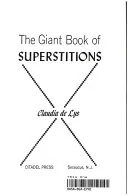
Giant Book of Superstitions
 82
82

Giant Book of Superstitions
Claudia DeLys's "Giant Book of Superstitions" offers a sweeping survey of folk beliefs, presenting a staggering breadth of material. The strength lies in its encyclopedic scope, touching upon countless practices and their purported origins. For instance, its examination of animal superstitions, detailing everything from the ill-omen of a black cat to the protective charm of a rabbit's foot, is particularly exhaustive. However, the book’s original 1979 publication date means its scholarly apparatus feels somewhat dated; it lacks engagement with more recent anthropological or psychological analyses of belief systems. While DeLys avoids overt judgment, the sheer volume of information sometimes overshadows deeper analytical connections between disparate superstitions. Nevertheless, for a comprehensive catalog of what people have believed and why, it remains a solid reference.
📝 Description
82
### What It Is
Claudia DeLys's "Giant Book of Superstitions" is a comprehensive catalog and analysis of folk beliefs and practices that have shaped human behavior across cultures and centuries. Published originally in 1979, this work meticulously details the origins, meanings, and rituals associated with a vast array of superstitions. It moves beyond simple enumeration to explore the psychological and social underpinnings of these beliefs, presenting them not as mere irrationalities but as expressions of fundamental human needs for order, meaning, and control.
### Who It's For
This volume is essential for folklorists, anthropologists, and cultural historians seeking to understand the pervasive influence of superstition on societal norms and individual actions. It also serves as a valuable resource for students of comparative religion, psychology, and those interested in the history of magic and occult practices. Individuals curious about the roots of everyday customs, from knocking on wood to avoiding black cats, will find extensive explanations.
### Historical Context
The book emerged during a period of renewed academic and popular interest in folklore and cultural studies, following earlier seminal works like those of Sir James Frazer. It provided a systematic approach to a subject often relegated to the anecdotal, grounding superstitions within broader historical narratives. The 1979 publication date places it in dialogue with emerging anthropological theories and a growing public fascination with the esoteric, though DeLys maintains a scholarly, descriptive tone.
### Key Concepts
DeLys categorizes superstitions by theme, examining beliefs related to nature, animals, personal relationships, health, and fortune. The work highlights how these beliefs often function as systems of sympathetic magic or as attempts to appease unseen forces. It traces the evolution of these ideas, showing how they adapt and persist through different eras and geographical locations, reflecting enduring human concerns about fate, protection, and prosperity.
💡 Why Read This Book?
• Understand the psychological underpinnings of common superstitions by examining DeLys's categorization of beliefs related to luck and misfortune, offering insights into human desires for control. • Trace the historical lineage of specific folk practices, such as those surrounding childbirth and fertility, learning how they evolved from ancient rituals to modern customs. • Gain a broader perspective on sympathetic magic through detailed examples of practices involving effigies or charms, revealing their persistent appeal across cultures.
⭐ Reader Reviews
Honest opinions from readers who have explored this book.
❓ Frequently Asked Questions
When was "Giant Book of Superstitions" first published?
The "Giant Book of Superstitions" by Claudia DeLys was first published in September 1979. This original edition laid the groundwork for subsequent explorations into the origins and meanings of folk beliefs.
What types of superstitions does the book cover?
The book comprehensively covers superstitions related to nature, animals, gender dynamics, love, food, luck, health, and various other aspects of daily life and human experience.
Does the book explain the origins of superstitions?
Yes, a primary focus of "Giant Book of Superstitions" is exploring the evolution and meaning behind common superstitious beliefs, tracing their historical roots and cultural contexts.
Is "Giant Book of Superstitions" suitable for academic study?
Absolutely. It serves as a valuable resource for folklorists, anthropologists, and cultural historians due to its extensive cataloging and analysis of folk beliefs and practices.
What makes Claudia DeLys's approach unique?
DeLys presents superstitions not just as curiosities but as significant expressions of human psychology, exploring the needs for order, meaning, and control that drive these beliefs.
Can I find information on specific animal superstitions?
Yes, the book dedicates significant attention to animal-related superstitions, detailing beliefs about various creatures and their supposed influence on luck or events.
🔮 Key Themes & Symbolism
Animal Omens
The work meticulously details a vast array of superstitions concerning animals, from the ill-fortune associated with black cats crossing one's path to the protective qualities attributed to a rabbit's foot. DeLys explores how these beliefs, often rooted in ancient animistic traditions or perceived symbolic associations, have permeated folklore across cultures. The book examines the psychological comfort or warning these animal omens provide, serving as a form of divination or protection in the absence of empirical understanding.
Beliefs About Fate and Luck
A significant portion of "Giant Book of Superstitions" is dedicated to the human desire to influence or predict destiny. DeLys catalogues practices and beliefs surrounding luck, chance, and fortune, including rituals for good luck and methods for warding off bad luck. This theme highlights the enduring human quest for control over unpredictable events, often manifested through charms, amulets, or specific actions intended to manipulate the forces of fate.
Nature and Elemental Superstitions
The book delves into superstitions tied to natural phenomena and elements – weather, celestial bodies, plants, and the earth itself. These beliefs often reflect a deep-seated connection to the environment and an attempt to understand or appease the powerful forces of nature. DeLys illustrates how practices related to the seasons, harvests, or celestial events served as both practical guides and spiritual expressions in pre-modern societies.
Superstitions in Relationships
Claudia DeLys examines how superstitious beliefs have shaped perceptions and practices within human relationships, particularly concerning love, marriage, and gender. This includes beliefs about finding a partner, ensuring marital fidelity, or predicting the sex of a child. These superstitions reveal societal expectations and anxieties surrounding intimacy and procreation, often employing symbolic actions or omens to navigate these complex aspects of life.
💬 Memorable Quotes
“Beliefs about luck and misfortune are often tied to specific actions or objects.”
— This highlights the practical, ritualistic nature of superstitions, suggesting they provide tangible methods for individuals to engage with the concept of fate or chance.
“Animals have long been imbued with symbolic meaning in folk traditions.”
— This points to the deep historical roots of animal superstitions, linking them to older animistic beliefs and the human tendency to project meaning onto the natural world.
“Many superstitions serve as a form of psychological reassurance.”
— This interpretation emphasizes the function of these beliefs in managing anxiety and uncertainty, offering a sense of order or control in the face of the unknown.
“Nature itself has been a source of omens and protective rituals.”
— This underscores the fundamental role of the natural environment in shaping human belief systems and practices related to divination and safeguarding.
“Superstitions surrounding love and relationships reflect societal hopes and fears.”
— This suggests that folk beliefs in this domain are not arbitrary but are deeply connected to cultural norms, desires, and anxieties about partnership and family.
🌙 Esoteric Significance
Tradition
While not explicitly aligned with a single esoteric lineage like Hermeticism or Kabbalah, "Giant Book of Superstitions" touches upon themes prevalent in Western esotericism. Its exploration of sympathetic magic, talismans, and omens resonates with practices found in ceremonial magic and folk magic traditions that often draw from these older systems. The work functions as a compendium of the practical, often subconscious, magical thinking that underpins many cultures, providing context for the more formalized esoteric systems.
Symbolism
The book implicitly explores symbolism through the superstitions it details. For instance, the recurring negative symbolism of the number thirteen, or the potent symbolism of black cats as harbingers of misfortune, are examined. Similarly, the symbolic power attributed to natural elements like salt (for purification) or certain plants (for protection) is a recurring motif, illustrating how everyday objects and creatures are imbued with deeper, often occult, meanings.
Modern Relevance
Contemporary practitioners of folk magic, witchcraft, and even certain forms of psychology draw upon the historical understanding provided by works like DeLys's. It offers a foundational text for understanding the roots of many rituals and beliefs still active today. Thinkers exploring the psychology of belief, cognitive biases, and the persistence of irrational thought in modern society also find value in its extensive documentation of human tendencies.
👥 Who Should Read This Book
• Folklore enthusiasts and cultural historians seeking a comprehensive catalog of beliefs and practices across diverse societies. • Students of anthropology and comparative religion interested in the psychological and social functions of superstition. • Individuals curious about the origins of everyday folk customs and their enduring influence on human behavior.
📜 Historical Context
Published in 1979, Claudia DeLys's "Giant Book of Superstitions" arrived during a period of significant academic and popular interest in folklore, anthropology, and the history of magic. It followed in the wake of monumental works like Sir James George Frazer's "The Golden Bough," which had explored similar themes of primitive belief and ritual. DeLys's approach, while encyclopedic, presented superstitions as integral to understanding human psychology and societal development, moving beyond purely ethnographic description. The late 1970s also saw a surge in occult and metaphysical literature, and while DeLys maintained a scholarly distance, her work contributed to a broader cultural fascination with the unexplained. The book's detailed cataloging offered a systematic counterpoint to the more mystical or New Age interpretations gaining traction at the time, providing a grounded, if extensive, reference for the persistence of folk belief.
📔 Journal Prompts
The perceived luck associated with specific animals and their symbolic meaning.
Rituals and practices designed to influence fortune or ward off ill-luck.
The role of nature and elemental forces in ancient and modern superstitions.
How beliefs about relationships, love, and gender are reflected in folk superstitions.
The psychological need for control that underlies many superstitious behaviors.
🗂️ Glossary
Sympathetic Magic
A type of magic based on the principle that like produces like, or that a person or thing can be affected by means of something that resembles it or is connected to it.
Omen
An event regarded as a portent of good or evil, often involving natural phenomena, animals, or unusual occurrences.
Talisman
An object believed to have magical properties, typically used to ward off evil or bring good fortune.
Folk Belief
Traditional beliefs, customs, and practices passed down through generations within a community or culture.
Divination
The practice of seeking knowledge of the future or the unknown by supernatural means.
Animism
The belief that natural objects, phenomena, and the universe itself possess souls or consciousness.
Ritual
A sequence of activities involving gestures, words, actions, or objects, performed according to a set sequence, often for religious or magical purposes.