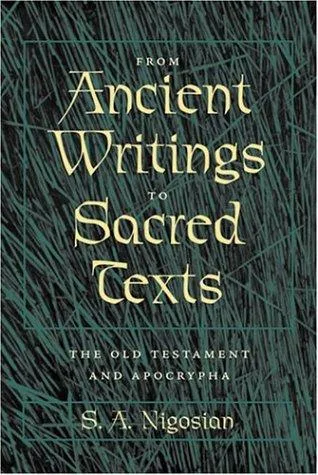
From Ancient Writings to Sacred Texts
 81
81

From Ancient Writings to Sacred Texts
Nigosian’s 2004 study, From Ancient Writings to Sacred Texts, offers a grounded examination of how ancient communities solidified their foundational narratives into enduring scriptures. The author’s strength lies in his methodical approach, meticulously tracing the often-turbulent path from oral tradition to codified law and myth. He avoids sensationalism, presenting a scholarly yet readable account of textual development. A notable passage details the complex process of canonizing the Hebrew Bible, highlighting the gradual acceptance of texts over centuries, a process far removed from a single divine revelation event. However, the work's primary limitation is its somewhat dry presentation; it can feel like a dense academic treatise at times, lacking the evocative language that might fully capture the profound impact these texts had on their original audiences. It’s a valuable resource for understanding the mechanics of scripture formation, but less so for feeling the spiritual weight of that creation. Ultimately, it is a solid, if understated, contribution to the study of religious textual history.
📝 Description
81
### What It Is From Ancient Writings to Sacred Texts, first published in 2004 by S. A. Nigosian, examines the evolution and transmission of religious and philosophical texts across various ancient cultures. It traces the development of canonical scriptures, exploring how oral traditions were codified and how different societies approached the concept of sacred literature. The work offers a comparative perspective on textual authority and interpretation.
### Who It's For This book is intended for students of comparative religion, ancient history, and textual criticism. Those interested in the foundational texts of major world religions, the history of religious ideas, and the socio-political factors influencing scriptural development will find it particularly relevant. It serves as an accessible entry point for individuals seeking to understand the origins of religious texts beyond their theological content.
### Historical Context Published in the early 21st century, Nigosian's work engages with ongoing scholarly debates surrounding the formation of religious canons. It addresses questions that have occupied scholars since the Enlightenment, particularly the critical study of biblical texts and the historical development of other major religious traditions. The book implicitly contrasts with earlier, more faith-centric approaches to scripture, situating itself within a lineage of historical-critical scholarship that gained prominence in the 19th century, influenced by figures like Julius Wellhausen and his work on the Pentateuch.
### Key Concepts The book delves into concepts such as textual transmission, canonization, oral tradition versus written scripture, and the phenomenology of religious experience as reflected in texts. It analyzes how early religious communities perceived and preserved their foundational narratives and doctrines. The work also touches upon the influence of cultural and political environments on the shaping of sacred literature, demonstrating that the concept of a fixed, divinely revealed text was not always the dominant paradigm.
💡 Why Read This Book?
• Understand the historical processes behind the formation of major religious scriptures, such as the specific challenges in canonizing the Hebrew Bible, a subject explored in detail. • Gain insight into the distinction between oral traditions and their later written codification, a fundamental concept for appreciating early religious development. • Learn how socio-political factors influenced the acceptance and dissemination of sacred texts in antiquity, providing a concrete example of historical forces shaping religious ideas.
⭐ Reader Reviews
Honest opinions from readers who have explored this book.
❓ Frequently Asked Questions
When was From Ancient Writings to Sacred Texts first published?
From Ancient Writings to Sacred Texts by S. A. Nigosian was first published in 2004. This date places it within contemporary scholarship on religious texts and their historical development.
What is the primary focus of S. A. Nigosian's book?
The book primarily focuses on the evolution of religious and philosophical texts in ancient societies, examining how oral traditions became codified scriptures and the varying concepts of textual authority across cultures.
Does the book discuss specific ancient religions?
Yes, the work explores the textual development within various ancient cultures, implicitly covering foundational texts that are central to major world religions, though it maintains a comparative and historical perspective.
Is this book suitable for beginners in religious studies?
Yes, it serves as an accessible introduction for individuals interested in the historical origins and formation of religious scriptures, offering a comparative view beyond purely theological interpretations.
What academic disciplines does this book relate to?
The book is relevant to comparative religion, ancient history, textual criticism, and the sociology of religion, offering insights into how texts become sacred.
Does the book present religious texts as divinely inspired?
The book adopts a historical-critical approach, examining the human and social processes involved in the creation and canonization of texts, rather than focusing on divine inspiration.
🔮 Key Themes & Symbolism
Oral Tradition to Scripture
This theme investigates the critical transition from fluid, spoken narratives to fixed, written documents that form the bedrock of religious traditions. Nigosian details how communities preserved their foundational stories and laws, often through generations of oral transmission before committing them to parchment. The work highlights the inherent challenges and transformations that occur during this process, demonstrating that the written word often reflects a later stage of interpretation and stabilization compared to the original living tradition.
Canonization Processes
The book examines the complex and often lengthy process by which certain texts achieve canonical status within a religious tradition. It illustrates that canonization was rarely a singular event but a gradual consensus-building, influenced by theological, social, and political factors. Nigosian’s analysis reveals how different communities debated, accepted, or rejected texts, thereby shaping the boundaries of their sacred literature and establishing authoritative versions for liturgical and doctrinal use.
Textual Authority and Interpretation
A central theme is the evolving concept of textual authority in the ancient world. Nigosian explores how societies viewed their foundational writings – whether as divinely revealed, divinely inspired, or historically significant narratives. The work touches upon how the interpretation of these texts was shaped by the cultural and intellectual milieu, leading to diverse understandings and applications of scripture across different historical periods and geographical regions.
Comparative Textual Studies
The book employs a comparative methodology to illuminate similarities and differences in textual development across various ancient cultures. By contrasting the ways different civilizations approached scripture, Nigosian offers a broader perspective on the universal aspects of textual creation and preservation, as well as the unique historical trajectories of individual religious traditions. This approach underscores that the phenomenon of sacred text is not monolithic but multifaceted.
💬 Memorable Quotes
“The journey from spoken word to inscribed text involved significant shifts in community perception and textual stability.”
— This interpretation highlights that the act of writing down a tradition fundamentally changed how it was perceived by its adherents, moving from a dynamic, living experience to a more static, authoritative document.
“Canonization was a historical process, not a singular divine decree.”
— This emphasizes that the authoritative status of religious texts developed over time through human decisions and communal acceptance, rather than being established instantaneously through a direct divine revelation to a single figure.
“Early religious communities grappled with defining the boundaries of their sacred literature.”
— This paraphrased concept points to the internal debates and selections that occurred within nascent religious groups as they determined which writings were essential and authoritative for their faith and practice.
“Cultural context profoundly shaped the meaning and authority ascribed to ancient writings.”
— This reflects the idea that the societal environment in which a text emerged and was later interpreted played a crucial role in its perceived importance and the weight given to its contents.
“The transmission of texts involved active human agency and potential alteration.”
— This interpretation suggests that the copying and dissemination of ancient scriptures were not passive processes; scribes and communities made choices that could subtly or overtly influence the final form of the text.
🌙 Esoteric Significance
Tradition
While not explicitly aligned with a single esoteric lineage like Hermeticism or Gnosticism, Nigosian's work is foundational for understanding the *historical* underpinnings of texts often invoked in esoteric traditions. It provides a critical, academic lens through which esoteric practitioners can examine the human and historical processes behind the scriptures they may draw upon for inspiration or ritual. It offers a counterpoint to purely mystical interpretations by grounding texts in their original socio-historical contexts.
Symbolism
The book primarily focuses on textual and historical analysis rather than symbolic interpretation. However, the very concept of a 'sacred text' itself can be seen as a symbol of divine order, revealed wisdom, or foundational truth within various traditions. The process of canonization can symbolize the community's collective striving for spiritual coherence and authoritative guidance, representing a shared commitment to a particular worldview.
Modern Relevance
Contemporary scholars of comparative religion and textual criticism continue to build upon the historical-critical methods Nigosian employs. Modern esoteric thinkers and practitioners may use this work to critically engage with the source materials of their traditions, understanding the historical layers and human elements involved in scripture. It informs practices that seek authentic roots by differentiating between historical development and later esoteric interpretations of foundational texts.
👥 Who Should Read This Book
• Students of comparative religion and ancient history seeking to understand the origins of religious literature beyond devotional readings. • Individuals interested in textual criticism and the academic study of how ancient narratives became authoritative scriptures. • Esoteric practitioners who wish to critically examine the historical development of texts they may use in their spiritual or philosophical pursuits.
📜 Historical Context
Published in 2004, S. A. Nigosian’s From Ancient Writings to Sacred Texts engages with a long-standing tradition of critical scholarship on religious texts, particularly the historical-critical method that gained traction in the 19th century. The book emerged in an academic landscape where debates about the historicity of religious narratives and the formation of canons were well-established. It implicitly positions itself against earlier, more devotional or apologetic approaches to scripture, aligning with a secular academic pursuit of understanding religious phenomena. While not directly referencing contemporaries in its blurb, the work operates within the discourse shaped by scholars examining the Dead Sea Scrolls, early Christian writings, and the development of the Hebrew Bible. The reception of such historical-critical analyses, while largely accepted in academic circles, occasionally faced pushback from more conservative religious factions who preferred traditional interpretations of divine authorship and textual immutability.
📔 Journal Prompts
The shift from oral tradition to written scripture: analyze its impact on religious authority.
The concept of canonization: how might community consensus shape spiritual truth?
Textual transmission: reflect on the implications of human agency in preserving sacred narratives.
Comparing ancient textual practices: identify a parallel between different cultures' approaches to scripture.
The role of S. A. Nigosian's analysis of textual evolution in understanding modern religious discourse.
🗂️ Glossary
Canonization
The process by which a collection of texts is officially recognized or accepted as authoritative and sacred within a religious or scholarly tradition.
Oral Tradition
The transmission of cultural knowledge, stories, beliefs, and laws from generation to generation by word of mouth, rather than by writing.
Textual Criticism
The scholarly study of ancient texts to determine their original wording and meaning, often involving comparing different manuscript versions.
Scripture
Writings considered sacred or authoritative within a religious tradition, often believed to be divinely inspired or revealed.
Codification
The process of arranging laws, rules, or principles into a systematic code or collection, particularly the formal recording of oral traditions.
Phenomenology of Religion
The study of religious experiences and phenomena as they appear to consciousness, focusing on the subjective experience of believers.
Transmission
The process by which texts are copied, passed down, and disseminated through time and across different communities.