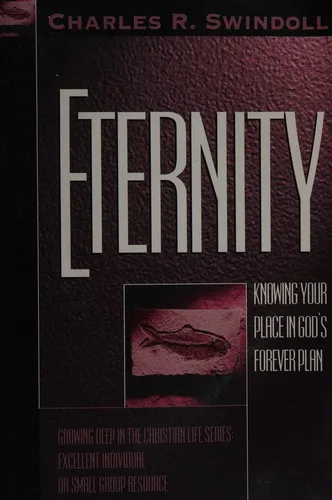
Eternity
 81
81

Eternity
Charles R. Swindoll's "Eternity" presents a clear, if conventional, theological exploration of divine timelessness. The strength lies in its accessible language, making complex ideas about God's relationship with time understandable to a broad audience. However, the work's primary limitation is its adherence to orthodox interpretations, offering little in the way of novel philosophical or esoteric perspectives that might challenge or expand upon established doctrines. A passage discussing God's omnipresence, wherein Swindoll argues God exists outside the linear progression of time we experience, is well-articulated but familiar. Ultimately, "Eternity" serves as a solid, albeit unadventurous, primer on its subject.
📝 Description
81
### What It Is Eternity by Charles R. Swindoll, first published in 1993, is a work that grapples with theological concepts of time, existence, and the divine.
### Who It's For This book is best suited for individuals engaged in theological studies, philosophy of religion, or those seeking a deeper understanding of Christian eschatology.
### Historical Context Published in 1993, Eternity emerged during a period of renewed interest in theological discussions surrounding the nature of God and the afterlife. It followed a decade where evangelical scholarship saw significant output, engaging with both classical doctrines and contemporary philosophical challenges.
### Key Concepts The work primarily explores concepts such as the nature of God's timelessness, the human perception of time, and the implications of eternal existence for believers. Swindoll examines biblical passages to construct his arguments.
💡 Why Read This Book?
• Understand the theological concept of divine timelessness, contrasting it with human temporal experience, as explored through Swindoll's interpretation of biblical texts. • Gain a clearer perspective on the author's specific interpretation of God's relationship with creation, as presented in his discussions of eternity. • Examine the book's approach to eschatology, specifically how it frames the Christian understanding of the afterlife and its temporal implications.
⭐ Reader Reviews
Honest opinions from readers who have explored this book.
❓ Frequently Asked Questions
What is the primary focus of Charles R. Swindoll's "Eternity"?
The primary focus of "Eternity" is the theological concept of God's timelessness and its implications for human existence and understanding of the divine.
When was "Eternity" by Charles R. Swindoll first published?
"Eternity" by Charles R. Swindoll was first published in 1993.
Does "Eternity" delve into philosophical debates about time?
While grounded in theological arguments, the work touches upon philosophical concepts of time as they relate to divine attributes and human perception.
Is "Eternity" considered an esoteric text?
While it explores deep theological concepts, its primary classification is within Christian theology rather than esoteric philosophy, though it can inform esoteric contemplation.
What biblical themes are central to "Eternity"?
Central biblical themes include God's eternal nature, the concept of the 'already and not yet', and the eternal destiny of believers.
Who is Charles R. Swindoll?
Charles R. Swindoll is an American evangelical Christian author and theologian, known for his accessible teaching on biblical subjects.
🔮 Key Themes & Symbolism
Divine Timelessness
The book grapples with the theological attribute of God's existence outside of linear time. Swindoll explores how this concept, often challenging to human comprehension, is presented in scripture. The work examines the paradox of an eternal being interacting with a temporal creation, suggesting God's perspective transcends our sequential experience of past, present, and future. This theme is crucial for understanding God's sovereignty and foreknowledge from a theological standpoint.
Human Perception of Time
Eternity contrasts God's eternal perspective with humanity's experience of time as a progression of moments. Swindoll discusses how our limited, temporal viewpoint shapes our understanding of divine action and prophecy. The work analyzes biblical narratives through this lens, highlighting how human limitations in perceiving time can affect faith and obedience. It emphasizes the need to adjust our temporal perspective to align with divine revelation.
Eschatological Implications
The book addresses the theological concept of the end times and the eternal state. Swindoll interprets biblical passages concerning heaven, hell, and the final judgment, framing them within the context of eternity. The discussions explore how an understanding of God's eternal nature informs Christian hope and the ultimate destiny of believers. It presents eternity not merely as endless duration but as a qualitatively different state of existence.
Scriptural Authority
Central to Swindoll's exploration is the reliance on biblical texts as the primary source for understanding eternity. The work systematically references and interprets various scripture passages to support its theological claims about God's attributes and future events. This focus underscores the author's commitment to a biblically-derived theology, where doctrine is founded upon scriptural exposition and exegesis.
💬 Memorable Quotes
“God exists outside of time.”
— This foundational statement suggests God's nature is not bound by the sequential flow of moments that define human experience. It implies a perspective that encompasses all of history simultaneously.
“Our perception of time is limited.”
— This highlights the human condition, emphasizing that our understanding of past, present, and future is a product of our finite existence, distinct from the infinite nature of the divine.
“Eternity is not just endless time.”
— This interpretation posits eternity as a state or dimension qualitatively different from mere duration, suggesting a realm or mode of being beyond temporal constraints.
“Scripture reveals God's eternal plan.”
— This suggests that the Bible serves as the authoritative guide to understanding divine purposes and actions, which are inherently tied to God's eternal perspective and will.
“Faith requires trusting in the unseen future.”
— This concept connects the human struggle with time and uncertainty to the practice of faith, urging a reliance on divine promises despite the inability to fully grasp future events.
🌙 Esoteric Significance
Tradition
While "Eternity" is firmly rooted in evangelical Christian theology, its exploration of timelessness and divine perspective can resonate with esoteric traditions that posit realities beyond ordinary sensory perception and temporal linearity. It aligns with Gnostic ideas of a transcendent Godhead and Hermetic principles of correspondence, albeit through a specific doctrinal lens.
Symbolism
The primary symbolic concept is 'eternity' itself, representing not just endless duration but a state of being outside temporal constraints, mirroring the concept of the Absolute or the Unmanifest in various mystical traditions. The 'divine perspective' serves as a symbol for an omniscient, non-linear awareness that contrasts sharply with human consciousness.
Modern Relevance
Contemporary discussions in contemplative Christianity and theological philosophy that re-examine classical doctrines of God's nature continue to find value in Swindoll's clear articulation. Thinkers exploring the intersection of science and theology, particularly regarding time and cosmology, might find the book's foundational theological statements useful for comparison.
👥 Who Should Read This Book
• Students of Christian theology seeking foundational texts on the nature of God and eschatology. • Lay readers interested in a clear, biblically-based exploration of theological concepts related to time and eternity. • Individuals engaged in comparative religious studies who wish to understand specific evangelical perspectives on the divine.
📜 Historical Context
Charles R. Swindoll's "Eternity," published in 1993, arrived within a landscape of evangelical theological writing that often sought to reconcile traditional doctrines with contemporary intellectual challenges. The preceding decades had seen robust debates in Christian philosophy and theology concerning divine attributes, hermeneutics, and eschatology. Swindoll's work can be seen in dialogue with scholars like J.P. Moreland, who was also actively engaging philosophical concepts with Christian theology during this period. While "Eternity" focuses on a specific aspect of God's nature, it contributes to the broader evangelical project of articulating a coherent Christian worldview. The reception was generally positive within its target audience, reinforcing established theological understandings rather than provoking controversy, unlike some more polemical theological works of the era.
📔 Journal Prompts
The concept of divine timelessness and its impact on prayer.
Reflecting on the human experience of time versus God's eternal perspective.
Scriptural interpretations of eternity presented in the book.
The implications of an eternal God for understanding history.
Connecting the book's view of eternity to personal faith and hope.
🗂️ Glossary
Timelessness
The theological attribute of God's existence outside of and independent from the linear progression of time. It suggests God is not bound by past, present, or future.
Eschatology
The theological study of 'last things,' including death, judgment, heaven, hell, and the ultimate destiny of humanity and the cosmos.
Divine Sovereignty
The doctrine that God has supreme authority and power over all creation, including the unfolding of history and human events.
Omnipresence
The attribute of being present everywhere at the same time; in theology, often discussed alongside timelessness to describe God's total reality.
Biblical Exegesis
Critical explanation or interpretation of a text, especially of the Bible, involving careful analysis of its original meaning and context.
Temporal
Relating to time; characterized by a limited duration or existence within a sequence of moments.
Eternal Plan
The concept that God has had a predetermined plan for creation and redemption existing within His eternal nature before time began.