Enneads
 81
81

Enneads
Plotinus’s Enneads remains a monumental, if demanding, achievement in philosophical and mystical literature. Porphyry’s posthumous compilation presents a coherent system, albeit one that requires considerable intellectual investment. The strength of the Enneads lies in its sustained effort to articulate the ineffable, to map the journey of the soul from the material world back to its divine source. The concept of emanation, particularly the descent of the Soul and its subsequent yearning for return, is rendered with a unique blend of abstract reasoning and spiritual urgency. However, the sheer density of the arguments can be a significant hurdle. Passages discussing the hypostases – the One, Intellect, and Soul – demand meticulous rereading. While the work offers profound conceptual architecture, its prose, even in translation, can feel relentlessly academic, sometimes obscuring the ecstatic heights it seeks to describe. The Enneads is a rigorous exploration of ultimate reality, best approached with patience and a dedicated mind.
📝 Description
81
### What It Is The Enneads is the collected philosophical writings of Plotinus, a significant figure in Neoplatonism. Compiled by his student Porphyry posthumously, the work is divided into nine books, each containing nine treatises. It presents a complex metaphysical system that posits a hierarchical structure of reality emanating from a singular, ineffable 'The One'. This foundational text explores the nature of the soul, the intellect, and the ultimate divine principle through rigorous philosophical argument.
### Who It's For This volume is for readers seeking to engage with the core texts of Western esoteric philosophy. It appeals to scholars of ancient philosophy, students of comparative religion, and individuals interested in the development of mystical thought. Those who appreciate detailed philosophical discourse and are willing to grapple with abstract concepts will find it rewarding. It is not introductory material but a deep dive into a seminal philosophical system.
### Historical Context Plotinus lived in the 3rd century CE, a period of intense intellectual and spiritual ferment in the Roman Empire. His philosophy emerged from a synthesis of Platonic thought with elements from Aristotle and Stoicism, developing into what is known as Neoplatonism. This movement offered a sophisticated philosophical framework that profoundly influenced later Christian, Jewish, and Islamic mystical traditions, as well as Renaissance humanism and modern occultism. His contemporaries included thinkers grappling with Gnosticism and earlier philosophical schools.
### Key Concepts The Enneads introduces several pivotal concepts central to Plotinus's thought. The treatise explores the nature of the 'One' (or the Good) as the ultimate, transcendent source from which all existence proceeds. It details the emanation of 'Intellect' (Nous) and 'Soul' (Psyche) from this One, forming a divine hierarchy. The work also discusses the human soul's potential for ascent back to the One through intellectual and spiritual purification, a process often described as 'ecstasy' or 'union'. The concept of 'Evil' is addressed as a privation or absence of the Good, rather than an independent substance.
💡 Why Read This Book?
• Learn about the Neoplatonic concept of 'the One' and its emanations, understanding a foundational influence on Western metaphysics and mysticism. • Grasp the soul's journey as described by Plotinus, exploring the path of ascent through Intellect and potential union with the divine. • Engage with a primary text that shaped subsequent philosophical and esoteric traditions, offering direct insight into the 3rd-century CE intellectual landscape.
⭐ Reader Reviews
Honest opinions from readers who have explored this book.
❓ Frequently Asked Questions
When was Plotinus alive and when were the Enneads compiled?
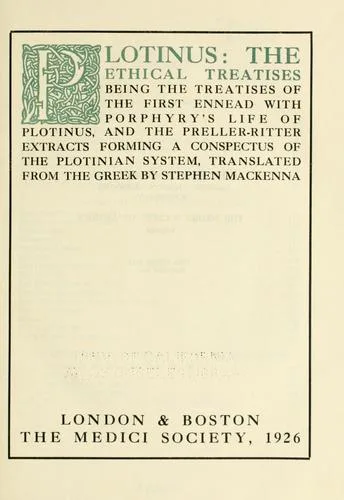
Plotinus lived during the 3rd century CE, roughly from 204/205 to 270 CE. His student Porphyry compiled and edited his writings into the Enneads after Plotinus's death, organizing them into nine books of nine treatises each.
What is the central philosophical concept in Plotinus's Enneads?
The central concept is the 'One' or the 'Good,' an ineffable, transcendent source from which all reality emanates in a hierarchical fashion, including Intellect (Nous) and Soul (Psyche).
How does Plotinus describe the nature of evil?
Plotinus views evil not as a positive force, but as a privation or absence of the Good, a falling away from the perfect order of the One, akin to darkness being the absence of light.
What is the significance of 'emanation' in the Enneads?
Emanation describes the process by which reality flows or radiates from the One without diminishing it. It's a hierarchical outflow, moving from the perfect simplicity of the One to the multiplicity of the material world.
What role does the human soul play in Plotinus's philosophy?
The human soul is seen as a divine spark, originating from the Soul (Psyche) that emanates from the One. Its purpose is to recollect its divine origin and ascend back towards union with the Intellect and the One.
How did Neoplatonism, as presented in the Enneads, influence later thought?
Neoplatonism, particularly through Plotinus's Enneads, deeply influenced early Christian theology (e.g., Augustine), Islamic philosophy, and later Renaissance thinkers and Western esoteric traditions.
🔮 Key Themes & Symbolism
The One and Emanation
The Enneads meticulously details Plotinus's concept of the One, the ultimate, ineffable source of all existence. This primary reality is beyond being and thought, yet it is the fount from which all subsequent levels of reality emanate. These emanations, including Intellect (Nous) and Soul (Psyche), are not separate creations but rather necessary overflows of the One's perfection. Understanding this doctrine of emanation is crucial for grasping Plotinus's cosmology and his view of the interconnectedness of all things within a divinely ordered hierarchy.
The Soul's Journey and Ascent
A central theme is the nature and destiny of the human soul. Plotinus describes the soul as having fallen from its divine origin, becoming entangled with the material world. The Enneads outlines a path of spiritual and intellectual purification, urging the soul to turn away from sensory distractions and towards the higher realms of Intellect and ultimately, the One. This ascent is often described as a process of recollection, remembrance, and ecstatic union, a return to the soul's true home.
Intellect and the Forms
The second hypostasis, Intellect (Nous), is presented as the realm of pure thought and the eternal Forms. It contains the blueprint of reality and is the locus of divine intelligence. Plotinus argues that Intellect is distinct from the One but derives its existence and nature from it. For the soul seeking to ascend, engaging with the realm of Intellect is a critical step, allowing it to apprehend the eternal verities before attempting the even more challenging union with the ineffable One.
Evil as Privation
Plotinus addresses the problem of evil by defining it as a lack of good, a privation, rather than an independent substance or force. In his hierarchical cosmology, evil arises from the furthest remove from the One, in the realm of matter, which is characterized by deficiency and formlessness. This concept offers a way to reconcile the existence of imperfection and suffering with the ultimate goodness and perfection of the divine source.
💬 Memorable Quotes
“We must not be surprised that the soul, when it leaves the body, has not yet reached the Good.”
— This highlights Plotinus's view that the soul's journey and purification do not cease with physical death. It implies a process of continued effort and potential further descent or ascent depending on the soul's orientation.
“The soul has become a stranger in its own land.”
— This metaphor captures the essence of the soul's alienation in the material world. It suggests a fundamental disconnect between the soul's true divine nature and its current embodiment and worldly concerns.
“The Intellect is the first principle after the One.”
— This statement defines the hierarchical structure of Plotinus's metaphysics. Intellect (Nous) is the immediate emanation from the ineffable One, serving as the realm of divine thought and the Forms.
“Evil is the last of the series, and therefore is not evil because it is last, but because it is last.”
— This is a paraphrase capturing Plotinus's idea that evil is not an active force but a consequence of distance from the Good. It is the furthest point from the One, inherently lacking the divine presence.
“All things are ordered in the best possible way.”
— This reflects Plotinus's belief in a divinely ordered cosmos. Despite the appearance of chaos or suffering, the entire reality, as an emanation from the Good, is fundamentally good and optimally arranged.
🌙 Esoteric Significance
Tradition
The Enneads is a foundational text for Neoplatonism, a philosophical and mystical tradition deeply intertwined with esoteric currents. While rooted in Greek philosophy, particularly Plato, Plotinus's system provided a metaphysical architecture that would be absorbed and reinterpreted by Hermeticism, Gnosticism, Kabbalah, and later Theosophy. It offered a hierarchical cosmology and a path of spiritual ascent that resonated with mystical aspirations across diverse traditions, acting as a bridge between classical philosophy and later esoteric doctrines.
Symbolism
Key symbolic motifs include the 'One' as the ultimate, ineffable source, often represented by concepts of light, unity, and absolute simplicity. 'Intellect' (Nous) symbolizes divine wisdom and the realm of eternal Forms, the blueprint of reality. The 'Soul' (Psyche) represents the animating principle and the individual's connection to the divine, often depicted as a spark yearning for its origin. The concept of 'ecstasy' or 'union' symbolizes the soul's ultimate goal – a transcendent, non-dualistic merging with the One.
Modern Relevance
Plotinus's Enneads continues to influence contemporary esoteric thinkers, philosophers, and spiritual practitioners. Its concepts of emanation, the nature of consciousness, and the soul's journey toward transcendence are revisited in various modern spiritual movements and philosophical inquiries. Thinkers in fields ranging from comparative mysticism to depth psychology often draw upon Plotinian ideas to explore consciousness, the self, and the relationship between the material and spiritual realms.
👥 Who Should Read This Book
• Students of Western Esotericism seeking primary source material on Neoplatonism and its influence on later mystical traditions. • Academic researchers in philosophy and comparative religion interested in the development of metaphysical thought in the ancient world. • Individuals on a spiritual or philosophical path who wish to engage with a rigorous and influential system of thought concerning the nature of reality and the soul's ultimate destiny.
📜 Historical Context
Plotinus (c. 204/205 – 270 CE) was a pivotal figure in the development of Neoplatonism during a dynamic period in the Roman Empire. His philosophical system, presented in the Enneads, emerged from and reacted to the intellectual milieu of the 3rd century CE, a time marked by the flourishing of various philosophical schools and the rise of Gnosticism. Plotinus sought to synthesize Platonic thought with Aristotelian and Stoic elements, creating a comprehensive metaphysical framework. His work offered a sophisticated alternative to the more mystical or dualistic tendencies found in some Gnostic systems. Neoplatonism, as articulated by Plotinus, would go on to exert a profound and lasting influence, shaping the theological and philosophical underpinnings of Christianity (notably through Augustine of Hippo), Islamic thought, and later Renaissance Neoplatonism, significantly impacting the intellectual landscape for centuries.
📔 Journal Prompts
The soul's entanglement with the material world: How does Plotinus's description of this state reflect your own experience?
Plotinus's concept of the One: What are the challenges and possibilities in contemplating an ineffable, transcendent source?
The Intellect (Nous) as the realm of Forms: How might understanding these eternal verities inform your perception of transient phenomena?
Reflecting on Evil as Privation: How does this perspective differ from viewing evil as an active force, and what are its implications?
The soul's potential for ascent: What practices or shifts in perspective might facilitate a return to one's divine origin, according to Plotinus?
🗂️ Glossary
The One (or The Good)
The ultimate, ineffable, transcendent principle from which all reality emanates. It is beyond being, thought, and all description, representing absolute unity and perfection.
Intellect (Nous)
The second hypostasis, emanating from the One. It is the realm of pure thought, containing the eternal Forms or Ideas, and is the source of divine intelligence.
Soul (Psyche)
The third hypostasis, emanating from Intellect. It is the animating principle of the universe and of individual beings, possessing a dual nature connecting the intelligible realm with the material world.
Emanation
The process by which reality flows or proceeds from the One, and subsequently from Intellect and Soul, in a hierarchical manner without diminishing the source. It is an outflow of divine being.
Privation
In Plotinus's philosophy, evil is understood not as a positive entity but as an absence or lack of the Good. It is a deficiency inherent in matter or in states furthest from the One.
Ecstasy (Ekstasis)
A state of transcendent awareness or rapture where the soul temporarily transcends its individual consciousness to achieve union with the divine, particularly with the One.
Forms (or Ideas)
The eternal, perfect archetypes or patterns that exist within the realm of Intellect (Nous). They are the intelligibles that the soul seeks to apprehend during its ascent.