Desert wisdom
 83
83

Desert wisdom
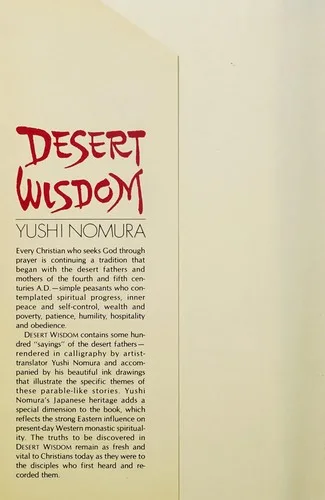
Yushi Nomura's "Desert Wisdom" is a text that demands patience, offering a potent distillation of contemplative thought. Its strength lies in its unflinching gaze upon the psychological crucible that extreme environments can forge. Nomura avoids the common pitfall of romanticizing solitude, instead presenting it as a stark, often challenging, arena for self-confrontation. The discussion surrounding the 'divine indifference' of the desert serves as a particularly powerful lens through which to examine egoic attachments. However, the book's esoteric density can, at times, feel somewhat abstract, requiring a significant interpretative effort from the reader to fully grasp its practical implications. A passage detailing the stripping away of societal conditioning feels particularly sharp, illustrating the book's core argument effectively. "Desert Wisdom" is a rigorous, if demanding, exploration for the serious spiritual seeker.
📝 Description
83
### What It Is Desert Wisdom, authored by Yushi Nomura and first published in 2000, offers a unique exploration of spiritual and philosophical concepts often found in ascetic traditions. It moves beyond simplistic interpretations of solitude, examining the profound psychological and metaphysical shifts that can occur when individuals confront vast, unyielding landscapes. The book analyzes how such environments serve as mirrors, reflecting the inner state of the seeker and challenging conventional perceptions of self and reality. Nomura's approach is less about geographical location and more about the internal 'desert' that individuals may encounter on their spiritual paths.
### Who It's For This work is intended for readers who are not satisfied with superficial spiritualities and seek a deeper, more rigorous engagement with their inner lives. It will appeal to those interested in comparative mysticism, the psychology of consciousness, and the philosophical implications of extreme environments on spiritual development. Individuals drawn to contemplative practices, hermeticism, or the study of asceticism will find fertile ground for reflection. It is particularly suited for those who appreciate a text that demands introspection and rewards careful, sustained reading.
### Historical Context Published at the turn of the millennium, Desert Wisdom emerged during a period of burgeoning interest in Eastern philosophies and contemplative practices within Western esoteric circles. While figures like Aldous Huxley had already popularized Indian spiritual traditions in the mid-20th century, Nomura's work presents a distinct perspective that focuses on the archetypal desert as a crucible for spiritual transformation. The book's publication in 2000 coincides with a growing awareness of the psychological benefits of mindfulness and solitude, albeit framed here within a more overtly metaphysical context. It stands apart from the New Age movement's often generalized approach, offering a more focused and philosophically dense examination.
### Key Concepts The central thesis revolves around the 'desert experience' as a potent catalyst for spiritual awakening. Nomura posits that the starkness and silence of desert environments strip away societal conditioning and egoic defenses, revealing underlying truths. Concepts such as 'emptiness' (sunyata, in Buddhist terms, though Nomura's usage is broader), 'divine indifference,' and the 'unfolding of the self' are explored not as abstract notions but as lived realities encountered in profound isolation. The text also touches upon the idea of the 'inner landscape' as being as significant, if not more so, than any physical desert.
💡 Why Read This Book?
• You will learn to recognize the 'inner landscape' as a spiritual crucible, similar to how Nomura describes the physical desert's role in spiritual development, allowing for a deeper understanding of personal challenges. • Gain insight into the concept of 'divine indifference' as presented in the book, enabling you to reframe your relationship with external validation and societal expectations. • Understand how the minimalist environment, as explored in the text, can serve to dismantle egoic defenses, providing a framework for cultivating authentic self-awareness beyond conventional practices.
⭐ Reader Reviews
Honest opinions from readers who have explored this book.
❓ Frequently Asked Questions
What is the central metaphor of Yushi Nomura's "Desert Wisdom"?
The central metaphor is the desert itself, not merely as a physical place, but as an internal state or experience. It represents a space of profound solitude and starkness that strips away egoic defenses and societal conditioning, facilitating spiritual insight.
When was "Desert Wisdom" by Yushi Nomura first published?
Yushi Nomura's "Desert Wisdom" was first published in the year 2000, marking its emergence at the turn of the millennium.
What kind of reader would most benefit from "Desert Wisdom"?
Readers seeking a rigorous, philosophical approach to spirituality, interested in contemplative practices, asceticism, and the psychology of consciousness would benefit most from this work.
Does "Desert Wisdom" focus on specific geographical deserts?
While it uses the desert as a primary metaphor, the book's focus is less on specific geographical locations and more on the archetypal experience of profound solitude and confrontation with emptiness.
What esoteric traditions does "Desert Wisdom" draw upon?
While not strictly adhering to one tradition, the work engages with themes common in asceticism, mysticism, and contemplative philosophies, including concepts akin to Buddhist emptiness and Gnostic detachment.
Is "Desert Wisdom" a practical guide for living in the desert?
No, it is not a practical guide for survival or living in a physical desert. Instead, it uses the desert as a metaphor for an internal spiritual journey of self-discovery and transformation.
🔮 Key Themes & Symbolism
The Desert as Inner Crucible
Nomura posits the desert not just as a physical location but as a potent metaphor for the inner spiritual journey. This 'desert experience' is characterized by profound solitude and a stripping away of external distractions and societal conditioning. It functions as a crucible, forcing the individual to confront their ego, fears, and attachments in the stark reality of their own consciousness. The vast, indifferent landscape mirrors the internal space where true self-discovery can unfold, moving beyond conventional psychological frameworks into a more metaphysical exploration of being.
Divine Indifference and Ego Annihilation
A core concept explored is the 'divine indifference' of the desert environment. This is not an absence of divinity, but a lack of anthropocentric concern. The universe, like the desert, operates on its own terms, indifferent to human desires and struggles. Nomura suggests that aligning with this indifference, rather than fighting against it, is key to ego annihilation. By ceasing to seek external validation or cosmic favoritism, the seeker can dissolve the self-centered illusion and experience a deeper connection to reality as it is.
The Unfolding Self in Emptiness
The book delves into the concept of 'emptiness' (akin to Eastern notions of sunyata) as a fertile ground for the self to unfold. In the absence of egoic structures and external definitions, a more authentic and essential self can emerge. This is not a nihilistic void but a space of pure potentiality. Nomura suggests that true spiritual progress involves embracing this emptiness, allowing the self to be reshaped and revealed through the process, rather than clinging to a fixed identity.
Confronting the Absolute
Through the metaphor of the desert, Nomura guides readers toward a confrontation with the Absolute. The stark environment, devoid of human artifice, offers a direct encounter with reality stripped bare. This confrontation can be disorienting, challenging deeply held beliefs about existence and purpose. However, it is through this direct, unmediated experience—this facing of the Absolute without the buffer of the ego—that profound spiritual transformation and liberation are possible, leading to a redefinition of one's place in the cosmos.
💬 Memorable Quotes
“The desert does not judge; it simply is. In its vastness, we find ourselves unadorned.”
— This highlights the non-judgmental nature of the archetypal desert experience. It serves as a mirror, reflecting the individual's true state without the imposition of external moral or social frameworks, fostering authentic self-confrontation.
“To seek solace in the desert is to find the silence that precedes all sound.”
— This suggests that the profound quietude of the desert is not merely an absence of noise, but a return to a primordial state of existence. It's a space where the fundamental reality, untouched by creation, can be perceived.
“The sand shifts, erasing every footprint. So too must the self be willing to yield.”
— This emphasizes the impermanence and the need for surrender. Just as the desert landscape is constantly reshaped by natural forces, the spiritual seeker must be willing to let go of rigid self-identity and allow for transformation.
“In the stark light of the desert sun, illusions of self begin to fracture.”
— This points to the clarifying and revealing power of the desert environment. The intense, unfiltered light exposes the false constructs and superficial aspects of the ego, initiating a process of disillusionment and spiritual awakening.
“The oasis is not found, but recognized when the thirst for illusion is quenched.”
— This redefines the concept of spiritual attainment. The 'oasis' of enlightenment or peace is not something to be sought externally, but an inner realization that dawns when the ego's desires and attachments are finally relinquished.
🌙 Esoteric Significance
Tradition
The work aligns broadly with ascetic and contemplative traditions found across various esoteric and religious lineages, including Hermeticism, Gnosticism, and certain schools of Buddhist thought (particularly regarding emptiness). It departs from strictly dogmatic adherence, instead extracting the universal principles of spiritual purification through isolation and self-confrontation. Nomura synthesizes these ideas into a coherent philosophy centered on the 'desert experience' as a catalyst for direct spiritual realization, independent of specific cultural or historical religious frameworks.
Symbolism
The primary symbol is the **Desert** itself, representing a state of profound solitude, emptiness, and existential clarity. It strips away the ego's defenses, revealing the raw nature of consciousness. Another key motif is **Stark Light**, symbolizing absolute truth or the unvarnished reality that exposes illusions and superficialities. The **Shifting Sands** symbolize impermanence and the necessity of letting go of fixed identities and attachments, encouraging fluidity and adaptability in the spiritual journey.
Modern Relevance
Contemporary interest in mindfulness, digital detox, and radical self-reliance echoes themes present in "Desert Wisdom." Thinkers and practitioners exploring deep introspection, the psychology of consciousness, and the benefits of solitude for mental and spiritual well-being can find a philosophical underpinning in Nomura's work. Its emphasis on confronting existential realities without succumbing to despair resonates with modern anxieties and the search for authentic meaning in a complex world.
👥 Who Should Read This Book
• Seekers of profound spiritual transformation who are weary of superficial self-help and desire a text that challenges their assumptions about the self and reality. • Students of comparative mysticism and philosophy interested in the archetypal role of extreme environments and solitude in spiritual traditions across cultures. • Individuals engaged in contemplative practices or undergoing periods of significant personal transition who seek a framework for understanding the psychological and metaphysical dimensions of their experiences.
📜 Historical Context
Yushi Nomura's "Desert Wisdom," published in 2000, arrived during a period where Western interest in Eastern contemplative traditions and mindfulness was significant, influenced by figures like Alan Watts and the spread of Zen Buddhism. However, Nomura's work distinguishes itself by focusing on the archetypal 'desert' as a unique spiritual crucible, rather than solely drawing from established Eastern doctrines. While thinkers like Mircea Eliade explored the symbolism of the desert in myth and ritual, Nomura applies this to a more direct, psychological, and metaphysical examination of spiritual transformation. The book's emergence can also be seen against the backdrop of a growing disillusionment with purely materialist worldviews, prompting a search for deeper meaning. It offered a more rigorous, less New Age-oriented path for those seeking profound inner change, differentiating itself from the broader 'spiritual but not religious' trends of the era.
📔 Journal Prompts
The desert as an inner crucible: Map the external conditions that mirror your internal spiritual challenges.
Reflect on the concept of 'divine indifference' and how it might liberate you from the need for external validation.
Explore the 'unfolding self': What aspects of your identity feel most fixed, and how might embracing 'emptiness' loosen their grip?
Confronting the Absolute: Describe a moment where you felt directly exposed to reality without egoic filters.
The symbolism of shifting sands: Identify areas in your life where clinging to a fixed position prevents growth.
🗂️ Glossary
Inner Landscape
Refers to the internal psychological and spiritual terrain of an individual, often explored metaphorically as a physical space like a desert, reflecting one's inner state and journey.
Desert Experience
The archetypal spiritual journey undertaken in profound solitude, characterized by the stripping away of ego and societal conditioning, leading to direct confrontation with fundamental truths.
Divine Indifference
The concept that the ultimate reality or divine principle operates without personal bias or concern for human affairs, demanding alignment rather than petition.
Ego Annihilation
The dissolution of the false, constructed self (ego) through rigorous spiritual practice, leading to a more authentic and unconditioned state of being.
Emptiness (Sunyata)
A Buddhist concept often translated as 'emptiness,' signifying the lack of inherent, independent existence in all phenomena, understood here as a fertile ground for spiritual unfolding.
Absolute
The ultimate, unconditioned reality or ground of being, beyond human comprehension and conceptualization, which the spiritual seeker may confront directly.
Stark Light
Symbolic of pure, unadulterated truth or reality that reveals illusions and superficialities, often associated with the harsh, clarifying illumination of the desert sun.