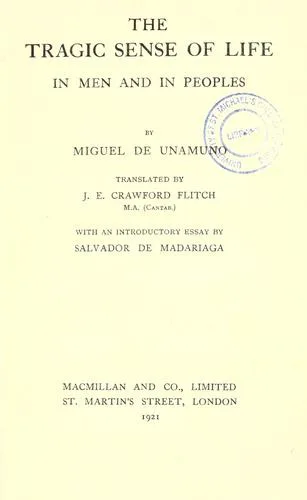
Del sentimiento trágico de la vida en los hombres y en los pueblos

 83
83

Del sentimiento trágico de la vida en los hombres y en los pueblos
Miguel de Unamuno’s "The Tragic Sense of Life" is less a book and more a philosophical wrestling match. Unamuno doesn't offer solace; he parades the existential anguish that defines humanity, particularly the relentless yearning for immortality against the stark reality of oblivion. His prose, especially when discussing the internal schism between reason and faith, possesses a raw, almost feverish intensity. A notable strength is his unflinching confrontation with doubt, refusing easy answers. However, the book’s relentless focus on this singular existential struggle can, at times, feel repetitive, its arguments circling back with a circularity that mirrors the very anxieties it describes. The passage where he dissects the "will to believe" as a desperate, almost biological imperative rather than a serene conviction, is particularly arresting. Ultimately, Unamuno forces a confrontation with one's own mortality and the desperate hope for something beyond it.
📝 Description
83
### What It Is 'Del sentimiento trágico de la vida en los hombres y en los pueblos' (The Tragic Sense of Life in Men and in Peoples), first published in 1921, is a philosophical and existential inquiry by Miguel de Unamuno. It is not a manual of occult practices but a deep exploration of the human condition, faith, doubt, and the perpetual struggle between reason and the yearning for immortality.
### Who It's For This work is for readers who grapple with fundamental questions about existence, mortality, and the nature of belief. It appeals to those interested in existential philosophy, the psychology of faith, and the intellectual currents of early 20th-century Spain, particularly as they intersect with spiritual and philosophical anxieties. It is for the thoughtful individual confronting the abyss of meaning.
### Historical Context Published in 1921, Unamuno's treatise emerged during a period of significant intellectual ferment across Europe. Spain itself was navigating post-colonial anxieties and internal philosophical debates. Unamuno's work can be seen in dialogue with thinkers like Søren Kierkegaard, whose own explorations of faith and despair predate Unamuno's but share a similar existential intensity. The era was also marked by burgeoning scientific rationalism, which Unamuno directly challenges.
### Key Concepts The book centers on the "tragic sense of life," a profound awareness of human finitude juxtaposed with an insatiable desire for eternal existence. Unamuno examines the conflict between the "will to believe" and the corrosive force of doubt, the role of suffering, and the search for meaning in a seemingly indifferent universe. He posits that this inherent tension, this "biting of the nails," is essential to a truly vital human existence.
💡 Why Read This Book?
• Understand the "tragic sense of life" concept, distinguishing it from mere pessimism by recognizing its roots in Unamuno's 1921 exploration of human finitude versus the desire for immortality. • Confront the intellectual tension between reason and faith, as Unamuno articulates this conflict in the early 20th century, challenging the prevailing rationalism of his time. • Grasp the "will to believe" not as a passive acceptance, but as an active, often desperate struggle for meaning that Unamuno details through his personal philosophical journey.
⭐ Reader Reviews
Honest opinions from readers who have explored this book.
❓ Frequently Asked Questions
What is the core philosophy behind Miguel de Unamuno's 'The Tragic Sense of Life'?
The core philosophy is the "tragic sense of life," which Unamuno, writing in 1921, describes as the fundamental human condition: the awareness of our mortality clashing with an insatiable desire for eternal existence and meaning.
How does 'The Tragic Sense of Life' relate to existentialism?
Published before existentialism became a widespread philosophical movement, Unamuno's work foreshadows key existential themes like anguish, the search for meaning in an absurd world, and the subjective experience of faith and doubt.
Who were Miguel de Unamuno's contemporaries that influenced or were influenced by his work?
Unamuno was part of the Generation of '98 in Spain. While direct engagement varied, his philosophical intensity echoes thinkers like Søren Kierkegaard, who also explored faith, doubt, and individual existence.
What is the 'will to believe' according to Unamuno?
For Unamuno, the 'will to believe' is not a rational conclusion but a profound, often desperate, human impulse to affirm faith and hope for immortality, even in the face of reason's skepticism.
Is 'The Tragic Sense of Life' a religious text?
It is not a religious text in the devotional sense. Rather, it's a philosophical exploration of faith, doubt, and the human struggle for spiritual meaning, deeply personal and critical of dogma.
What is the significance of 'pueblos' (peoples) in the title?
The inclusion of 'peoples' alongside 'men' suggests Unamuno's concern extends beyond individual existential crises to the collective consciousness and shared spiritual yearnings of nations or communities.
🔮 Key Themes & Symbolism
Finitude vs. Immortality
Unamuno's central thesis revolves around the stark contrast between humanity's awareness of its inevitable death (finitude) and the deep-seated, almost biological, yearning for eternal life (immortality). This tension is not a problem to be solved but the very engine of human consciousness and the source of the "tragic sense." He argues that this awareness fuels our deepest desires, our greatest fears, and our most fervent hopes, making the struggle for meaning a defining characteristic of being human, first articulated in his 1921 work.
Reason vs. Faith
The book meticulously dissects the perpetual conflict between rational thought, which often leads to doubt and an awareness of mortality, and the vital "will to believe," which seeks solace and meaning in faith, particularly in the promise of an afterlife. Unamuno posits that this internal battle is inescapable and that a life lived authentically must acknowledge both forces. He does not advocate for blind faith but for a faith born from the desperate need to transcend the limitations imposed by reason alone.
The "Biting of the Nails"
This evocative phrase captures the essence of Unamuno's concept of existential anxiety and the active struggle for meaning. It refers to the restless, gnawing unease that arises from confronting our mortality and the potential meaninglessness of existence. This is not passive despair but an active, often painful, engagement with life's fundamental questions. Unamuno suggests that this perpetual internal "gnawing" is what keeps the human spirit alive and striving, a core idea presented in his 1921 publication.
Suffering and the Human Condition
Unamuno views suffering not merely as an unfortunate byproduct of existence but as integral to the human experience and the pursuit of spiritual significance. He argues that it is through struggle, pain, and the confrontation with loss that we truly understand our own humanity and our desperate need for something beyond the ephemeral. The book suggests that embracing this suffering is key to a profound, albeit tragic, appreciation of life.
💬 Memorable Quotes
“The ultimate problem of philosophy is the problem of the immortality of the soul.”
— This statement encapsulates Unamuno's central preoccupation. He argues that all other philosophical inquiries—about God, meaning, or morality—ultimately stem from humanity's desperate need to believe in and achieve eternal existence beyond the physical body.
“Faith is the eternal struggle of reason against the abyss.”
— This highlights the dynamic and often agonizing relationship between rational thought and the innate human desire for belief. Unamuno sees faith not as a passive acceptance but as an active, ongoing battle against doubt and the terrifying void of meaninglessness.
“To live is to carry death within us.”
— This concise phrase reflects the core of the 'tragic sense of life.' It means that the awareness of our own mortality is not an external fact but an internal component of our very existence, shaping every moment.
“We have to create God by ourselves.”
— This suggests that the concept of God and the belief in a higher power are not divinely revealed truths but human constructs born out of our profound existential needs and our 'will to believe'.
“The worst thing is not to die, but to have lived without living.”
— Unamuno implies that a life devoid of existential struggle, authentic feeling, and the pursuit of meaning is a far greater tragedy than physical death itself. He values intensity and struggle over mere existence.
🌙 Esoteric Significance
Tradition
While not strictly aligned with a single esoteric lineage like Hermeticism or Kabbalah, Unamuno's work deeply engages with the Gnostic struggle between the finite human condition and a yearning for transcendent meaning or immortality. His emphasis on the internal battle against doubt and the search for spiritual substance within the individual echoes Gnostic themes of inner knowledge and liberation from material limitations, albeit framed through a Catholic existential lens rather than a purely mystical one.
Symbolism
The primary 'symbol' Unamuno employs is the human consciousness itself, torn between the rational intellect and the passionate will to believe. The 'abyss' represents the void of meaninglessness and death, a constant presence against which faith struggles. The 'biting of the nails' symbolizes the restless, consuming anxiety and the active, persistent nature of existential yearning, a motif representing the internal torment that drives the search for enduring significance.
Modern Relevance
Contemporary thinkers grappling with nihilism, the crisis of faith in secular societies, and the psychological toll of mortality find resonance in Unamuno's unflinching analysis. His work informs discussions in existential psychology and philosophy of religion, particularly concerning the subjective experience of belief and the persistent human need for transcendence, influencing those who explore the intersection of personal struggle and spiritual seeking.
👥 Who Should Read This Book
• Individuals wrestling with the tension between scientific understanding and a desire for spiritual meaning, seeking philosophical frameworks beyond traditional dogma. • Students of existential philosophy and literature who wish to understand pre-WWII European thought and the roots of existentialist concerns. • Readers interested in the intellectual history of Spain and the philosophical responses to modernity from the early 20th century.
📜 Historical Context
Miguel de Unamuno’s "Del sentimiento trágico de la vida en los hombres y en los pueblos," published in 1921, emerged from the intellectual landscape of early 20th-century Spain, a period marked by the lingering effects of the Spanish-American War and the philosophical inquiries of the Generation of '98. Unamuno’s work grappled with existential questions that mirrored those explored by European contemporaries like Søren Kierkegaard, though Unamuno developed a distinct voice focused on the Spanish psyche. While not a direct philosophical school, existentialism as a burgeoning current found fertile ground in Unamuno's passionate exploration of faith, doubt, and the human yearning for immortality. The prevailing scientific rationalism of the era provided a backdrop against which Unamuno’s passionate, faith-driven arguments stood in stark relief, challenging the intellectual currents that sought to explain existence solely through empirical means.
📔 Journal Prompts
The human yearning for immortality versus the certainty of finitude.
The internal conflict between reason and the 'will to believe'.
The nature of existential suffering as depicted by Unamuno.
Reflecting on the 'biting of the nails' in personal experience.
The creation of meaning in a seemingly indifferent universe.
🗂️ Glossary
Tragic Sense of Life
Unamuno's concept describing the fundamental human condition: the awareness of our mortality (finitude) juxtaposed with an insatiable desire for eternal existence and meaning, creating a perpetual inner conflict.
Will to Believe
The innate, often desperate, human impulse to affirm faith, hope, and the pursuit of immortality, even when reason suggests otherwise. It's a vital force driving the search for meaning.
Finitude
The state of being limited, especially the awareness of one's own mortality and the finite nature of human existence within the universe.
Immortality
The concept of eternal life or unending existence, a central object of human desire and a key element in Unamuno's philosophical struggle against oblivion.
Abyss
A metaphor for the void, meaninglessness, and the terrifying reality of death that confronts human consciousness, against which faith and the will to believe struggle.
Generation of '98
A group of Spanish writers, poets, and essayists profoundly affected by the moral and political crisis of Spain in 1898 after the loss of its last colonies. Unamuno was a leading figure.
Biting of the Nails
An idiom used by Unamuno to represent the restless, gnawing anxiety and existential struggle that arises from confronting mortality and the search for meaning.