Crop Circles
 81
81

Crop Circles
Hugh Manistre's "Crop Circles" offers a compelling, if sometimes overly earnest, exploration of a phenomenon that captured imaginations at the turn of the millennium. The strength of the book lies in its detailed cataloging of early formations and its persistent attempt to find meaningful patterns, particularly its focus on the geometric precision and symbolic potential of the designs. Manistre’s exploration of how these formations might relate to ancient sacred sites and astronomical events is particularly well-argued for its time. However, the work occasionally falters by leaning too heavily on speculative interpretations without sufficient grounding in verifiable evidence, a common pitfall in esoteric literature. The chapter discussing potential links between circle formations and geomagnetic anomalies, while intriguing, could have benefited from more rigorous scientific interfacing. Ultimately, "Crop Circles" serves as a valuable historical document of early esoteric engagement with the phenomenon, offering a unique perspective on a visual language that continues to mystify.
📝 Description
81
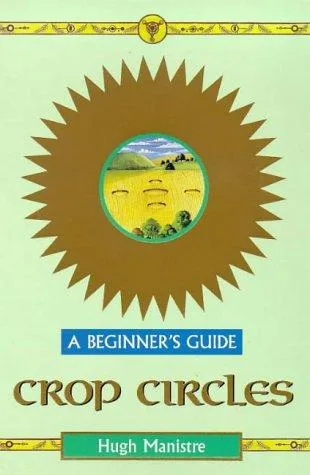
### What It Is Crop Circles, first published in 1999 by Hugh Manistre, is a foundational text examining the phenomenon of geometric patterns appearing in agricultural fields. It moves beyond simple observation to explore potential origins, meanings, and the impact of these formations on human consciousness and esoteric thought. The book presents a methodical inquiry into the visual language of the circles.
### Who It's For This work is essential for researchers of aerial phenomena, ufology, and anomalous crop formations. It will also appeal to those interested in archaeoastronomy, sacred geometry, and the intersection of natural patterns with human interpretation. Students of comparative mythology and esoteric symbolism will find connections to broader patterns of meaning.
### Historical Context The late 20th century saw a surge of public interest in crop circles, particularly with formations becoming more elaborate and widespread. This period was marked by both intense scientific skepticism and a growing esoteric fascination. Manistre's work emerged within this milieu, contributing to a discourse that sought to contextualize these events within historical and mystical frameworks, contrasting with purely scientific or hoaxes-only explanations.
### Key Concepts The book dissects the symbolic language embedded within crop circle designs, often referencing ancient geometries and celestial alignments. It explores theories linking these formations to energetic phenomena, consciousness shifts, and even extraterrestrial or interdimensional communication. The concept of the circle itself as a primal symbol of unity and the cosmos is central.
💡 Why Read This Book?
• Understand the early esoteric interpretations of crop circles, learning how Manistre linked their geometry to concepts like sacred geometry and celestial alignments observed in the 1990s. • Gain insight into the historical context of crop circle study in 1999, appreciating the cultural and intellectual climate that fostered such investigations. • Explore the symbolic language of specific formations, discovering how Manistre interpreted their patterns as potential messages or energetic signatures.
⭐ Reader Reviews
Honest opinions from readers who have explored this book.
❓ Frequently Asked Questions
When was the first edition of Crop Circles published?
The first edition of Hugh Manistre's "Crop Circles" was published in 1999, a period of significant public and esoteric interest in the phenomenon.
What is the main focus of Hugh Manistre's book?
The book primarily focuses on the interpretation of crop circle patterns, exploring their potential symbolic meanings, geometric significance, and connections to esoteric traditions and consciousness.
Does the book discuss theories about the origin of crop circles?
Yes, "Crop Circles" by Hugh Manistre delves into various theories regarding the origin of these formations, including those involving energetic phenomena, consciousness, and non-human intelligence.
Is "Crop Circles" considered an esoteric text?
Yes, the book is categorized as esoteric, examining the crop circle phenomenon through lenses of symbolism, sacred geometry, and mystical interpretation rather than purely scientific or skeptical viewpoints.
What kind of reader would appreciate this book?
Readers interested in ufology, anomalous phenomena, sacred geometry, comparative mythology, and the historical development of esoteric thought regarding crop circles would find this book valuable.
What historical period does the book primarily cover regarding crop circles?
While Manistre's work is from 1999, it often references earlier formations and the burgeoning period of crop circle appearances that gained significant attention in the late 20th century.
🔮 Key Themes & Symbolism
Sacred Geometry and Design
Manistre's work extensively analyzes the geometric precision found in crop circles, positing that these patterns are not random but imbued with meaning. The book explores how these designs often echo ancient symbols, mandalas, and architectural principles, suggesting a connection to universal laws of form and harmony. The application of the Golden Ratio and fractal patterns within formations is discussed as evidence of an underlying intelligent design, linking the terrestrial phenomenon to cosmic order and esoteric principles of creation.
Consciousness and Energetic Phenomena
A significant theme is the potential impact of crop circles on human consciousness and their relationship to subtle energies. The book investigates anecdotal accounts of altered states of awareness experienced by individuals near formations, as well as theories suggesting crop circles are manifestations of Earth energies or unknown energetic fields. Manistre explores how these formations might act as focal points for energy, influencing both the local environment and the observer's perception.
Symbolism and Ancient Analogues
The book draws parallels between crop circle motifs and symbols found in ancient cultures, mythologies, and religious traditions. Manistre examines how recurring geometric shapes and arrangements in circles mirror symbols from hermeticism, Kabbalah, and indigenous cosmologies. This comparative approach suggests that crop circles tap into a universal symbolic language, offering a modern manifestation of ancient wisdom and archetypal imagery.
The 'Unknown' Origin Debate
Rather than definitively assigning an origin, Manistre's "Crop Circles" navigates the various hypotheses surrounding their creation. It critically examines both natural and artificial explanations, including hoaxes, but dedicates substantial attention to more esoteric possibilities such as extraterrestrial or interdimensional intelligence, atmospheric plasma, or even Earth-based consciousness. The book aims to expand the discourse beyond simple debunking.
💬 Memorable Quotes
“The geometric elegance of the formations suggests a deliberate artistry beyond mere chance.”
— This interpretation highlights the author's view that the complexity and precision of crop circles point towards an intelligent source, emphasizing their aesthetic and mathematical qualities as evidence of design.
“Many circles exhibit fractal characteristics, mirroring natural growth patterns.”
— This paraphrased concept suggests that the self-similar patterns found in some crop circles are not arbitrary but reflect fundamental principles of natural organization and cosmic mathematics.
“Encountering a formation can induce altered states of perception in observers.”
— This speaks to the idea that crop circles possess an energetic or psychological quality that affects individuals who are in close proximity, potentially opening them to new ways of seeing or experiencing reality.
“The symbolism within the circles often aligns with ancient cosmological diagrams.”
— This highlights the author's exploration of how the visual language of crop circles connects to established esoteric traditions and historical representations of the cosmos and universal order.
“We must consider possibilities beyond conventional explanations for these aerial inscriptions.”
— This emphasizes the book's invitation to explore unconventional hypotheses, encouraging readers to remain open to a wide range of potential origins and meanings for the crop circle phenomenon.
🌙 Esoteric Significance
Tradition
Manistre's work fits within the broader tradition of Western Esotericism, particularly drawing from Hermeticism and archetypal psychology. It seeks to find universal patterns and symbolic meanings in contemporary phenomena, aligning with the Hermetic principle of 'As Above, So Below.' The book departs from purely occult magical practices by focusing on interpretation of external signs rather than direct invocation, but it shares the goal of uncovering hidden knowledge and divine order within the material world.
Symbolism
Key symbols analyzed include the circle itself, representing wholeness, unity, and the cosmos, and intricate geometric designs like fractals and sacred geometric forms (e.g., the Seed of Life). Manistre interprets these as visual representations of fundamental universal laws, energetic principles, or even encoded messages from non-human intelligences, connecting them to ancient mandalas and cosmograms used for meditation and understanding.
Modern Relevance
Contemporary interest in sacred geometry, consciousness studies, and the interpretation of synchronistic events continues to draw upon the foundational work of authors like Manistre. Researchers in fields such as cymatics (the study of visible sound and vibration) and those exploring the intersection of art, science, and spirituality find resonance with his early analyses. The book's approach to interpreting complex visual patterns as potentially meaningful communication remains relevant for understanding modern symbolic languages and phenomena.
👥 Who Should Read This Book
• Researchers of anomalous phenomena: Those investigating crop circles, UFOs, and unexplained aerial events will find this book a valuable record of early esoteric interpretations. • Students of sacred geometry: Individuals interested in the mathematical and symbolic patterns found in nature and ancient art will appreciate the detailed analysis of geometric designs. • Esoteric scholars: Anyone studying the history of Western Esotericism and how contemporary events are integrated into mystical frameworks will find this a relevant case study.
📜 Historical Context
Published in 1999, Hugh Manistre's "Crop Circles" arrived during a period of intense global fascination with these mysterious agricultural patterns. The late 20th century saw an explosion in the complexity and number of formations reported, shifting the discourse from mere curiosities to phenomena demanding deeper investigation. Manistre's work emerged within a burgeoning esoteric subculture that sought to interpret these events not as hoaxes or natural occurrences alone, but as meaningful communications. This era was characterized by the rise of the internet, which facilitated the rapid dissemination of images and theories. While scientific bodies largely remained skeptical, figures like Colin Andrews were documenting formations and advocating for serious study, providing a backdrop against which Manistre's more symbolic and mystical interpretations could find an audience. The book implicitly engaged with the growing field of ufology and paranormal research, seeking to place crop circles within a broader context of anomalous aerial phenomena.
📔 Journal Prompts
The deliberate artistry in crop formations: Reflect on the concept of intentional design in nature or human creations.
Geometric patterns as universal language: How might visual symbols convey meaning across different cultures or species?
Energetic influence of symbols: Consider the potential impact of geometric forms on consciousness or environment.
Crop circles as modern mandalas: Explore the parallels between these formations and traditional meditative symbols.
Interpreting anomalous phenomena: What frameworks can help understand events that defy conventional explanation?
🗂️ Glossary
Sacred Geometry
The study of geometric shapes and patterns that are considered fundamental to the structure of the universe and often found in nature, art, and architecture, believed to hold symbolic or spiritual significance.
Fractal
A complex geometric pattern that exhibits self-similarity at different scales; it is created by repeating a simple process over and over in an ongoing feedback loop.
Hermeticism
A philosophical and religious tradition based on writings attributed to Hermes Trismegistus, emphasizing divine wisdom, the interconnectedness of all things, and the potential for human spiritual enlightenment.
Archetype
In Jungian psychology, a universal, archaic pattern and image that derive from the collective unconscious and are the experiences of the human race.
Synchronicity
The occurrence of events that appear meaningfully related but lack a causal connection, often interpreted as significant coincidences.
Cymatics
The study of visible sound and vibration, often involving the creation of patterns in a medium like sand or liquid by applying sound frequencies.
Esoteric
Intended for or likely to be understood by only a small number of people with a specialized knowledge or interest; relating to mystical or occult matters.