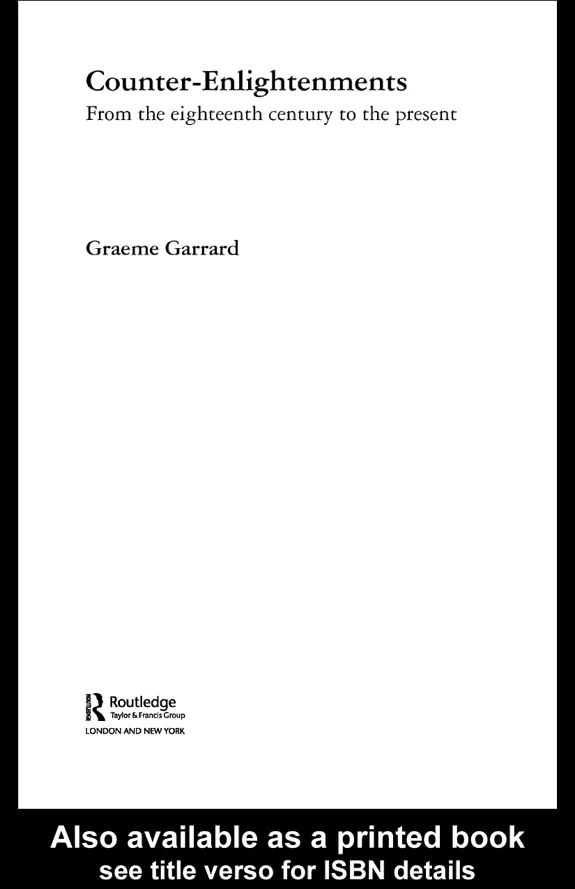
Counter-Enlightenments
 74
74

Counter-Enlightenments
Graeme Garrard’s *Counter-Enlightenments* navigates the intellectual terrain that questions the very foundations of the Enlightenment project. Garrard meticulously traces a lineage of thought that has consistently pushed back against reason’s presumed supremacy and the teleological march of progress. A significant strength lies in the author’s clear exposition of complex philosophical arguments, making accessible the critiques leveled by figures often relegated to the margins of standard intellectual histories. For instance, his treatment of the German Romantics’ engagement with tradition offers a compelling alternative to the narrative of linear intellectual development. However, the book's breadth, while impressive, occasionally leads to a sense of survey rather than deep engagement with any single counter-Enlightenment thinker. The section on Nietzsche, while informative, feels somewhat condensed given his pivotal role. Garrard’s work is a valuable contribution for those seeking to understand the persistent critiques of modernity, though readers seeking an exhaustive analysis of every dissenting voice might find it a starting point rather than an endpoint.
📝 Description
74
### What It Is Counter-Enlightenments offers a critical examination of the intellectual and philosophical currents that have challenged the dominance of Enlightenment ideals since their inception. Published in 2004, Graeme Garrard’s work maps a complex lineage of thought that questioned reason's absolute authority, the universality of human rights, and the progressive narrative of history.
### Who It's For This book is intended for readers interested in the history of Western philosophy, particularly those who want to understand the underpinnings of anti-Enlightenment thought. It appeals to students of political theory, cultural studies, and anyone seeking to grasp the intellectual roots of postmodernism and critiques of modernity. It is for those who question the foundational assumptions of liberal democracy and secular humanism.
### Historical Context Garrard situates his analysis within the broader intellectual landscape that reacted against the perceived limitations of Enlightenment universalism. The work engages with thinkers who emerged in the wake of the French Revolution and continued through the 20th century, a period marked by profound social and political upheaval. Key figures and movements that grappled with these ideas include German Romanticism, post-structuralism, and various forms of critical theory, all of which offered alternatives or critiques to the Enlightenment project's emphasis on reason and progress.
### Key Concepts The book explores concepts such as the critique of universalism, the nature of tradition versus reason, and the challenges posed to secular modernity. It investigates how certain thinkers sought to re-evaluate pre-Enlightenment modes of thought, including religious or mythical worldviews, as potentially offering richer frameworks for understanding human existence than purely rationalist approaches. The work also examines the historical moments when these counter-currents gained significant traction, often in response to perceived failures or excesses of the Enlightenment's legacy.
💡 Why Read This Book?
• Gain a nuanced understanding of thinkers who challenged Enlightenment universalism, such as Joseph de Maistre, and grasp their critiques of reason's limitations. • Explore the intellectual currents that reacted against the French Revolution’s perceived excesses, understanding how figures like Carl Schmitt re-evaluated the nature of political authority. • Discover alternative frameworks for understanding tradition and modernity, learning how the 20th century saw renewed interest in pre-Enlightenment modes of thought as presented in the book's analysis of figures like Hans-Georg Gadamer.
⭐ Reader Reviews
Honest opinions from readers who have explored this book.
❓ Frequently Asked Questions
What is the central argument of Graeme Garrard's Counter-Enlightenments?
The book argues that a significant and persistent intellectual tradition has existed since the Enlightenment, actively critiquing its core tenets of reason, progress, and universalism, offering alternative philosophical and political frameworks.
Which historical periods or movements does Counter-Enlightenments primarily focus on?
It examines thinkers and movements that emerged from the late 18th century onwards, reacting to the French Revolution and continuing through the 20th century, including Romanticism, conservatism, and various forms of critical theory.
Who are some key figures discussed in Counter-Enlightenments?
The work engages with a range of thinkers including Edmund Burke, Joseph de Maistre, Carl Schmitt, Hans-Jürgen Syberberg, and Hans-Georg Gadamer, among others who offered critiques of Enlightenment philosophy.
What does the book mean by 'counter-Enlightenment'?
'Counter-Enlightenment' refers to intellectual and philosophical traditions that oppose or question the foundational principles of the 18th-century Enlightenment, such as radical empiricism, faith in progress, and universal human reason.
How does Counter-Enlightenments relate to postmodernism?
The book explores the intellectual precursors to postmodernism, showing how critiques of universalism, grand narratives, and the authority of reason, developed by counter-Enlightenment thinkers, paved the way for later postmodern thought.
Is Counter-Enlightenments a defense of pre-Enlightenment ideas?
No, the book is an analytical exploration and historical tracing of counter-Enlightenment thought, not necessarily an endorsement. It examines these critiques objectively, understanding their historical significance and philosophical content.
🔮 Key Themes & Symbolism
Critique of Universalism
The book dissects the Enlightenment's ambition to establish universal principles of reason and governance, highlighting how counter-Enlightenment thinkers have consistently challenged these claims. It examines arguments that universal reason might suppress diverse traditions or particularities. For example, the work explores how figures like Joseph de Maistre viewed universal declarations of rights as abstract and detached from the realities of human society and established order, suggesting that local customs and traditions provided a more authentic basis for social cohesion.
Tradition vs. Reason
A central theme is the tension between Enlightenment emphasis on rational inquiry and the counter-Enlightenment valorization of tradition, authority, and historical inheritance. Garrard investigates how thinkers have argued that tradition embodies accumulated wisdom that rationalism alone cannot grasp. The work delves into how Romantic thinkers and later conservatives saw tradition not as an obstacle to progress, but as a vital source of meaning, identity, and social stability, often critiquing the perceived destructive potential of unchecked rationalism.
The Nature of Modernity
Counter-Enlightenments scrutinizes the very concept of modernity, questioning the Enlightenment narrative of inevitable progress and secularization. It explores how critics have viewed modern society as potentially alienating or spiritually impoverished due to its reliance on rational-technical modes of thought. The book examines arguments that the perceived failures or excesses of modernity, such as the World Wars, demonstrated the limitations of Enlightenment ideals and spurred a re-evaluation of alternative worldviews.
Political Authority and Order
The work engages with counter-Enlightenment perspectives on political authority, order, and legitimacy. It contrasts Enlightenment ideals of popular sovereignty and individual rights with views emphasizing organic social structures, historical continuity, and the necessity of strong, often divinely sanctioned, authority. Thinkers like Carl Schmitt are analyzed for their critiques of liberal constitutionalism and their theories on sovereignty and the political, which often stem from a deep suspicion of Enlightenment rationalism's capacity to maintain social order.
💬 Memorable Quotes
“The Enlightenment's universal claims were often met with a defense of particular traditions.”
— This highlights a core conflict: the Enlightenment sought overarching principles applicable everywhere, while its critics emphasized the unique value and validity of specific historical, cultural, or religious ways of life.
“Reason alone proved insufficient to grasp the complexities of human society.”
— This paraphrased concept suggests that intellectual traditions opposing the Enlightenment argued that purely rational analysis fails to account for the emotional, spiritual, and historical dimensions of human experience and social organization.
“The narrative of progress was seen by some as a destructive illusion.”
— This points to a critique where the idea of inevitable societal improvement, central to Enlightenment thought, was viewed by counter-Enlightenment thinkers as potentially leading to the erosion of valuable past achievements or a disregard for enduring human truths.
“Authority derived from tradition offered a more stable foundation than abstract rights.”
— This interpretation captures an argument that established customs and historical legitimacy provide a more secure basis for social order and governance than the Enlightenment's focus on individual rights, which could be seen as destabilizing.
“Secularization was not an inevitable or purely positive development.”
— This reflects a perspective that challenged the Enlightenment's assumption that the decline of religious influence was inherently good or an irreversible trend, suggesting that secular modernity had its own significant drawbacks.
🌙 Esoteric Significance
Tradition
While *Counter-Enlightenments* is primarily a work of intellectual history and philosophy, its engagement with thinkers who prioritize tradition, myth, and non-rational modes of understanding can resonate with esoteric traditions. It explores how certain philosophies, reacting against Enlightenment rationalism, implicitly or explicitly validate worldviews that are often found in esoteric lineages—those that emphasize intuition, symbolic interpretation, and a holistic understanding of reality beyond empirical verification. The book's examination of conservatism and Romanticism touches upon areas that have historically intersected with esoteric thought, particularly in their valorization of ancient wisdom and hidden knowledge.
Symbolism
The book indirectly engages with symbolism by discussing thinkers who saw value in pre-rational forms of knowledge and social organization. While not explicitly analyzing esoteric symbols, it explores the concept of tradition as a symbolic repository of collective wisdom, often expressed through myths, rituals, and established social orders. The critique of abstract universalism can be seen as a call to recognize the symbolic power of particular cultures and historical narratives, which often hold deeper, less literal meanings that resonate with esoteric interpretations of reality.
Modern Relevance
Contemporary thinkers and movements that question secularism, critique liberal universalism, and seek alternative frameworks for meaning and order often draw on the intellectual currents discussed in *Counter-Enlightenments*. This includes certain strands of post-structuralism, traditionalist philosophy (e.g., René Guénon, Julius Evola, though not directly covered, their intellectual lineage shares critiques with those examined), and political thought that emphasizes cultural particularity and historical continuity. For those in esoteric circles, the book provides an intellectual grounding for understanding why many esoteric traditions were historically marginalized by the Enlightenment's rise and why their re-evaluation holds contemporary significance.
👥 Who Should Read This Book
• Students of philosophy and political theory seeking to understand critiques of modernity and the Enlightenment legacy, particularly those interested in figures like Carl Schmitt or Edmund Burke. • Readers of cultural studies and intellectual history looking to explore the lineage of anti-universalist thought and its impact on contemporary debates about identity and relativism. • Individuals interested in alternative philosophical frameworks that question the dominance of scientific rationalism, offering insights into the enduring appeal of tradition and historical authority.
📜 Historical Context
Published in 2004, Graeme Garrard's *Counter-Enlightenments* emerged at a time when critiques of modernity and foundational Western philosophical assumptions were prominent in academic discourse. The book situates itself within a long intellectual tradition that has questioned the Enlightenment's legacy since its inception. Key figures like Edmund Burke, writing in the late 18th century, offered early critiques of the French Revolution's rationalist excesses, foreshadowing later counter-Enlightenment thought. Garrard engages with thinkers such as Carl Schmitt, whose work in the mid-20th century challenged liberal democracy and the universality of law, and Hans-Georg Gadamer, who explored the role of tradition in understanding. The intellectual currents Garrard examines stand in opposition to the progressive, rationalist narratives championed by Enlightenment figures like Immanuel Kant and the French *philosophes*. While not a direct engagement, the reception of thinkers like Schmitt by scholars in political theory and legal studies in the late 20th century provided a fertile ground for Garrard's analysis.
📔 Journal Prompts
The critique of universalism as presented by Joseph de Maistre.
The concept of tradition as a source of wisdom, distinct from reason.
Carl Schmitt's notion of the political and its relation to order.
The Romantic valorization of myth and history.
The perceived limitations of progress narratives in modernity.
🗂️ Glossary
Enlightenment
An 18th-century intellectual and cultural movement emphasizing reason, individualism, and skepticism towards tradition and authority, advocating for progress and universal human rights.
Counter-Enlightenment
A diverse range of philosophical and intellectual traditions that emerged in opposition to or critique of the core tenets of the Enlightenment, often emphasizing tradition, authority, and particularity.
Universalism
The philosophical belief that certain principles, values, or truths are applicable to all people, regardless of their culture, history, or context.
Romanticism
An artistic, literary, musical, and intellectual movement that originated in Europe toward the end of the 18th century, characterized by an emphasis on emotion, individualism, glorification of the past and nature, and skepticism towards Enlightenment rationalism.
Secularization
The historical process by which religious institutions, beliefs, and practices lose social significance and influence in a society, often associated with the rise of Enlightenment rationalism and modernity.
Tradition
The transmission of customs, beliefs, or knowledge from generation to generation, often viewed by counter-Enlightenment thinkers as a source of accumulated wisdom and social cohesion.
Sovereignty
Supreme power or authority; in political theory, the authority of a state to govern itself or another state.