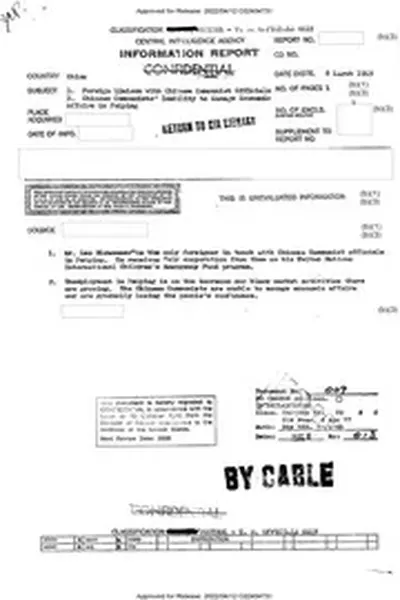
CIA Reading Room cia-rdp58-00453r000300010128-1: PATENTS - A BILL TO WITHHOLD CERTAIN PATENTS THAT MIGHT BE DETRIMENTAL TO THE NATIONAL SECURITY, AND FOR OTHER PURPOSES.

 84
84

CIA Reading Room cia-rdp58-00453r000300010128-1: PATENTS - A BILL TO WITHHOLD CERTAIN PATENTS THAT MIGHT BE DETRIMENTAL TO THE NATIONAL SECURITY, AND FOR OTHER PURPOSES.



Review by Lorelei Sage (Contemplative Literature Editor) — This declassified CIA document, "PATENTS - A BILL TO WITHHOLD CERTAIN PATENTS THAT MIGHT BE DETRIMENTAL TO THE NATIONAL SECURITY," transcends its utilitarian origins to touch upon profound esoteric themes. It illuminates the age-old practice of controlling knowledge, akin to ancient guardians of forbidden lore. The bill's intent to safeguard national security through patent withholding speaks to the hidden powers that shape our reality, a concept familiar to practitioners of occult philosophy. Its strength lies in revealing the tangible mechanisms through which potentially disruptive innovations are managed, offering a unique perspective for scholars and seekers interested in the intersection of power, technology, and hidden influence.
📝 Description
84
Unveiling the veiled, this extraordinary document from the CIA Reading Room's declassified archives, "PATENTS - A BILL TO WITHHOLD CERTAIN PATENTS THAT MIGHT BE DETRIMENTAL TO THE NATIONAL SECURITY, AND FOR OTHER PURPOSES," offers a rare glimpse into the arcane machinations of statecraft and knowledge control. Beyond its bureaucratic title lies a profound exploration of how nascent technologies and their potential to alter societal paradigms are assessed and contained. This is not merely a legislative text; it is a testament to the human impulse to safeguard secrets, to understand the power inherent in invention, and to ponder the ethical tightrope walk between progress and peril. For the seeker of hidden truths, the student of esoteric governance, or the philosopher contemplating the evolution of consciousness, this document serves as a cryptic map. It hints at suppressed innovations, at the silent wars fought not with armies but with ideas, and at the profound responsibility that accompanies the custodianship of powerful, potentially world-altering knowledge. The very act of its declassification, a controlled release of restricted information, mirrors the themes of concealed wisdom and emergent understanding that resonate deeply within esoteric traditions.
✍️ Author

CIA Reading Room
The Central Intelligence Agency (CIA) is a civilian foreign intelligence service of the federal government of the United States tasked with advancing national security through collecting and analyzing intelligence from around the world and conducting cover…
💡 Why Read This Book?
Delve into the clandestine world of information control and its impact on technological evolution. This document offers a unique lens on how potent ideas are managed, revealing the hidden currents of power that shape progress. Ideal for seekers of esoteric knowledge, scholars of governance, and anyone intrigued by the unseen forces influencing societal development. Uncover the philosophical implications of suppressed innovation.
⭐ Reader Reviews
Honest opinions from readers who have explored this book.
❓ Frequently Asked Questions
What is the primary purpose of this document?
The document outlines a legislative proposal to prevent the release of certain patents deemed a threat to national security, aiming to control potentially destabilizing technological advancements.
Does this document reveal specific suppressed technologies?
While it discusses the *concept* of withholding patents, it does not name specific suppressed technologies. Its value lies in understanding the *process* of control.
What is the 'esoteric' aspect of this document?
Its esoteric nature lies in its depiction of hidden knowledge control, the power dynamics surrounding innovation, and the philosophical implications of secrecy and societal shaping.
Who is the intended audience for this declassified reading?
This is for serious researchers, occult scholars, intelligence historians, and individuals fascinated by the interplay of power, secrecy, and technological advancement.
Is this a historical artifact or a current policy statement?
This is a historical artifact from 1951, reflecting past legislative considerations regarding patent control and national security.
🔮 Key Themes & Symbolism
The Arcane Art of Information Containment
This document illuminates the historical and philosophical underpinnings of controlling knowledge, a practice deeply resonant within esoteric traditions. It explores how societies, through their governing bodies, have sought to manage the dissemination of potentially disruptive ideas and technologies, much like ancient orders guarded sacred texts or forbidden lore. The very notion of 'withholding' speaks to a deliberate act of shaping reality by limiting access to certain truths or innovations, raising profound questions about the ethics and efficacy of such measures in the long arc of human development.
Patents as Vessels of Transformative Power
Beyond their legal definition, patents in this context are presented as conduits for transformative power. The bill's concern stems from the potential for these patented inventions to fundamentally alter the existing order, whether militarily, economically, or socially. This perspective aligns with esoteric thought, which often views certain discoveries or inventions as holding keys to unlocking new levels of consciousness or manipulating fundamental forces. The document implicitly acknowledges that some knowledge is so potent it requires careful stewardship, lest it fall into hands that would wield it destructively or to the detriment of collective progress.
The State as Custodian of Forbidden Futures
The governmental agency's role, as depicted in this bill, is that of a custodian of 'forbidden futures.' By identifying and potentially suppressing certain patents, the state acts as a gatekeeper, determining which technological trajectories are permissible and which are deemed too perilous. This echoes the archetypal role of the guardian of mysteries, who must discern who is worthy and ready to receive certain forms of knowledge. The document invites contemplation on the immense responsibility such custodianship entails and the inherent risks of either over- or under-censorship in the pursuit of societal well-being and security.
💬 Memorable Quotes
“A Bill to withhold certain patents...”
— Highlights the active suppression and control of technological progress, hinting at hidden agendas and unseen forces shaping innovation.
“...that might be detrimental to the national security...”
— Reveals the core rationale for secrecy and control, framing it as a protective measure against potential threats, aligning with esoteric doctrines of safeguarding.
“...and for other purposes.”
— This enigmatic addendum suggests broader, unstated objectives, inviting deeper inquiry into the multifaceted reasons behind patent withholding.
“Approved For Release 2007/03/06”
— Underscores the temporal veil of secrecy and the gradual, controlled unveiling of information, a common theme in esoteric revelations.
“W. L. P'f or aimer Office of General Petenta”
— Points to the bureaucratic machinery involved in managing these significant, potentially world-altering discoveries, emphasizing the human element in grand designs.
🌙 Esoteric Significance
Tradition
This document resonates with the principles found in traditions concerned with the guardianship of knowledge, such as certain branches of Hermeticism and Rosicrucianism, which emphasize the controlled dissemination of potent wisdom. It aligns with the esoteric concept of the 'Inner Circle' or 'Keepers of the Flame,' entities or organizations tasked with safeguarding secrets that could drastically alter human destiny if revealed prematurely.
Symbolism
The 'patent' itself can be seen as a symbol of codified knowledge, a formalized representation of a powerful idea. The act of 'withholding' symbolizes the deliberate obscuring of this knowledge, akin to a veil drawn over a sacred artifact. 'National security' represents the collective consciousness or societal order that is being protected, while 'other purposes' hints at the hidden, perhaps even spiritual, objectives that lie beyond mundane rationalization.
Modern Relevance
In an age of rapid technological advancement and information saturation, the document's themes of knowledge control and the ethical implications of innovation remain profoundly relevant. It prompts us to consider who controls the flow of information, the potential for 'suppressed' technologies to exist, and the long-term consequences of such control on societal progress and human understanding. The digital realm now presents new challenges and opportunities for both dissemination and containment, making these historical considerations vital.
👥 Who Should Read This Book
This document is a vital resource for occult scholars, intelligence historians, and researchers of esoteric philosophy seeking to understand the practical applications of knowledge control. It will appeal to practitioners of Hermeticism and those interested in the intersection of power, secrecy, and technological evolution. For the discerning seeker, it offers a tangible glimpse into the veiled mechanisms that have historically shaped societal progress and the flow of potentially world-altering information, inviting deeper contemplation on the unseen forces at play.
📜 Historical Context
Dating from February 1951, this document emerges from the nascent stages of the Cold War, a period of intense geopolitical tension and burgeoning technological arms races. The post-World War II era saw unprecedented advancements in science and technology, coupled with a pervasive sense of global uncertainty. National security became a paramount concern, driving governments to scrutinize and control any innovation that could provide a strategic advantage or pose a significant threat. The very existence of a bill dedicated to withholding patents reflects the anxieties of the time, where the potential for scientific discovery to be weaponized or destabilize international power dynamics was acutely felt. This context imbues the document with a palpable sense of urgency and a reflection of the era's deep-seated fears and aspirations regarding the future shaped by technological prowess.
📔 Journal Prompts
Reflect on the concept of 'detrimental knowledge.' What forms of knowledge, if revealed, could genuinely destabilize society?
Consider the role of secrecy in progress. When is withholding information justified, and when does it become an impediment?
Imagine you are a custodian of a powerful, world-altering invention. What ethical framework would guide your decision on its release?
How does the concept of 'national security' influence our perception and control of scientific and technological advancement?
Analyze the 'other purposes' clause. What might be the unstated, esoteric motivations behind controlling patents?
🗂️ Glossary
Patent
A government grant to an inventor, securing their exclusive right to make, use, or sell their invention for a limited time. In this context, it represents codified, potentially powerful knowledge.
National Security
The protection of a nation's interests, both domestically and internationally, from threats, often encompassing military, economic, and informational integrity.
Withhold
To hold back or keep something from being revealed or made public. In this bill, it signifies the deliberate suppression of certain patented inventions.
Detrimental
Causing harm or damage. The bill focuses on inventions that could be harmful to the national security framework.
Legislative Proposal
A formal suggestion or plan for a new law, brought before a legislative body for consideration and potential enactment.
















![Bidayah al-Hikmah (Arab-English) [The Elements of Islamic Metaphysics]](/img/thumb/bidayah-al-hikmah-arab-english-the-elements-of-islamic-metaphysics-allama-muhammad-husayn-tabatabai.webp)