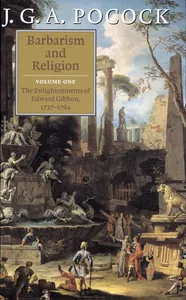
Barbarism and Religion : Volume 5, Religion

 80
80

Barbarism and Religion : Volume 5, Religion
J. G. A. Pocock's "Barbarism and Religion: Volume 5, Religion" offers a meticulously researched, if sometimes arid, dissection of how Western thought constructed its understanding of 'religion' in relation to concepts of civilization and barbarism. Pocock excels in tracing the lineage of these ideas, particularly within the Enlightenment discourse, revealing how categories of 'civilized' and 'barbarian' were historically contingent and often served ideological purposes. A particular strength lies in his granular analysis of how Enlightenment thinkers like David Hume discussed, and often dismissed, non-European religious practices. However, the volume's dense prose and academic focus can make it challenging for readers not already steeped in the history of political thought. The constant engagement with historiographical debates, while crucial for scholars, might obscure the broader narrative for a general audience. Ultimately, it's a vital, if demanding, resource for understanding the intellectual roots of modern secularism and its historical relationship with religious 'otherness'.
📝 Description
80
### What It Is Barbarism and Religion: Volume 5, Religion presents the final installment of J. G. A. Pocock's extensive examination of the historical relationship between civilization and its religious underpinnings. Published in 2010, this volume distills decades of scholarship, focusing specifically on how religious belief systems have interacted with, shaped, and been shaped by concepts of barbarism throughout history. It is not a theological treatise but a work of intellectual history that analyzes the discourse surrounding religion and its perceived role in societal development.
### Who It's For This work is intended for serious students of intellectual history, political theory, and the history of religion, particularly those interested in the evolution of Western thought. Readers seeking to understand the historical construction of 'religion' as a concept, its place in Enlightenment discourse, and its recurring association with notions of savagery or progress will find this volume particularly relevant. It requires a background in historical analysis and a willingness to engage with dense academic prose.
### Historical Context Pocock's work emerged from a post-Foucauldian intellectual landscape concerned with the genealogy of concepts. In the early 21st century, as this volume was published, historians were increasingly questioning grand narratives of progress and secularization. Pocock's analysis situates the discourse on religion and barbarism within the broader Enlightenment project, particularly figures like David Hume and his contemporaries. The study engages with the ongoing scholarly debate about the Enlightenment's legacy, including its sometimes-problematic classifications of societies and belief systems.
### Key Concepts The volume explores the historical discourse surrounding what constitutes 'religion' and how this definition has been weaponized or employed in arguments about civilization and barbarism. Pocock examines the Enlightenment's tendency to categorize non-Western or pre-Christian belief systems as primitive or superstitious, contrasting them with supposedly more rational or advanced forms of religious or secular thought. The work is concerned with the rhetoric of 'civilizing' and the role religion played in these narratives, often as both an object of critique and a tool for justification.
💡 Why Read This Book?
• Gain insight into the Enlightenment's construction of 'religion' as a concept, separate from its theological implications, enabling a critical view of historical categorizations. • Understand the historical discourse linking 'barbarism' with non-Western religious practices, as detailed in Pocock's analysis of figures like David Hume. • Appreciate the intellectual history behind secularization narratives and how 'religion' became a marker of perceived civilizational status in the 18th century.
⭐ Reader Reviews
Honest opinions from readers who have explored this book.
❓ Frequently Asked Questions
What is the main focus of J. G. A. Pocock's Barbarism and Religion: Volume 5, Religion?
This volume focuses on the historical discourse surrounding religion and its perceived relationship with barbarism, particularly within Enlightenment thought. It analyzes how 'religion' was defined and used as a concept to distinguish 'civilized' societies from 'barbarian' ones.
Who were key figures discussed in relation to religion and barbarism in this book?
The book engages with Enlightenment thinkers such as David Hume, examining their views on religious practices and their classifications of societies. It explores how their ideas contributed to the discourse of civilization versus barbarism.
When was Barbarism and Religion: Volume 5, Religion first published?
The first edition of J. G. A. Pocock's Barbarism and Religion: Volume 5, Religion was published in 2010, concluding his extensive multi-volume work on the subject.
Does this book offer theological interpretations of religions?
No, this is a work of intellectual history, not theology. It analyzes the historical and philosophical discourse about religion, its role in society, and its categorization, rather than interpreting religious doctrines themselves.
What is the significance of the 'barbarism' aspect in the book's title?
The title highlights how 'barbarism' was historically used as a contrasting term to 'civilization,' and how notions of religion were often employed to define and differentiate between these perceived states of society.
Is this volume suitable for beginners in history of religion?
While foundational, it is written for a scholarly audience. Beginners might find the dense prose and focus on historiographical debates challenging, but it offers a deep dive into the intellectual history of the concept of religion.
🔮 Key Themes & Symbolism
Enlightenment Categorizations
Pocock scrutinizes how the Enlightenment era developed frameworks for classifying societies and belief systems. This volume details how 'religion' itself became an object of analysis, often used to demarcate 'civilized' European cultures from those deemed 'barbarian.' It examines the intellectual tools and rhetorical strategies employed to create these distinctions, focusing on the discourse surrounding what constituted religious practice and its perceived level of sophistication or rationality.
Religion as a Marker of Civilization
The work explores the historical tendency to associate specific forms of religious belief and practice with societal progress or decline. Pocock traces how certain religious expressions were historically framed as indicators of 'barbarism,' while others, often more aligned with European philosophical currents, were presented as hallmarks of advanced civilization. This theme delves into the ideological function of religious discourse in shaping notions of cultural hierarchy.
The Concept of Barbarism
This volume investigates the historical evolution and application of the concept of 'barbarism.' Pocock analyzes how this term was deployed not merely as a descriptor of perceived savagery but as a complex intellectual construct used in debates about human nature, political organization, and cultural development. The book shows how religion was frequently implicated in these discussions, either as a cause of barbarism or as something to be overcome by civilization.
Discourse and Intellectual History
Fundamentally, this book is an exercise in discourse analysis within intellectual history. Pocock is concerned with how ideas about religion and barbarism were articulated, debated, and disseminated, particularly from the 17th century onwards. He examines the linguistic and conceptual frameworks that underpinned these discussions, revealing the contingent nature of historical judgments and the power of discourse in shaping our understanding of the past and present.
💬 Memorable Quotes
“The Enlightenment's conception of religion was often instrumental.”
— This interpretation suggests that for Enlightenment thinkers, 'religion' was frequently viewed not for its intrinsic spiritual value but for its perceived social or political utility, or as a tool for distinguishing 'civilized' from 'barbarian' societies.
“Barbarism served as a foil to civilization.”
— This highlights the dialectical relationship Pocock explores, where the concept of 'barbarism' was historically defined in opposition to, and often in critique of, prevailing notions of 'civilization,' with religion playing a key role in this demarcation.
“The study of religion became a study of human social evolution.”
— This paraphrased concept indicates that the historical analysis of religious phenomena by Enlightenment scholars was often tied to theories of social and cultural progress, using religion as a metric to gauge a society's level of development.
“Categorizing beliefs was central to defining the 'other'.”
— This interpretation points to the book's exploration of how intellectual frameworks, particularly concerning religious beliefs, were used to establish distinctions between one's own group (civilized) and foreign or subordinate groups (barbarian).
“The discourse on 'savagery' was intertwined with religious critique.”
— This suggests that discussions about what constituted 'savagery' or 'barbarism' in historical texts were frequently linked to critiques or analyses of the religious practices and beliefs of those societies being described.
🌙 Esoteric Significance
Tradition
While not overtly esoteric, Pocock's work engages with the historical construction of 'religion' as a category, a process that underpins many esoteric traditions. By dissecting how Western thought defined and categorized belief systems, he illuminates the intellectual foundations upon which esoteric philosophies often reacted against or built upon. His focus on the discourse of 'civilization' implicitly touches upon how esoteric knowledge was historically marginalized or labeled as 'superstitious' by dominant paradigms.
Symbolism
The primary 'symbols' explored are not mystical emblems but conceptual ones: 'Barbarism' and 'Religion' themselves function as potent, historically loaded signifiers. 'Barbarism' often symbolized a lack of rational control or adherence to primitive rites, while 'Religion' (as defined by the Enlightenment) represented a complex mix of superstition, ethical guidance, and social order. Pocock's analysis reveals how these conceptual symbols were manipulated in discourse to assert cultural superiority.
Modern Relevance
Contemporary discussions on secularism, post-colonialism, and the critique of Orientalism draw implicitly on the kind of historical deconstruction Pocock provides. Scholars examining the historical roots of religious intolerance, the politics of classification, or the ongoing debates about the role of religion in public life find value in understanding how these concepts were forged. Thinkers concerned with the genealogy of knowledge and power structures continue to engage with Pocock's meticulous tracing of historical discourses.
👥 Who Should Read This Book
• Scholars of intellectual history and the Enlightenment seeking a deep analysis of how concepts of religion and barbarism were constructed. • Students of political theory interested in the historical relationship between ideas of civilization, progress, and cultural categorization. • Researchers in comparative religion and anthropology who need to understand the historical biases embedded in Western definitions of religious practice.
📜 Historical Context
Published in 2010, J. G. A. Pocock's "Barbarism and Religion: Volume 5, Religion" emerged within a vibrant field of intellectual history deeply engaged with the Enlightenment and its legacy. The work built upon earlier scholarship, including that of Peter Gay, who had explored Enlightenment thought, but offered a more critical perspective on its universalist claims. Pocock's analysis situated the discourse on religion and barbarism within the context of 18th-century European intellectual currents, particularly engaging with thinkers like David Hume and his contemporaries who grappled with classifying different societies and belief systems. The intellectual climate of the late 20th and early 21st centuries, characterized by post-structuralist critiques of grand narratives and a heightened awareness of colonial discourse, provided fertile ground for Pocock's genealogical approach to concepts like 'religion' and 'barbarism.' Reception was primarily within academic circles, acknowledging its scholarly rigor but also its demanding nature.
📔 Journal Prompts
The Enlightenment's discourse on 'barbarism'.
The historical function of defining 'religion'.
Critiquing Enlightenment categorizations of belief systems.
The conceptual symbol of 'civilization' versus 'barbarism'.
The instrumental use of 'religion' in historical discourse.
🗂️ Glossary
Discourse
In this context, discourse refers to the historical conversation, debate, and written expression surrounding concepts like religion and barbarism. Pocock analyzes the language, assumptions, and power dynamics inherent in these discussions.
Genealogy of Concepts
An approach, often associated with thinkers like Foucault, that traces the historical origins and development of concepts to reveal their contingent nature and underlying power structures, rather than assuming their eternal truth.
Enlightenment
The 18th-century intellectual and philosophical movement emphasizing reason, individualism, and skepticism towards traditional authority, which significantly shaped Western thought on civilization, progress, and religion.
Civilization
Historically, a concept used to denote a high level of social, cultural, and technological development, often contrasted with perceived 'barbarism' or 'savagery.' Its definition was frequently subjective and tied to European norms.
Barbarism
A term used to describe societies or individuals perceived as uncivilized, primitive, or lacking in rational or moral development. Its application has historically been subjective and often used to justify dominance.
Secularization
The historical process whereby religious institutions, beliefs, and practices lose social and cultural significance. Pocock's work examines the historical discourse that contributed to this perceived trend.
Intellectual History
The study of the history of ideas, focusing on how philosophical, scientific, and cultural concepts have evolved over time and influenced societies.