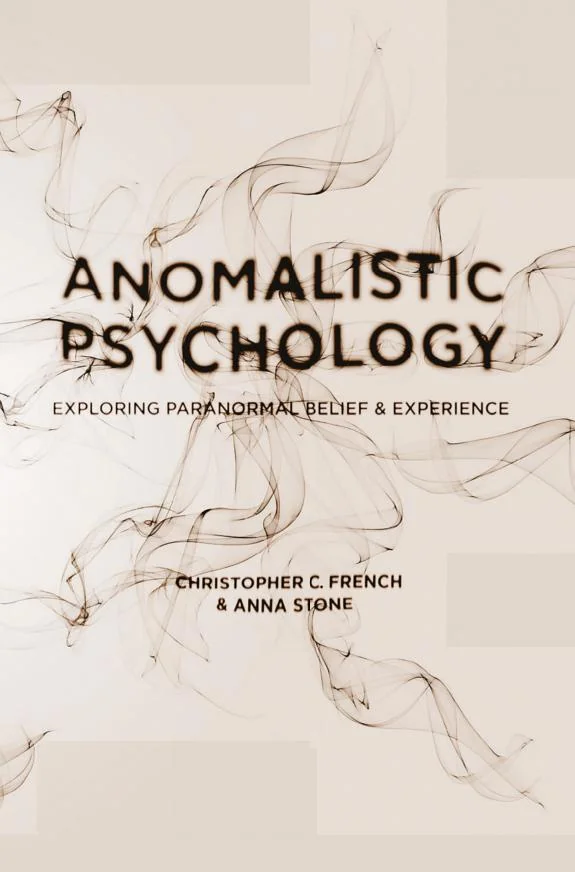
Anomalistic Psychology
 76
76

Anomalistic Psychology
Christopher C. French and Anna Stone’s Anomalistic Psychology offers a much-needed rational examination of experiences often relegated to the fringes of belief. The authors adeptly dissect claims of the paranormal, from UFO encounters to spectral apparitions, by focusing on the psychological architecture that generates these perceptions. They present a compelling case for understanding these phenomena through the lens of cognitive biases, suggestibility, and memory fallibility, rather than dismissing the experiences themselves. A particular strength lies in their clear explanations of concepts like confabulation and illusory correlation, making complex psychological mechanisms accessible. However, the book occasionally feels overly focused on debunking, potentially alienating readers who seek a more nuanced exploration that acknowledges the subjective reality of such experiences, even if the explanation lies within the mind. The passage detailing the psychological impact of eyewitness testimony, particularly in the context of alleged UFO sightings, provides a solid example of their analytical approach. Ultimately, Anomalistic Psychology serves as an excellent primer on the science behind the supernatural.
📝 Description
76
### What It Is Anomalistic Psychology examines the psychological underpinnings of paranormal beliefs and experiences, moving beyond sensationalism to explore the human mind's role in interpreting unusual phenomena. It investigates why individuals report alien abductions, ghost sightings, or other supernatural encounters, grounding these experiences in cognitive processes, biases, and social influences rather than solely accepting the phenomena as objective reality. The work seeks to understand the believer's perspective through a scientific lens.
### Who It's For This book is for anyone intrigued by the intersection of psychology and the unexplained. It caters to students of psychology, sociology, and anthropology seeking to understand belief systems and cognitive biases. It will also appeal to skeptics who wish to understand the psychological mechanisms behind paranormal claims and those who have had unusual experiences and seek a rational explanation or framework for their perceptions. Researchers in cognitive science will find its systematic approach valuable.
### Historical Context The field of anomalistic psychology builds upon decades of research into consciousness, perception, and belief. Early investigations into spiritualism and psychical research in the late 19th and early 20th centuries, by figures like the Society for Psychical Research, laid groundwork by attempting to systematically study alleged paranormal events. Later, cognitive psychology and social psychology provided frameworks for understanding how memory, attention, and group dynamics might influence reported experiences. This book situates itself within this ongoing scientific discourse, offering contemporary insights.
### Key Concepts The book explores concepts such as confabulation, where the mind fills in gaps in memory or understanding with plausible but inaccurate information. It examines the role of suggestibility, the tendency to accept information or influence from external sources, which is crucial in understanding how beliefs can be shaped. The impact of cognitive biases, like confirmation bias (seeking out information that supports existing beliefs) and illusory correlation (perceiving a relationship between variables that do not exist), are also central to understanding paranormal belief formation.
💡 Why Read This Book?
• Learn about the psychological mechanisms, such as confabulation and illusory correlation, that contribute to paranormal beliefs, enabling a deeper understanding of how the mind constructs reality. • Understand the role of suggestibility and cognitive biases, as discussed in relation to paranormal claims, offering practical insights into critical thinking and information evaluation. • Gain a scientific perspective on phenomena like alien encounters and ghost sightings, grounded in the research presented by French and Stone, fostering a more informed approach to extraordinary claims.
⭐ Reader Reviews
Honest opinions from readers who have explored this book.
❓ Frequently Asked Questions
What is anomalistic psychology and how does it differ from parapsychology?
Anomalistic psychology focuses on the psychological factors underlying belief in and experiences of paranormal phenomena, treating them as subjective experiences to be explained by known psychological principles. Parapsychology, conversely, often investigates whether paranormal phenomena themselves are real.
What psychological biases are discussed in relation to paranormal belief?
The book discusses several biases, including confirmation bias, where individuals favor information confirming their existing beliefs, and illusory correlation, the perception of a relationship between events that are not actually connected.
How does memory influence paranormal experiences according to the book?
Memory's fallibility is a key theme. The book explores how confabulation, the brain's attempt to fill memory gaps with plausible but untrue details, and suggestibility can significantly shape or even create the recollection of paranormal events.
Are alien abductions and ghost sightings explained psychologically in this book?
Yes, the book provides psychological explanations for reported alien abductions and ghost sightings, framing them as products of cognitive processes, perception, and belief systems rather than literal occurrences.
Who are the authors of Anomalistic Psychology?
Anomalistic Psychology was authored by Christopher C. French and Anna Stone. It was first published in September 2017.
What is the scientific approach to studying paranormal beliefs?
The scientific approach involves examining the cognitive, perceptual, and social factors that lead individuals to believe in or report paranormal experiences, utilizing empirical research methods and psychological theories.
🔮 Key Themes & Symbolism
Cognitive Biases in Belief
The work systematically explores how common cognitive biases, such as confirmation bias and illusory correlation, shape and reinforce paranormal beliefs. It illustrates how the human tendency to find patterns and connections, even where none exist, can lead individuals to interpret ambiguous events as evidence for the supernatural. This section is crucial for understanding how pre-existing belief systems are maintained and strengthened through selective attention and biased interpretation of evidence, providing a framework for analyzing why certain extraordinary claims gain traction.
The Psychology of Experience
Anomalistic Psychology delves into the subjective nature of experience, particularly in the context of alleged paranormal events like ghost sightings and alien abductions. It highlights how factors such as suggestibility, confabulation, and altered states of consciousness can lead to vivid personal experiences that feel profoundly real, regardless of objective verification. The authors examine the neurological and psychological underpinnings that make these experiences compelling to the individual, offering an explanation rooted in the mind's architecture.
Skepticism and Scientific Inquiry
The book champions a skeptical, evidence-based approach to understanding claims of the paranormal. It advocates for applying rigorous psychological research methods to investigate these phenomena, distinguishing between the objective reality of an event and the subjective experience or belief in it. This theme underscores the importance of critical thinking and scientific literacy in evaluating extraordinary claims, providing readers with tools to discern between well-supported explanations and unsubstantiated assertions.
Social and Cultural Influences on Belief
Beyond individual cognitive processes, the book acknowledges the significant role of social and cultural factors in the formation and dissemination of paranormal beliefs. It touches upon how shared narratives, media portrayals, and group dynamics can influence what people believe and how they interpret their experiences. This perspective situates paranormal belief within a broader social context, demonstrating that such beliefs are not solely personal but are also shaped by collective understanding and cultural narratives.
💬 Memorable Quotes
“The science behind claims of alien encounters and visions of ghosts can be even more fascinating than the sensationalist headlines.”
— This opening statement sets the book's intention: to explore the psychological mechanisms driving belief in the paranormal, suggesting that the human mind's capacity to generate such experiences is itself a compelling subject of study, distinct from the sensational claims themselves.
“What leads some people to believe in the paranormal?”
— This question frames the core inquiry of anomalistic psychology. It points towards an investigation into the cognitive, emotional, and social factors that contribute to the adoption and maintenance of supernatural beliefs, positioning belief itself as a psychological phenomenon worthy of scientific scrutiny.
“Why might someone think they have been abducted by aliens?”
— This query highlights the book's focus on specific, widely reported anomalous experiences. It signals an intent to dissect such claims through psychological analysis, exploring potential explanations rooted in perception, memory, suggestibility, and cognitive biases rather than literal abduction events.
“Is there any room for superstition in the modern world of science?”
— This rhetorical question probes the tension between scientific rationality and enduring superstitious beliefs. It suggests the book will explore how, despite scientific advancements, superstitious thinking persists and how psychology can help explain this apparent paradox.
“Anomalistic Psychology - Provides a lively and thought-provoking introduction to the psychology underlying paranormal belief and experience.”
— This descriptive statement defines the book's purpose and style. It promises an engaging exploration of the psychological roots of paranormal belief, indicating that the content is designed to be accessible and stimulating for readers interested in the subject.
🌙 Esoteric Significance
Tradition
While not strictly adhering to a single esoteric lineage, anomalistic psychology intersects with traditions that explore altered states of consciousness and subjective realities, such as Gnosticism's focus on inner experience and perception. It offers a scientific counterpoint to mystical claims, seeking to understand the mechanics of 'gnosis' or inner knowing through empirical study rather than divine revelation.
Symbolism
The book doesn't engage with traditional esoteric symbolism directly. However, the phenomena it examines—ghosts, aliens, visions—function as modern archetypes or symbols representing the unknown, the uncanny, or anxieties about existence. The psychological processes of interpretation and belief formation are, in a sense, the 'symbols' it deconstructs, revealing how the mind imbues ambiguous experiences with meaning.
Modern Relevance
Anomalistic psychology is highly relevant to contemporary discussions on misinformation, conspiracy theories, and the psychology of belief in the digital age. Thinkers and researchers in cognitive science, critical thinking, and even fields like digital forensics (analyzing user-generated content) draw upon its principles to understand how beliefs are formed and spread online and offline.
👥 Who Should Read This Book
• Students of psychology and cognitive science seeking to understand the empirical study of belief in the paranormal, moving beyond anecdotal evidence. • Skeptics and critical thinkers interested in the psychological mechanisms that contribute to paranormal claims, wanting to refine their analytical tools. • Individuals who have experienced unusual phenomena and are seeking rational, psychological explanations for their perceptions and memories.
📜 Historical Context
Published in 2017, Anomalistic Psychology arrives at a time when cognitive psychology has matured significantly, providing robust frameworks for understanding belief, perception, and memory. The book builds upon a long tradition of investigating anomalous experiences, tracing back to early psychical research societies like the Society for Psychical Research, founded in 1882. Contemporaries in the field of skeptical inquiry and cognitive science, such as Michael Shermer and Steven Pinker, have similarly explored the psychological underpinnings of belief and irrationality, though French and Stone focus specifically on the paranormal. While not facing significant censorship, the field itself has historically been met with skepticism from mainstream psychology, with some viewing it as too close to validating pseudoscientific claims. However, its persistence reflects a genuine scientific curiosity about why humans hold such pervasive beliefs.
📔 Journal Prompts
The concept of confabulation and its role in paranormal accounts.
Illusory correlation as a mechanism for paranormal belief.
The psychological impact of suggestibility on reported experiences.
Interpreting anomalous experiences through a cognitive lens.
The science behind alien encounter narratives.
🗂️ Glossary
Anomalistic Psychology
The branch of psychology that studies psychological factors related to beliefs in and experiences of paranormal phenomena, explaining them through known psychological principles.
Confabulation
The creation of false memories or the distortion of existing memories without the conscious intention to deceive; the mind fills gaps with plausible fabrications.
Suggestibility
The quality of being inclined to accept and act on the suggestions of others; a psychological state where external influences can shape beliefs, memories, or actions.
Confirmation Bias
The tendency to search for, interpret, favor, and recall information in a way that confirms or supports one's pre-existing beliefs or hypotheses.
Illusory Correlation
Perceiving a relationship between variables (people, events, qualities) even when no such relationship exists, often leading to stereotypes or superstitions.
Parapsychology
The study of alleged psychic phenomena and other paranormal claims, often including extrasensory perception (ESP) and psychokinesis (PK).
Cognitive Biases
Systematic patterns of deviation from norm or rationality in judgment, often arising from heuristics or mental shortcuts, that can influence belief formation.