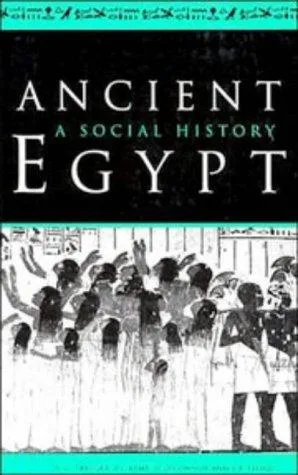
Ancient Egypt
 76
76

Ancient Egypt
Trigger, Kemp, and O'Connor's *Ancient Egypt* offers a commendable, if at times dense, examination of the civilization's formative periods. The strength lies in its systematic approach, particularly in detailing the archaeological evidence supporting the rise of the Egyptian state. The section on the development of hieroglyphic writing and its societal implications is particularly illuminating. However, for readers seeking the esoteric or mystical underpinnings often associated with Egypt, this academic treatment may feel somewhat dry. The authors' focus remains firmly on socio-political and economic structures, leaving less room for the symbolic interpretations that attract many to ancient Egypt. A passage discussing the theological implications of the Heliopolitan Ennead, while factual, could benefit from a more expansive interpretive lens. Ultimately, it is a foundational text for understanding Egypt's material and political history.
📝 Description
76
### What It Is Ancient Egypt by Bruce G. Trigger, B. J. Kemp, and D. O'Connor presents a comprehensive academic survey of one of humanity's most enduring civilizations. Published initially in 2012, this work moves beyond superficial fascination to dissect the foundational elements of Egyptian society, from its predynastic origins to the New Kingdom. It examines the development of its complex political structures, religious beliefs, and material culture with meticulous detail, relying on archaeological evidence and textual analysis.
### Who It's For This volume is intended for serious students of history, archaeology, and Egyptology. It serves as an invaluable resource for university-level courses and for independent researchers seeking an authoritative overview. Those with a dedicated interest in the ancient Near East, comparative civilizations, or the origins of complex societies will find its depth and rigor particularly rewarding. It is not a casual introduction but a scholarly examination.
### Historical Context The original publication date of 2012 places this work within a modern academic discourse on Egyptology, building upon decades of excavation and interpretation. It engages with the ongoing scholarly debates regarding the unification of Egypt, the nature of pharaonic kingship, and the evolution of religious practices. The authors likely engage with the methodologies and findings of prominent Egyptologists who preceded them, such as Flinders Petrie and James Henry Breasted, while also incorporating more recent archaeological discoveries and theoretical frameworks.
### Key Concepts The book explores the intricate relationship between geography and civilization, the divine kingship as a central organizing principle, and the development of a sophisticated bureaucracy. It also scrutinizes the evolution of religious cosmology, mortuary practices, and the emergence of monumental architecture as expressions of power and belief. The authors analyze the transition from decentralized settlements to a unified state, a process critical to understanding ancient Egyptian identity.
💡 Why Read This Book?
• Gain a rigorous understanding of the Predynastic Period's transition to dynastic rule, a crucial phase detailed in the book's early chapters. • Explore the socio-political functions of monumental architecture, such as the Step Pyramid of Djoser, as presented through archaeological evidence. • Grasp the evolution of Egyptian religious cosmology and its connection to kingship, a theme interwoven throughout the analysis of pharaonic ideology.
⭐ Reader Reviews
Honest opinions from readers who have explored this book.
❓ Frequently Asked Questions
What are the primary sources used in Bruce G. Trigger's 'Ancient Egypt'?
The work primarily relies on archaeological findings from sites across Egypt, including pottery typologies, settlement patterns, and tomb contents, alongside epigraphic evidence from inscriptions and papyri dating from the Predynastic period through the New Kingdom.
How does 'Ancient Egypt' discuss the concept of divine kingship?
The book examines divine kingship as a central ideological and political construct that legitimized pharaonic rule, exploring its development from early dynastic symbols to its mature expression in royal titulary and iconography.
What period of Egyptian history does the book focus on most intensely?
While covering a broad span, the book places significant emphasis on the formative periods: the Predynastic era and the Early Dynastic Period, detailing the processes leading to state formation and the establishment of the pharaonic system.
Is 'Ancient Egypt' suitable for beginners interested in the subject?
It is best suited for those with some prior academic interest or foundational knowledge, as it presumes a certain familiarity with historical and archaeological terminology and methodologies.
Does the book address Egyptian mythology extensively?
The book addresses mythology primarily through its socio-political and ritualistic functions, examining how myths informed state ideology and religious practices rather than as a purely narrative exploration.
When was 'Ancient Egypt' by Trigger, Kemp, and O'Connor first published?
The work was first published in 2012, placing it within contemporary scholarship on Egyptology and allowing it to incorporate recent archaeological discoveries and theoretical advancements.
🔮 Key Themes & Symbolism
State Formation and Kingship
This volume meticulously details the complex processes through which Egypt transitioned from disparate settlements into a unified state under a divine monarchy. It analyzes the evidence for early political consolidation, the development of administrative structures, and the ideological underpinnings of pharaonic authority. The authors highlight how concepts like divine kingship, represented through royal titulary and iconography, served to legitimize and centralize power during the Early Dynastic Period and beyond.
Religious and Ideological Systems
The work investigates the evolution of Egyptian religious beliefs, focusing on their integration with political and social structures. It examines the development of cosmological ideas, the significance of mortuary cults, and the role of temples as centers of economic and religious activity. The authors explore how religious ideology reinforced the social hierarchy and the pharaoh's divine status, particularly in relation to major deities and funerary practices.
Material Culture and Society
A significant portion of the book is dedicated to interpreting Egypt's material remains—settlements, tombs, artifacts, and monumental architecture. By analyzing these physical traces, the authors reconstruct aspects of daily life, economic activities, and technological advancements. The development of writing systems and their impact on administration and culture are also explored, underscoring the interconnectedness of societal components.
Chronology and Development
Trigger, Kemp, and O'Connor provide a structured chronological framework, tracing the civilization's trajectory from its prehistoric roots through the major dynastic periods. They address key debates regarding dating, cultural influences, and the sequence of developments, particularly concerning the unification of Upper and Lower Egypt. This systematic approach allows readers to understand the long-term evolution of Egyptian institutions and culture.
💬 Memorable Quotes
“The unification of Egypt was not a singular event but a protracted process.”
— This statement emphasizes the nuanced understanding of Egyptian history, moving away from simplistic narratives of conquest towards a more complex view of gradual political and cultural integration over centuries.
“Royal ideology played a crucial role in consolidating power and shaping societal norms.”
— This highlights the importance of the pharaoh's perceived divinity and the symbolic representations of kingship in maintaining social order and justifying the ruling elite's authority.
“Archaeological evidence provides the foundation for understanding early Egyptian social structures.”
— This underscores the authors' methodology, prioritizing empirical data from excavations to reconstruct the material conditions and societal organization of ancient Egypt.
“The development of writing facilitated administrative control and cultural transmission.”
— This points to the transformative impact of literacy and record-keeping on the Egyptian state, enabling efficient governance and the perpetuation of its cultural heritage.
“Mortuary practices reveal significant insights into Egyptian beliefs about the afterlife and social status.”
— This suggests that the elaborate tombs and burial rituals of ancient Egyptians were not merely about death but also reflected deeply held convictions about existence beyond life and the hierarchical structure of society.
🌙 Esoteric Significance
Tradition
While primarily an academic text, *Ancient Egypt* touches upon themes that resonate with esoteric traditions, particularly those interested in ancient mysteries and foundational civilizations. It aligns with a lineage of scholarship that views Egypt as a source of profound wisdom, albeit through a historical and archaeological lens rather than direct occult transmission. Its focus on divine kingship and cosmic order indirectly engages with Hermetic and Gnostic ideas about divine emanation and hierarchical structures.
Symbolism
The book implicitly engages with symbols central to esoteric thought. The ankh, representing life, is understood through its socio-political and religious contexts. The Eye of Horus, a powerful symbol of protection and royal power, is examined within the framework of pharaonic ideology and divine authority. The pyramid, as a monumental expression of royal power and a conduit to the afterlife, is analyzed for its architectural and cosmological significance.
Modern Relevance
Contemporary esoteric practitioners and scholars of comparative religion often return to foundational texts like this for historical context. Movements interested in ancient wisdom traditions, sacred geometry, and the roots of Western esotericism find value in understanding the historical realities that inspired later symbolic interpretations. Thinkers exploring ancient cosmologies and the origins of spiritual practices continue to draw upon the empirical data and analytical frameworks presented.
👥 Who Should Read This Book
• Academic students of history and archaeology: To build a solid, evidence-based understanding of Egyptian civilization's formative stages and development. • Researchers in comparative ancient civilizations: To analyze Egypt's unique trajectory of state formation and cultural evolution against broader global patterns. • Dedicated history enthusiasts: For those seeking a detailed, scholarly account that moves beyond popular depictions to explore the complexities of Egyptian society.
📜 Historical Context
Published in 2012, *Ancient Egypt* by Bruce G. Trigger, B. J. Kemp, and D. O'Connor arrives in a field rich with scholarship, engaging with the legacy of Egyptologists like Flinders Petrie, whose meticulous excavations in the late 19th and early 20th centuries laid much of the groundwork. The book operates within a modern academic milieu where competing theories on state formation, such as those proposed by scholars examining state collapse and regeneration, are actively debated. Its publication also follows significant advancements in archaeological techniques and theoretical approaches, including processual and post-processual archaeology, which likely inform the authors' interpretations. The work addresses enduring questions about Egyptian origins and development, contributing to an ongoing international dialogue, rather than being an isolated pronouncement.
📔 Journal Prompts
The Predynastic Period's transition to dynastic rule.
The socio-political functions of monumental architecture like the Step Pyramid of Djoser.
Egyptian religious cosmology and its connection to kingship.
The development and impact of hieroglyphic writing.
The concept of divine kingship in ancient Egypt.
🗂️ Glossary
Predynastic Period
The era in Egyptian history preceding the establishment of the First Dynasty, typically dated before c. 3100 BCE, characterized by the development of settled agricultural communities and early forms of social stratification.
Early Dynastic Period
The period following the unification of Egypt, encompassing the First and Second Dynasties (c. 3100–2686 BCE), marked by the consolidation of pharaonic rule and the establishment of key state institutions.
Divine Kingship
The ideology asserting that the pharaoh was a divine being or a mediator between the gods and humans, granting him absolute political and religious authority.
Titulary
The formal set of names and titles used by an Egyptian pharaoh, each conveying specific aspects of their power, divinity, and role in the cosmos.
Heliopolitan Ennead
A group of nine principal deities in Egyptian religion, centered around the sun god Atum, originating from Heliopolis, which formed a key part of the creation mythos.
Epigraphy
The study and interpretation of inscriptions, particularly ancient ones, providing crucial textual evidence for historical and cultural understanding.
Mortuary Cult
Religious practices and beliefs associated with the burial and afterlife of individuals, particularly royalty and elites, ensuring their continued existence and influence.