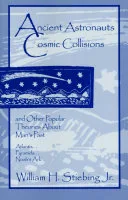
Ancient Astronauts, Cosmic Collisions
 75
75

Ancient Astronauts, Cosmic Collisions
William H. Stiebing’s Ancient Astronauts, Cosmic Collisions offers a much-needed dose of scholarly skepticism to a field often dominated by sensationalism. The book’s strength lies in its methodical dissection of claims, particularly its detailed examination of the Nazca Lines and Egyptian pyramids, contrasting them with established archaeological understanding. Stiebing doesn’t merely dismiss theories; he interrogates the evidence presented by their proponents, showing where logic falters or data is misconstrued. A notable passage discusses the astronomical observations attributed to ancient peoples, questioning whether these were advanced alien transmissions or sophisticated, yet human, calendrical systems. However, the work’s primary limitation is its rather dry, academic tone, which may deter casual readers drawn to the topic by popular media. While rigorously argued, it occasionally feels like a rebuttal rather than an exploration. Stiebing provides a solid, fact-based counterpoint to popular myths.
📝 Description
75
### What It Is Ancient Astronauts, Cosmic Collisions examines the persistent theories suggesting extraterrestrial influence on ancient human civilizations and celestial events. William H. Stiebing critically analyzes claims ranging from the construction of the Great Pyramid of Giza to supposed ancient airfields in Peru. The work scrutinizes the evidence presented by proponents of these ideas, contrasting it with established archaeological and astronomical understanding.
### Who It's For This book is for readers interested in the history of fringe theories, critical thinking regarding pseudoscientific claims, and the intersection of archaeology, mythology, and astronomy. It appeals to skeptics and those curious about why certain ancient astronaut narratives, such as those popularized by Erich von Däniken, gained traction despite lacking mainstream scientific support. Individuals seeking a balanced, evidence-based perspective on ancient mysteries will find value here.
### Historical Context The book situates its analysis within the broader context of ancient astronaut theories, which saw a surge in popularity from the mid-20th century onwards. Stiebing engages with the scientific and academic discourse that emerged in response to these claims, often characterized by cautious skepticism. The work implicitly addresses the cultural milieu that embraced speculative interpretations of ancient texts and artifacts, particularly in the decades following World War II and the dawn of the space age.
### Key Concepts Central to the book is the critical evaluation of 'evidence' presented for ancient astronaut theories. This includes examining astronomical alignments, architectural anomalies, and interpretations of ancient texts. Stiebing contrasts these with conventional explanations rooted in human ingenuity, natural phenomena, and the evolution of societies. The work also touches upon the psychology of belief and the appeal of extraordinary explanations for historical enigmas.
💡 Why Read This Book?
• Gain a critical framework for evaluating extraordinary claims about ancient history, learning to distinguish between evidence-based archaeology and speculative theories about extraterrestrial influence on sites like the Great Pyramid of Giza. • Understand the intellectual currents that fueled ancient astronaut theories from the mid-20th century, contrasting them with conventional explanations for anomalies, as discussed in the book's historical context. • Develop skills in interpreting archaeological and astronomical 'discoveries' by examining Stiebing's analysis of specific examples, such as the Nazca Lines, and learn to identify logical fallacies in pseudoscientific arguments.
⭐ Reader Reviews
Honest opinions from readers who have explored this book.
❓ Frequently Asked Questions
What specific ancient sites does William H. Stiebing analyze in Ancient Astronauts, Cosmic Collisions?
The book critically examines prominent sites often cited in ancient astronaut theories, including the Great Pyramid of Giza in Egypt and the Nazca Lines in Peru, questioning claims of advanced technology and extraterrestrial use.
Does Ancient Astronauts, Cosmic Collisions discuss the possibility of planetary collisions in ancient times?
Yes, the work addresses theories concerning near-collisions between planets in our solar system that are sometimes linked to ancient astronaut narratives, evaluating their scientific and historical plausibility.
Who is the intended audience for this book?
The book is aimed at readers interested in critical thinking, the history of pseudoscience, and a balanced perspective on ancient mysteries, particularly those curious about the evidence (or lack thereof) for extraterrestrial involvement in human history.
Is Ancient Astronauts, Cosmic Collisions a defense or a critique of ancient astronaut theories?
It functions primarily as a critical examination and rebuttal of ancient astronaut theories, meticulously analyzing the evidence presented by proponents and contrasting it with established archaeological and scientific consensus.
When was Ancient Astronauts, Cosmic Collisions first published?
William H. Stiebing's Ancient Astronauts, Cosmic Collisions was first published on June 3, 2010.
What is the main argument presented by William H. Stiebing?
Stiebing argues that the evidence presented for ancient astronaut intervention and advanced extraterrestrial technology in human history is largely speculative and lacks rigorous support when critically examined against scientific and historical data.
🔮 Key Themes & Symbolism
Critique of Extraterrestrial Claims
This theme centers on the rigorous examination of popular ancient astronaut theories. Stiebing dissects claims regarding extraterrestrial visitors influencing ancient cultures, scrutinizing evidence presented for advanced technology in structures like the Great Pyramid of Giza. The work contrasts these speculative interpretations with conventionally accepted archaeological and historical accounts, emphasizing the lack of empirical support for alien intervention in human development.
Archaeological and Astronomical Anomalies
The book addresses purported anomalies in ancient sites and astronomical records that proponents of ancient astronaut theories often highlight. This includes analyzing markings like the Nazca Lines and interpreting ancient celestial observations. Stiebing questions whether these phenomena truly indicate extraterrestrial contact or can be explained through human ingenuity, natural processes, and evolving scientific understanding over millennia.
The Nature of Evidence and Belief
A core concept is the exploration of how evidence is presented, interpreted, and accepted, particularly in fringe scientific and historical fields. Stiebing investigates the appeal of extraordinary explanations and the psychological factors that contribute to belief in ancient astronaut narratives. The work implicitly discusses the responsibility of critical evaluation when confronted with sensational claims about our past.
Solar System History
The book touches upon theories involving cosmic collisions and planetary interactions within our solar system's history. These discussions are often woven into the broader ancient astronaut framework, with proponents suggesting such events influenced early civilizations or were observed by ancient peoples. Stiebing evaluates the scientific plausibility of these celestial event theories and their connection to human history.
💬 Memorable Quotes
“Theories about ancient astronauts often rely on misinterpretations of ancient texts and artifacts.”
— This statement highlights the book's central thesis: that proponents of ancient astronaut theories frequently twist or misunderstand historical data to fit their pre-conceived notions of alien influence, rather than engaging with established scholarly interpretations.
“Claims of advanced technology in ancient structures lack corroborating archaeological evidence.”
— This paraphrased concept underscores Stiebing's critical approach. It suggests that while proponents point to perceived technological sophistication in ancient constructions like the Egyptian pyramids, there is no tangible archaeological proof—tools, blueprints, or direct accounts—to support an extraterrestrial origin.
“Natural phenomena and human ingenuity offer sufficient explanations for ancient marvels.”
— This interpretation reflects the book's position that extraordinary claims of alien intervention are unnecessary. Instead, it posits that conventional scientific understanding of geology, astronomy, and human capabilities adequately explains the creation and significance of ancient sites and artifacts.
“The appeal of ancient astronaut theories often stems from a desire for grand, external explanations.”
— This captures the idea that the popularity of ancient astronaut narratives might be driven by a psychological need for dramatic, non-human answers to historical mysteries, rather than a dispassionate assessment of available evidence.
“Scientific evaluation demands rigorous proof, not speculation.”
— This emphasizes the book's methodology, asserting that for any theory, especially those concerning extraterrestrial involvement in human history, verifiable, robust evidence is paramount. Speculative leaps or coincidental correlations are insufficient for scientific acceptance.
🌙 Esoteric Significance
Tradition
While not strictly within a singular esoteric tradition like Hermeticism or Gnosticism, this work engages with themes that touch upon ufology and ancient wisdom narratives, which often intersect with esoteric thought. It critiques speculative interpretations that claim hidden, non-human knowledge influenced ancient cultures, a concept present in various fringe and esoteric circles seeking alternative histories.
Symbolism
The book analyzes symbols and motifs often interpreted esoterically or within ancient astronaut frameworks. This includes the symbolic representation of celestial bodies in ancient art, the geometric precision of structures like the Great Pyramid, and abstract markings such as the Nazca Lines, questioning their purported symbolic meanings related to alien contact.
Modern Relevance
In an era saturated with information and conspiracy theories, Stiebing's critical approach remains relevant. Contemporary thinkers and researchers in fields ranging from critical thinking to skeptical inquiry continue to draw upon such works to debunk pseudoscientific claims. The book informs discussions on media literacy and the discerning evaluation of historical and scientific narratives in the digital age.
👥 Who Should Read This Book
• Skeptical readers and critical thinkers interested in deconstructing popular pseudoscientific theories about ancient history and extraterrestrial contact. • Students of archaeology, anthropology, and history seeking a balanced perspective that contrasts fringe claims with established academic consensus. • Enthusiasts of ancient mysteries who wish to understand the arguments against ancient astronaut theories and evaluate the evidence for themselves.
📜 Historical Context
Published in 2010, Ancient Astronauts, Cosmic Collisions emerged during a period where ancient astronaut theories, popularized by figures like Erich von Däniken in the late 1960s and 1970s, had become a significant subgenre in popular culture. While mainstream archaeology and history largely dismissed these ideas, they continued to thrive in books, documentaries, and television programs. Stiebing's work engages with this ongoing discourse, providing a counterpoint to the speculative narratives that often lack critical evaluation. The intellectual climate of the early 21st century, marked by increased access to information but also the proliferation of misinformation, provided a backdrop for such critical analyses. The book implicitly addresses the reception of these theories, which, despite lacking academic validation, often garnered widespread public attention and commercial success.
📔 Journal Prompts
The archaeological evidence for the Great Pyramid of Giza, as discussed in the text.
The interpretations of the Nazca Lines presented by proponents versus Stiebing's analysis.
The concept of advanced technology attributed to ancient civilizations.
The historical context of ancient astronaut theories since the mid-20th century.
The distinction between speculative claims and verifiable facts regarding celestial events.
🗂️ Glossary
Ancient Astronaut Theory
The speculative hypothesis that extraterrestrial beings visited Earth in ancient times and influenced human culture, technology, and religion, often credited with the construction of monumental architecture or the dissemination of knowledge.
Nazca Lines
A series of large geoglyphs etched into the desert floor in southern Peru, believed by some ancient astronaut theorists to have been created for alien spacecraft, but conventionally explained as ritualistic or astronomical markers.
Great Pyramid of Giza
The largest of the three pyramids in the Giza Necropolis, Egypt. Ancient astronaut theorists often cite its precise construction and alignment as evidence of advanced, non-human technology, while Egyptologists attribute it to sophisticated ancient Egyptian engineering and labor.
Pseudoscientific Claims
Statements, beliefs, or practices that are claimed to be both scientific and factual but are not verifiable by the scientific method, often lacking empirical evidence or rigorous testing.
Geoglyphs
Designs or motifs created on the ground by removing or arranging earth, stones, or other materials. The Nazca Lines are a prominent example, with their purpose and creators subject to various interpretations.
Cosmic Collisions
Theories suggesting that planets within our solar system have experienced near-misses or actual collisions throughout history, which some fringe theories link to ancient myths or events influencing early human civilization.
Archaeological Evidence
Material remains from past human life and activity, such as artifacts, structures, and ecofacts, used by archaeologists to reconstruct and understand history. The presence or absence of such evidence is central to Stiebing's critique.