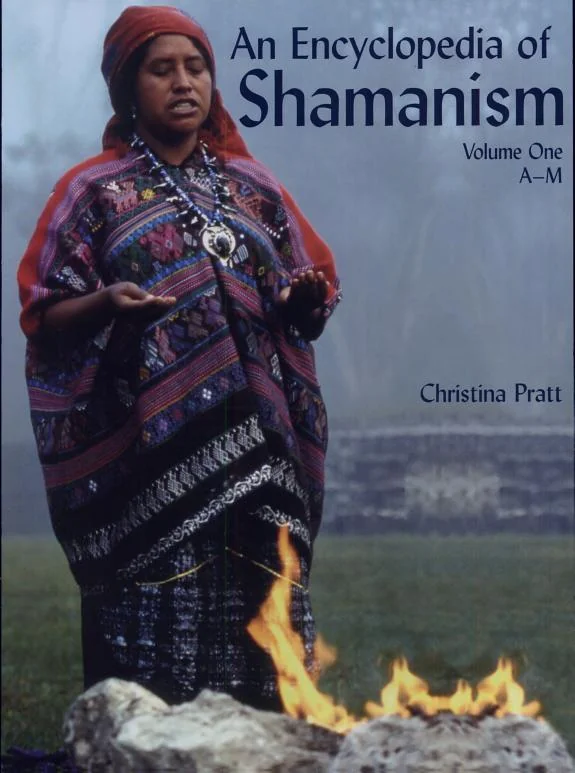
An Encyclopedia of Shamanism Volume 1
 82
82

An Encyclopedia of Shamanism Volume 1
Christina Pratt’s An Encyclopedia of Shamanism Volume 1 offers a sober and systematic account of a subject often shrouded in romanticism. Pratt avoids the pitfalls of New Age hyperbole, instead presenting shamanism as a demanding discipline requiring significant personal investment and mastery of consciousness. Her definition of shamanism as arising from the actions of initiated practitioners in non-ordinary reality and their consequences in ordinary reality is particularly sharp. A strength is the book’s detailed exploration of the mechanics of spirit communication and altered states, presented with clarity. However, the sheer density of information, particularly in the early sections, might feel overwhelming for absolute beginners. The section on the ethical considerations for a shaman, while crucial, is presented with a starkness that some may find challenging. Pratt’s work stands as a rigorous examination, prioritizing practical understanding and disciplined application over abstract mysticism.
📝 Description
82
### What It Is An Encyclopedia of Shamanism Volume 1, authored by Christina Pratt and first published in 2007, functions as a foundational text for understanding shamanic practices. It defines shamanism not as a formal religion, but as a discipline centered on initiated practitioners who master altered states of consciousness. The work emphasizes the reciprocal relationship between actions taken in non-ordinary reality and their manifest effects in the ordinary world.
### Who It's For This volume is geared towards individuals serious about exploring the mechanics and phenomenology of shamanism. It appeals to practitioners seeking deeper comprehension of altered states, students of comparative religion, and those interested in the intersection of consciousness studies and indigenous traditions. It requires a commitment to disciplined study, moving beyond superficial interest to engage with the demanding nature of shamanic development.
### Historical Context Published in 2007, Pratt's encyclopedia emerged during a period of renewed global interest in indigenous spiritualities and altered states of consciousness, influenced by earlier anthropological studies and New Age movements. While figures like Mircea Eliade had previously codified shamanism in academic circles, Pratt's work aims for a more practice-oriented and phenomenological approach, distinguishing itself from purely historical or anthropological accounts. It addresses a growing audience seeking direct experience and understanding of these ancient practices.
### Key Concepts The text meticulously details the core components of shamanism, including the nature of non-ordinary reality, the role of spirit helpers, and the methods for achieving and navigating altered states. It explores the ethical considerations and personal sacrifices inherent in the shamanic path, framing it as a rigorous discipline rather than a casual spiritual pursuit. The work also addresses the distinction between genuine shamanic practice and its appropriation or misrepresentation in contemporary contexts.
💡 Why Read This Book?
• Gain a disciplined framework for understanding altered states of consciousness, specifically detailing the methods and distinctions of initiated shamans as presented in Chapter 1, 'The Shamanic Worldview'. • Explore the practical applications of shamanic work, learning how actions in non-ordinary reality directly influence outcomes in ordinary reality, a core concept developed throughout the text. • Comprehend the rigorous demands of shamanic practice, including spiritual discipline and personal sacrifice, as outlined by Pratt in her discussion of the mature shaman's path.
⭐ Reader Reviews
Honest opinions from readers who have explored this book.
❓ Frequently Asked Questions
What is the primary distinction of shamanism according to Christina Pratt?
Pratt defines shamanism by the practice of initiated shamans who master altered states of consciousness, emphasizing the tangible results of their actions in both non-ordinary and ordinary reality.
Is An Encyclopedia of Shamanism Volume 1 a religious text?
No, the book clarifies that shamanism is not a religion, but rather a demanding spiritual discipline requiring personal sacrifice from its practitioners.
What is the significance of 'non-ordinary reality' in Pratt's work?
Non-ordinary reality is the dimension where shamans interact with spirits and energies to gain knowledge or effect change, with the results of these interactions manifesting in ordinary reality.
Who are the 'initiated shamans' mentioned in the book?
Initiated shamans are individuals who have undergone specific training and trials to gain mastery over altered states of consciousness and the spirit world.
Does the book focus on a specific cultural tradition of shamanism?
The book aims to provide a general framework and understanding of shamanism as a practice, rather than focusing exclusively on one particular cultural manifestation.
What kind of personal commitment does Pratt suggest is necessary for shamanic development?
Pratt emphasizes the need for significant spiritual discipline and personal sacrifice, particularly for those seeking the highest stages of mystical development within shamanism.
🔮 Key Themes & Symbolism
Mastery of Altered States
The core of Pratt's definition of shamanism lies in the practitioner's ability to enter and navigate altered states of consciousness. This isn't mere trance, but a disciplined engagement with non-ordinary reality. The book details the nature of these states and the skills required to maintain awareness and control, differentiating between accidental experiences and intentional, mastered journeys. Understanding these states is paramount for effective shamanic work and achieving mystical development.
Reciprocity of Realities
A central tenet explored is the interconnectedness between non-ordinary reality and ordinary reality. Pratt illustrates how the actions and energies engaged with by the shaman in spirit realms have direct, observable consequences in the physical world. This forms the practical basis of shamanic healing and influence, highlighting that the shaman’s work is not solely an internal or spiritual exercise but has tangible effects on life, health, and community.
Discipline and Sacrifice
Pratt firmly establishes shamanism as a path demanding rigorous spiritual discipline and significant personal sacrifice. It is not a religion in the conventional sense but a demanding practice that requires commitment, resilience, and a willingness to undergo trials. This aspect distinguishes serious practitioners from those seeking superficial spiritual experiences, emphasizing that true shamanic development is earned through arduous effort and dedication.
The Initiated Practitioner
The encyclopedia focuses on the role and capabilities of the 'initiated shaman.' This designation signifies an individual who has undergone a formal process of training and often a series of trials or initiations. These experiences equip them with the necessary skills and authority to operate effectively within non-ordinary reality and serve as intermediaries between worlds, distinguishing them from untrained individuals who might claim shamanic abilities.
💬 Memorable Quotes
“Shamanism arises from the actions the shaman takes in non-ordinary reality and the results of those actions in ordinary reality.”
— This statement encapsulates the functional definition of shamanism presented by Pratt, highlighting the practical, cause-and-effect nature of shamanic work that bridges spiritual and material realms.
“It is not a religion, yet it demands spiritual discipline and personal sacrifice.”
— This emphasizes that shamanism is a rigorous path of practice and personal development, distinct from formalized religious structures, requiring deep commitment and often hardship.
“The practice of initiated shamans who are distinguished by their mastery of a range of altered states of consciousness.”
— This defines the core competency of a shaman according to Pratt: not just entering altered states, but possessing a high degree of control and understanding within them.
“The mature shaman who seeks the highest stages of mystical development.”
— This points to the advanced potential within shamanism, framing it as a progressive path towards profound spiritual realization, accessible through dedicated practice.
“Shamanism can be defined as...”
— Pratt begins her definition with a direct statement, signaling an intent to provide a clear, analytical framework for understanding shamanism from its outset.
🌙 Esoteric Significance
Tradition
While not strictly aligned with a single Western esoteric lineage like Hermeticism or Kabbalah, Pratt's work engages with the universal archetypes and consciousness-altering practices that underpin many esoteric traditions. It provides a phenomenological framework that can inform and be informed by Gnostic ideas of traversing spiritual realms or Hermetic principles of correspondence. It acts as a bridge, offering a rigorous approach to altered states that complements the theoretical studies often found in Western esotericism.
Symbolism
The concept of 'non-ordinary reality' is a primary symbolic landscape within the book, representing the spiritual or energetic dimension accessible through altered states. Spirit helpers, often depicted as animals or ancestral figures, serve as crucial symbolic guides and allies, embodying specific energies or wisdom relevant to the shaman's work. The journey itself is a potent symbol of transformation and the quest for knowledge, mirroring initiatory journeys found across various esoteric paths.
Modern Relevance
Pratt's work remains relevant for contemporary thinkers exploring consciousness, altered states, and transpersonal psychology. It informs practitioners of modern shamanic modalities, such as core shamanism as developed by Michael Harner, by offering a detailed theoretical foundation. Furthermore, its emphasis on disciplined practice and the tangible results of non-ordinary reality engagement resonates with those seeking to integrate spiritual or altered-state experiences into practical, everyday life, influencing contemporary approaches to healing and self-discovery.
👥 Who Should Read This Book
• Aspiring shamans and practitioners of alternative healing modalities seeking a rigorous understanding of altered states and spirit work. • Students of comparative religion and anthropology interested in the phenomenological aspects of indigenous spiritual practices. • Individuals exploring consciousness studies and transpersonal psychology who require detailed insights into the mechanics of non-ordinary reality.
📜 Historical Context
Published in 2007, Christina Pratt's An Encyclopedia of Shamanism Volume 1 entered a field already shaped by the seminal works of anthropologists like Mircea Eliade, whose 'Shamanism: Archaic Techniques of Ecstasy' (1951) provided a foundational academic framework. Pratt's work emerged during a period of significant popular engagement with shamanic themes, fueled by earlier anthropological studies and the burgeoning New Age movement. Unlike purely academic ethnographies or New Age interpretations, Pratt's encyclopedia aimed for a more systematic, practice-oriented explanation of shamanic principles. It addressed an audience actively seeking to understand the mechanics and phenomenology of altered states and spirit work, distinguishing itself from earlier, more generalized discussions of shamanism. The book sought to provide a coherent structure for understanding diverse shamanic traditions as expressions of a unified underlying practice, positioning itself as a guide for serious students rather than a casual introduction.
📔 Journal Prompts
The distinct nature of actions within non-ordinary reality and their consequences in ordinary reality.
Mastery of altered states as a defining characteristic of the initiated shaman.
The personal sacrifice demanded by the mature shaman's path.
Distinguishing shamanism as a discipline versus a formal religion.
The role of spirit helpers in navigating non-ordinary reality.
🗂️ Glossary
Non-ordinary reality
The dimension or state of consciousness accessible through shamanic practices, where spirits and energies are encountered, and from which influence can be exerted on ordinary reality.
Altered states of consciousness
Varied states of awareness experienced by the shaman, achieved through techniques like drumming or chanting, enabling access to non-ordinary reality.
Initiated shaman
An individual who has undergone specific training, trials, and often spiritual experiences to gain recognized competence and authority in shamanic practices.
Spirit helpers
Beings encountered in non-ordinary reality that provide guidance, power, or assistance to the shaman in their work.
Ordinary reality
The consensus, everyday physical world of normal waking consciousness, contrasted with non-ordinary reality.
Spiritual discipline
The rigorous mental, emotional, and ethical training required for effective and responsible shamanic practice.
Mystical development
The process of advancing towards profound spiritual understanding and realization, often involving direct experience of spiritual realities.