中国民间崇拜

 82
82

中国民间崇拜
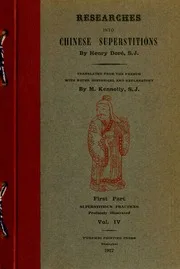
Henri Doré's 'Chinese Folk Worship' is less a narrative and more an encyclopedic archive, a testament to a dedicated missionary's ethnographic rigor. The sheer breadth of cataloged deities and rituals is astonishing, offering a granular view into a spiritual ecosystem often overlooked by scholarly focus on philosophical traditions. One particularly illuminating section details the worship of local earth gods (Tudi Gong), revealing their intimate connection to village life and agricultural cycles. However, the work's primary limitation lies in its perspective; while invaluable for its documentation, it occasionally betrays a subtle undertone of cataloging the 'exotic' from a Western, Catholic lens. Despite this, the book serves as an indispensable primary source for understanding the lived religious experience of ordinary Chinese people. It remains a foundational text for anyone studying Chinese popular religion.
📝 Description
82
### What It Is
中国民间崇拜, or 'Chinese Folk Worship,' presents an extensive catalog of the diverse deities, spirits, and ritualistic practices that have permeated Chinese society for centuries. Henri Doré, a French Jesuit missionary and ethnographer, meticulously documented these traditions, offering an insider's perspective on the syncretic nature of popular religion. The work is not a theoretical treatise but a detailed compilation of observed beliefs and customs, ranging from imperial ancestor veneration to the worship of local agricultural deities.
### Who It's For
This volume is essential for scholars of Chinese religion, cultural historians, anthropologists, and anyone seeking a granular understanding of non-canonical spiritual life in China. It appeals to those interested in comparative religion, particularly the intersection of Buddhism, Taoism, and Confucianism in popular practice. Readers with an interest in the history of missionary work and its ethnographic contributions will also find value.
### Historical Context
The original research for Doré's work likely took place during the early 20th century, a period of significant upheaval and transition in China. As Western influence grew and traditional structures began to shift, figures like Doré attempted to capture and preserve ethnographic data. This book emerged from a broader European academic interest in non-Western cultures, often undertaken by missionaries who possessed unique access and observational opportunities. The compilation reflects a critical attempt to categorize and understand a complex religious landscape from an external viewpoint.
### Key Concepts
The book systematically explores the pantheon of Chinese folk religion, detailing the attributes and worship methods for numerous deities. It highlights the concept of 'syncretism,' where elements from different religious traditions—Buddhism, Taoism, Confucianism, and local animism—are blended into a cohesive, albeit often localized, spiritual practice. Ancestor worship is presented as a foundational element, underscoring the Confucian emphasis on filial piety and societal harmony. The work also touches upon the role of talismans, divination, and spirit mediums in mediating between the human and spiritual realms.
💡 Why Read This Book?
• Learn about the worship of specific local deities like the Tudi Gong, understanding their role in agricultural communities, a concept meticulously documented by Doré during his extensive fieldwork. • Gain insight into the syncretic nature of Chinese popular religion by examining how Buddhist, Taoist, and Confucian elements merge in practices observed by Doré in the early 20th century. • Discover the importance of ancestor veneration within the broader context of Chinese folk beliefs, as detailed in Doré's comprehensive survey of familial and societal rituals.
⭐ Reader Reviews
Honest opinions from readers who have explored this book.
❓ Frequently Asked Questions
What is the original language of '中国民间崇拜'?
The original title '中国民间崇拜' is in Chinese. Henri Doré, the author, was French, and his extensive ethnographic work was initially published in French before being translated.
When was Henri Doré's research on Chinese folk worship conducted?
Henri Doré conducted his extensive ethnographic research on Chinese folk worship during the early 20th century, a period when he served as a missionary in China.
What is Tudi Gong and why is it significant in Chinese folk worship?
Tudi Gong, or the Earth God, is a crucial figure in Chinese folk worship. The book details how this deity is venerated at a local level, often tied to specific villages and agricultural cycles, highlighting the localized nature of popular religious practice.
Does the book discuss the influence of Taoism and Buddhism on Chinese folk religion?
Yes, Henri Doré's work extensively details the syncretic nature of Chinese folk worship, showing how elements from Taoism, Buddhism, and Confucianism are blended with indigenous beliefs and practices.
Is 'Chinese Folk Worship' a scholarly analysis or an ethnographic survey?
The book functions primarily as an ethnographic survey, meticulously cataloging deities, rituals, and beliefs observed by Henri Doré during his time in China, rather than offering a theoretical interpretation.
What is the Esoteric Library's edition of '中国民间崇拜'?
The Esoteric Library's edition offers a curated version of Henri Doré's seminal work on Chinese folk worship, making this historical ethnographic record accessible to contemporary readers interested in esoteric and religious studies.
🔮 Key Themes & Symbolism
The Pantheon of Popular Deities
Doré meticulously documents a vast array of gods, goddesses, and spirits worshipped in Chinese folk traditions. This includes not only major figures but also local patrons, nature spirits, and deified historical personages. The work emphasizes the practical, everyday roles these deities played in people's lives, from ensuring good harvests to protecting against illness. It highlights how these figures formed a dynamic spiritual ecosystem, accessible to the common populace and integrated into the fabric of daily existence, often blending characteristics from Buddhist, Taoist, and Confucian traditions.
Syncretism in Practice
A central theme is the pervasive syncretism within Chinese popular religion. Doré illustrates how distinct religious and philosophical systems—Buddhism, Taoism, Confucianism—did not exist in isolation but frequently merged. Deities might be adopted from one tradition and given attributes or rituals from another. The book provides concrete examples of this blending, showing how festivals, iconography, and theological concepts intertwined, creating a flexible and adaptive spiritual landscape that responded to local needs and cultural influences.
Ancestor Worship and Filial Piety
The profound significance of ancestor worship is a recurring motif throughout Doré's survey. He details the rituals, altars, and social obligations associated with venerating deceased family members. This practice is presented not merely as a religious rite but as a cornerstone of Confucian social order and familial ethics, reinforcing bonds between the living and the dead. The book underscores how this devotion to ancestors contributed to social cohesion and the maintenance of tradition across generations.
Rituals and Observances
Doré's ethnographic approach captures the myriad rituals and observances that characterized Chinese folk religion. This encompasses everything from elaborate temple ceremonies and public festivals to private household rites and individual prayers. The work details the use of offerings, incantations, talismans, and divination methods. These practices provided structure and meaning, offering devotees a means to interact with the spiritual world, seek blessings, and ward off misfortune, reflecting a deeply embedded cosmological worldview.
💬 Memorable Quotes
“The Tudi Gong, or Earth God, is a ubiquitous figure in Chinese village life.”
— This highlights the localized and omnipresent nature of certain deities in Chinese folk worship. The Earth God's connection to the land and agricultural cycles made him a vital figure for communities reliant on farming, demonstrating the practical integration of religion into daily existence.
“Buddhist and Taoist elements often blend seamlessly in popular temples.”
— This observation points to the profound syncretism that defines Chinese folk religion. It signifies that practitioners did not strictly adhere to singular doctrines but freely incorporated figures and practices from various traditions to meet spiritual needs.
“Ancestor veneration forms the bedrock of familial and social obligations.”
— This conveys the deep-seated importance of ancestor worship, linking it directly to the Confucian ethical framework of filial piety and social harmony. It suggests that respect for the dead was fundamental to maintaining community structure and personal integrity.
“Talismans and charms served as tangible means of protection against malevolent forces.”
— This emphasizes the practical, apotropaic function of many folk religious practices. It illustrates how individuals sought direct, material means to engage with and influence the spiritual realm, particularly for safeguarding against perceived threats.
“The worship of local patrons ensured the well-being of specific communities.”
— This underscores the highly localized and specialized nature of folk deities. Unlike universal gods, these patrons were tied to particular geographical areas or social groups, reflecting a belief system deeply rooted in place and community identity.
🌙 Esoteric Significance
Tradition
While not strictly belonging to a single esoteric lineage like Hermeticism or Kabbalah, Doré's work is foundational for understanding the practical application of esoteric principles within a specific cultural matrix. Chinese folk worship embodies a potent form of practical magic and animism, deeply interwoven with Taoist cosmology and Buddhist concepts of rebirth and karma. It represents a vital, earth-bound manifestation of esoteric thought, focusing on direct interaction with spiritual forces for worldly benefit, a common thread in many esoteric traditions seeking to harness unseen powers.
Symbolism
The book details numerous symbols crucial to Chinese folk religion. The Dragon, a potent symbol of imperial power, fertility, and auspiciousness, appears frequently in iconography and rituals. The Yin-Yang symbol (Taijitu) represents the fundamental duality and balance of the cosmos, a concept central to Taoist philosophy and integrated into folk beliefs. Representations of the Eight Immortals, each with their own Taoist legend and associated powers, also feature prominently, embodying different aspects of spiritual attainment and worldly desires.
Modern Relevance
Contemporary scholars of religion, anthropology, and sinology continue to reference Doré's meticulous cataloging as a primary source for understanding the historical roots of modern Chinese spiritual practices. Practitioners of Taoism and those interested in comparative religion draw upon his descriptions to understand the syncretic evolution of these traditions. Furthermore, the book's detailed account of spirit mediums and shamanic practices offers insights relevant to modern parapsychological and occult studies, providing historical context for phenomena that continue to fascinate and be explored.
👥 Who Should Read This Book
• Scholars of East Asian religions and cultural history seeking primary source material on pre-modern Chinese spiritual practices. • Anthropologists and ethnographers interested in detailed accounts of ritual, belief systems, and social structures in a non-Western context. • Individuals exploring comparative religion or esoteric traditions who wish to understand the diverse manifestations of spiritual belief and practice across cultures.
📜 Historical Context
Henri Doré's extensive work on Chinese folk worship was compiled during a period of profound societal change in early 20th century China. As a French Jesuit missionary, his research (likely conducted between the 1910s and 1930s) coincided with both increased Western engagement with China and internal shifts away from imperial structures. This era saw a surge in ethnographic documentation by Western scholars, often missionaries who possessed unique access to local customs. Doré’s efforts can be seen in the context of a broader European academic and religious interest in understanding non-Western cultures, paralleling the work of figures like Marcel Granet, who also studied Chinese society and religion, albeit with different theoretical frameworks. While Doré's work aimed at documentation, it implicitly engaged with the prevailing intellectual currents that sought to categorize and sometimes pathologize non-Western spiritual practices. The sheer volume and detail of his observations provided an invaluable, albeit externally viewed, record of a complex religious landscape.
📔 Journal Prompts
The ubiquitous Tudi Gong and its local significance.
Syncretic blending of Buddhist and Taoist iconography in temples.
The role of ancestor veneration in maintaining social order.
The practical application of talismans and charms for protection.
The symbolic meaning of the Dragon in Chinese folk worship.
🗂️ Glossary
Tudi Gong (土地公)
Literally 'Earth God,' this is a local deity revered in Chinese folk religion, often responsible for the well-being of a specific village, area, or even a single building. Worship is typically localized and tied to agricultural cycles and community protection.
Syncretism
The merging or blending of different religious and philosophical beliefs, symbols, and practices. In Chinese folk religion, this commonly involves the integration of elements from Buddhism, Taoism, Confucianism, and indigenous animistic beliefs.
Ancestor Veneration
A religious practice where deceased family members are honored and respected, often through rituals, offerings, and memorial services. It is a cornerstone of Confucian filial piety and deeply embedded in Chinese social and spiritual life.
Talismans (符)
Objects or inscribed papers believed to possess magical properties, used for protection, good fortune, or to ward off evil spirits. They are a common feature in Chinese folk religion and Taoism.
Dragon (龍)
A powerful and auspicious mythological creature in Chinese culture, symbolizing imperial authority, power, strength, good luck, and control over natural forces like water and rain.
Eight Immortals (八仙)
A group of legendary Taoist figures who have attained immortality. Each Immortal is associated with specific attributes and is widely revered in Chinese folk religion and Taoism.
Spirit Medium (乩童)
An individual believed to be possessed by a spirit or deity, who then acts as an intermediary to communicate messages, offer prophecies, or perform rituals. This practice is common in certain forms of Chinese folk religion.