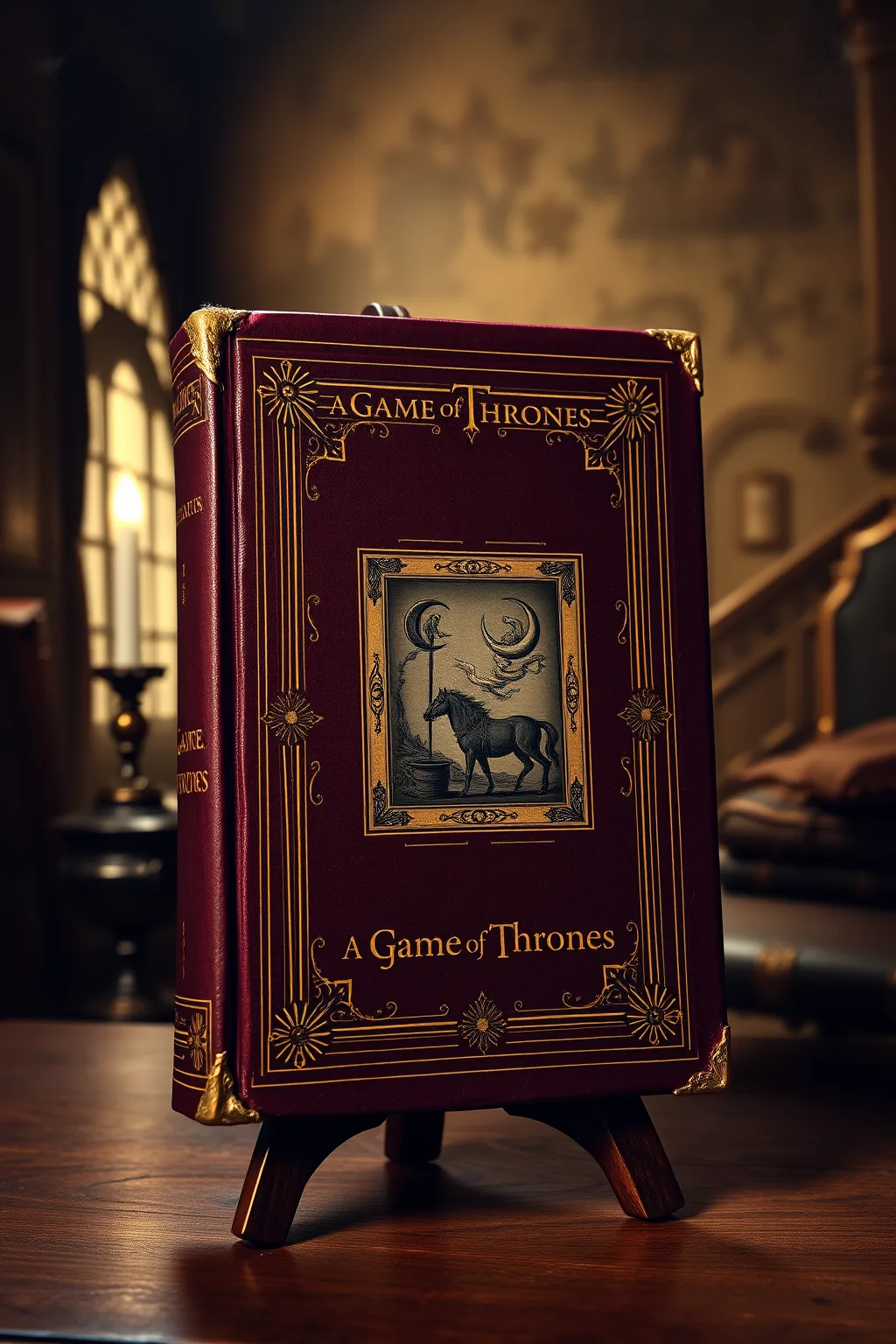
A Game of Thrones
 78
78

A Game of Thrones
George R. R. Martin’s *A Game of Thrones* does not shy away from the grim realities of power struggles. The novel’s strength lies in its meticulously crafted political machinations and its morally grey characters, particularly the Stark family’s descent into the viper’s nest of King’s Landing. The introduction of Daenerys Targaryen’s storyline in Essos, though initially slower, lays crucial groundwork. A notable limitation is the sheer number of characters and plot threads introduced, which can feel overwhelming, demanding significant reader investment from the outset. The scene depicting Eddard Stark’s growing unease and suspicion in the capital, particularly his interactions with Varys and Littlefinger, exemplifies the novel’s sharp portrayal of courtly deceit. Ultimately, *A Game of Thrones* is a demanding but rewarding entry into a modern epic that prioritizes consequence over comfort.
📝 Description
78
### What It Is
A Game of Thrones, the inaugural volume in George R. R. Martin's epic fantasy series *A Song of Ice and Fire*, was first published in 1996. It introduces readers to the fictional continent of Westeros and its complex political landscape, focusing on the noble families vying for control of the Iron Throne. The narrative unfolds across multiple perspectives, presenting a sprawling world populated by humans and hinting at ancient, supernatural forces.
### Who It's For
This work is suited for readers who appreciate intricate world-building, morally ambiguous characters, and narratives that eschew simple heroism. Those interested in the dynamics of power, the consequences of ambition, and the often brutal realities of medieval-esque societies will find ample material. It appeals particularly to those who enjoy epic sagas with deep historical and political underpinnings.
### Historical Context
Published in 1996, *A Game of Thrones* emerged during a period of renewed interest in epic fantasy, following successes like Robert Jordan's *The Wheel of Time* series. Martin's approach, however, distinguished itself by its unflinching realism and its willingness to subvert typical genre conventions. While Tolkien had established a benchmark for detailed world-building, Martin’s work engaged with more mature themes and political machinations, drawing comparisons to historical chronicles and challenging the idealized portrayals of fantasy then prevalent.
### Key Concepts
The narrative explores themes of power, duty, honor, and survival. It examines the corrupting influence of ambition and the stark consequences of political intrigue. The concept of "winter is coming," a recurring phrase, serves as a potent symbol for impending doom and the necessity of preparation against overwhelming, cyclical threats. The interplay between human agency and destiny, particularly in the face of ancient prophecies and magical undertones, forms a central tension.
💡 Why Read This Book?
• Gain insight into the pragmatic application of political strategy and negotiation, as exemplified by the subtle maneuvering within King's Landing's Small Council. • Understand the symbolic weight of "winter is coming," a motif representing cyclical threats and the necessity of foresight, crucial for navigating the narrative's escalating conflicts. • Experience the visceral impact of consequences, as demonstrated by Eddard Stark's fate, which underscores the novel's departure from conventional heroic arcs.
⭐ Reader Reviews
Honest opinions from readers who have explored this book.
❓ Frequently Asked Questions
When was George R. R. Martin's A Game of Thrones first published?
A Game of Thrones, the first book in the A Song of Ice and Fire series, was initially published in 1996 by Bantam Spectra.
What are the main families featured in A Game of Thrones?
The primary noble houses introduced are the Starks of Winterfell, the Lannisters of Casterly Rock, and the Baratheons of Storm's End, alongside the deposed Targaryens.
What is the significance of 'winter is coming' in the book?
This Stark family motto serves as a recurring symbol for impending hardship, political upheaval, and potentially supernatural threats, emphasizing the need for preparedness.
Where does the story of A Game of Thrones take place?
The narrative unfolds primarily across the continent of Westeros, with significant storylines also set in the eastern continent of Essos.
Does A Game of Thrones contain magic and supernatural elements?
Yes, while grounded in political realism, the book incorporates subtle hints of magic, ancient prophecies, and the potential return of mythical creatures and forces.
Who is the author of A Game of Thrones?
The author is George R. R. Martin, an American novelist and short-story writer, known for his epic fantasy series A Song of Ice and Fire.
🔮 Key Themes & Symbolism
The Nature of Power
The novel meticulously dissects the acquisition, maintenance, and corrupting influence of power. It contrasts the blunt force of the Lannisters with the perceived honor of the Starks, demonstrating how political acumen, manipulation, and sheer ruthlessness often triumph over traditional virtues. The struggle for the Iron Throne serves as the central axis around which these power dynamics revolve, illustrating that power is not merely held but constantly contested and reshaped through alliances, betrayals, and strategic maneuvering within the court of King's Landing.
Honor vs. Survival
A central tension lies in the conflict between adherence to codes of honor and the pragmatic demands of survival in a treacherous world. Characters like Eddard Stark embody a rigid sense of duty and justice, which often proves detrimental in the cutthroat politics of Westeros. Conversely, characters who compromise their principles or act with ruthless expediency often fare better, raising questions about the efficacy of honor in a world that rewards cunning and ruthlessness. This dichotomy forces readers to question the true meaning of virtue when faced with existential threats.
Impending Doom and Prophecy
The pervasive threat of "winter is coming" functions as more than a mere climatic warning; it symbolizes a larger, cyclical force of destruction and change that looms over Westeros. Coupled with ancient prophecies and the subtle re-emergence of magic, this theme introduces an element of fate and destiny that characters must confront. The narrative explores how individuals and societies react to the foreknowledge of catastrophe, grappling with belief, denial, and preparation in the face of overwhelming, potentially supernatural, adversity.
Family and Loyalty
The bonds of family and the dictates of loyalty are paramount forces driving the narrative. The Stark children, bound by duty to their father and their northern home, face immense pressure as they are drawn into the dangerous politics of the south. Similarly, the Lannisters operate with a fierce, albeit often twisted, loyalty to their own house, prioritizing its advancement above all else. These familial allegiances shape alliances, fuel conflicts, and determine the personal stakes for each character navigating the brutal landscape.
💬 Memorable Quotes
“A reader has no life, but he has infinite lives. He learns and loves and laughs and weeps in worlds beyond his own.”
— This is not a direct quote from the book but a conceptual interpretation of the reader's experience within the narrative. It highlights how engaging with stories allows individuals to transcend their own existence and experience a multitude of lives and emotions vicariously.
“Winter is coming.”
— This Stark family motto encapsulates a pervasive sense of impending doom and the need for vigilance. It represents not just a literal cold season but also the arrival of political turmoil, supernatural threats, and existential challenges that loom over Westeros.
“The lone wolf dies, but the pack survives.”
— This adage, often attributed to the Starks, emphasizes the importance of collective strength and loyalty. It suggests that individual survival is secondary to the continuation and well-being of the group, highlighting the value placed on familial and communal bonds.
“When you play the game of thrones, you win or you die. There is no middle ground.”
— This statement, often paraphrased or implied within the text, underscores the absolute and unforgiving nature of the political struggle for power. It asserts that the contest for the Iron Throne allows for no neutrality or partial success; failure results in utter destruction.
“The things I do for love.”
— Uttered by Jaime Lannister, this phrase reveals the complex motivations behind his actions, particularly his infamous deed. It suggests that even morally reprehensible acts can be driven by a twisted sense of affection or loyalty, adding a layer of tragic depth to his character.
🌙 Esoteric Significance
Tradition
While not strictly adhering to a single esoteric lineage, *A Game of Thrones* draws upon archetypal themes found in Western esotericism, particularly Gnosticism and Hermeticism. The struggle against perceived malevolent forces (like the White Walkers), the exploration of hidden knowledge and prophecies, and the emphasis on inner transformation (or corruption) through trials echo Gnostic narratives. The cyclical nature of history and the manipulation of power dynamics can be seen through a Hermetic lens, where understanding universal laws allows for influence over the material world. The work departs by embedding these elements within a deeply materialistic and political framework, rather than a purely spiritual quest.
Symbolism
The recurring motif of "winter is coming" symbolizes not only literal hardship but also the return of ancient, perhaps magical, forces that threaten the established order, echoing apocalyptic themes found in various mythologies. The Iron Throne itself is a potent symbol of ultimate, often corrupting, power, forged through conquest and maintained through fear and manipulation. The dragons, once symbols of Targaryen dominion and immense power, represent lost magic and a potential catalyst for radical change, hinting at a reawakening of primordial forces that challenge human dominion.
Modern Relevance
Contemporary esoteric thought often examines power structures and societal decay, making Martin's work relevant. Thinkers and practitioners in fields like political occultism or those exploring Jungian archetypes in modern narratives find resonance in the book's depiction of shadow selves, the corrupting nature of power, and the cyclical patterns of conflict. The series’ exploration of hidden influences and the subversion of conventional morality provides fertile ground for analyzing societal dynamics through an esoteric framework, prompting reflection on the hidden forces that shape human affairs.
👥 Who Should Read This Book
• Readers interested in political philosophy and strategy who wish to see abstract concepts like Machiavellianism and the balance of power dramatized through compelling character arcs. • Aspiring writers and world-builders seeking detailed examples of intricate plot construction, multi-perspective narration, and the creation of complex, lived-in fictional societies. • Students of mythology and comparative religion looking to analyze how archetypal themes of prophecy, cyclical destruction, and the return of magic are integrated into contemporary popular fiction.
📜 Historical Context
When *A Game of Thrones* was released in 1996, the fantasy genre was largely dominated by the heroic quests and clear demarcations of good versus evil exemplified by authors like J. R. R. Tolkien and the burgeoning *Wheel of Time* series by Robert Jordan. Martin’s novel offered a stark departure, grounding its epic scope in the gritty realism of medieval politics and human frailty. Unlike the more archetypal figures prevalent in contemporary fantasy, Martin populated his world with complex, often morally ambiguous characters whose decisions had tangible, brutal consequences. The book’s reception was positive, though its sheer scale and mature themes signaled a shift in what epic fantasy could encompass. It engaged with a tradition of historical fiction, particularly works focusing on dynastic struggles like Sharon Kay Penman's novels, while infusing it with speculative elements. This approach challenged established genre norms and paved the way for a new wave of darker, more intricate fantasy narratives.
📔 Journal Prompts
The implications of Eddard Stark's adherence to honor in King's Landing.
Reflect on the symbolic meaning of "winter is coming" in relation to personal challenges.
Analyze the motivations behind Jaime Lannister's actions and the phrase 'The things I do for love.'
Consider the contrast between Stark loyalty and Lannister ambition.
Explore the nature of power as depicted through the struggle for the Iron Throne.
🗂️ Glossary
The Iron Throne
The seat of power in Westeros, forged from the swords of Aegon the Conqueror's defeated enemies. It represents absolute rule and is the object of intense political struggle throughout the series.
King's Landing
The capital city of the Seven Kingdoms of Westeros and the seat of the Iron Throne. It is a center of political intrigue, power plays, and courtly machinations.
The Wall
An immense structure of ice separating the Seven Kingdoms from the wild lands to the north. It is guarded by the Night's Watch and symbolizes a bulwark against unknown threats.
Essos
The large eastern continent, home to various city-states, nomadic tribes, and the exiled Targaryen dynasty. Many characters, like Daenerys, spend significant time here.
Small Council
The king's chief advisors in King's Landing, responsible for managing the realm's affairs. Membership is highly coveted and a source of significant political maneuvering.
Maester
Scholars trained at the Citadel in Oldtown. They serve as advisors, healers, and record-keepers for the noble houses of Westeros, often possessing vast knowledge.
The Night's Watch
An ancient order sworn to defend the Wall and the Seven Kingdoms from threats beyond. Its members often come from the lowest strata of society.