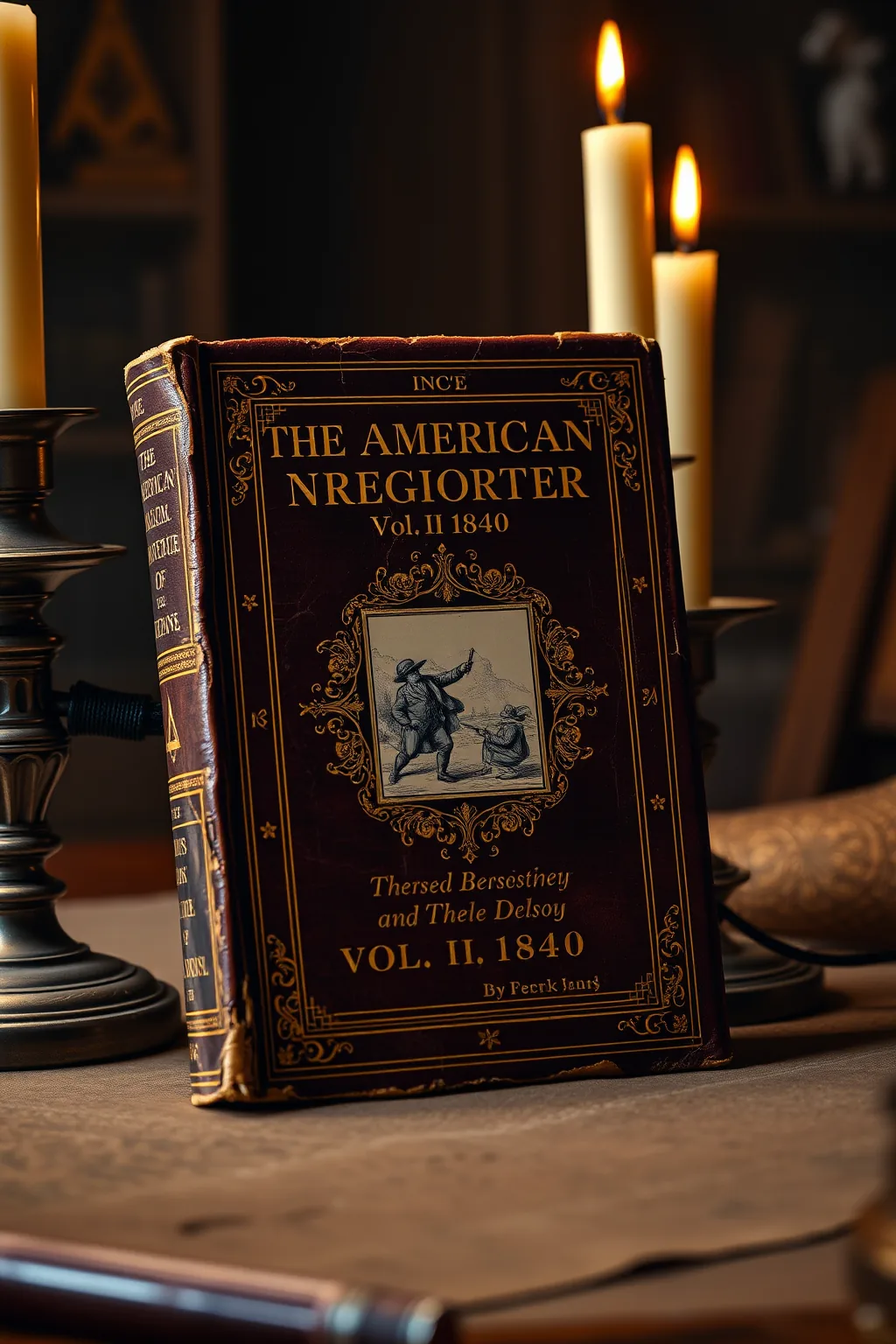
The American Masonic Register Vol II 1840
 76
76

The American Masonic Register Vol II 1840


Silas Hawthorne (Hermetic Studies Editor) — 'The American Masonic Register Vol II, 1840' is a vital artifact for anyone plumbing the depths of Masonic esotericism. This volume eschews superficial accounts, instead offering a profound glimpse into the philosophical and symbolic architecture that undergirded 19th-century American Masonry. Its strength lies in its authentic portrayal of the intellectual currents and symbolic language employed by the Craft during this formative period. Scholars and dedicated practitioners will find invaluable material for understanding the esoteric underpinnings of the fraternity, offering a richer, more nuanced perspective than commonly encountered. It serves as a crucial bridge to understanding the evolution of Western esoteric thought.
📝 Description
76
The American Masonic Register Vol II, published in 1840, details 19th-century American Freemasonry's esoteric currents.
This 1840 volume of The American Masonic Register offers a look into the esoteric practices and beliefs within 19th-century American Freemasonry. It moves beyond simple descriptions of rituals to present a complex picture of the symbolism, philosophical ideas, and the search for hidden knowledge prevalent in fraternal groups of the time. The text suggests a connection to generational secrets and the members' drive for self-improvement and understanding.
This register is intended for those seriously interested in Masonic traditions, students of mystical history, or individuals seeking to grasp the historical basis of Western esoteric thought. It highlights the philosophical foundations of Masonic ideas, including concepts like cosmic order, the creator figure, and personal transformation through alchemical parallels. The writing style encourages serious thought and reflection on the long-standing questions that have influenced spiritual and philosophical discussions.
Published in 1840, this register sits within a period of significant interest in esoteric traditions across the West. It reflects Freemasonry's engagement with ideas found in Hermeticism, Kabbalah, and early Rosicrucianism, which often sought to interpret religious and philosophical texts through symbolic and allegorical lenses. The focus on alchemy and celestial harmony suggests an effort to integrate these older esoteric systems with contemporary Masonic ritual and moral philosophy, aiming for a comprehensive understanding of the spiritual life.
💡 Why Read This Book?
Uncover the rich, often hidden, esoteric dimensions of American Freemasonry in the mid-19th century. This volume offers a rare glimpse into the philosophical debates, symbolic interpretations, and spiritual aspirations of the Craft. Ideal for scholars, practitioners, and seekers of esoteric knowledge who wish to understand the deep roots of fraternal mysteries and their impact on Western thought.
⭐ Reader Reviews
Honest opinions from readers who have explored this book.
❓ Frequently Asked Questions
What is the primary focus of 'The American Masonic Register Vol II, 1840'?
This volume primarily focuses on the philosophical, symbolic, and ritualistic aspects of American Freemasonry in 1840, offering insights into the esoteric teachings and intellectual pursuits of the time.
Is this book suitable for beginners interested in Freemasonry?
While accessible, the book delves into complex esoteric themes. Beginners may benefit from prior foundational knowledge of Freemasonry or esoteric studies to fully appreciate its depth.
What kind of knowledge can be gained from this register?
Readers can gain knowledge of Masonic symbolism, philosophical concepts, historical context of American lodges, and the spiritual quest for enlightenment prevalent in the era.
Is the author's identity known?
The author of this specific volume is officially listed as Unknown, which is common for compiled registers of this nature, often overseen by committees or lodge officers.
Where can I read this text?
As part of the Esoteric Library, this historical text is available to read and explore online, offering free access to its profound contents.
🔮 Key Themes & Symbolism
The Philosophy of the Square and Compass
This volume meticulously unpacks the profound philosophical underpinnings of Freemasonry, particularly focusing on the symbolic language of the square and compass. It explores how these foundational emblems represent moral rectitude, the pursuit of knowledge, and the harmonious integration of earthly duties with spiritual aspirations. The text looks at the geometric and cosmological significance attributed to these symbols, reflecting a belief in an ordered universe governed by divine principles, and how the Mason strives to align their life with this cosmic blueprint.
Arcane Symbolism and Hidden Meanings
Fundamentally, , 'The American Masonic Register Vol II, 1840' is a repository of arcane symbols and their intricate interpretations within the Masonic tradition. Readers will encounter discussions on classical allegories, ancient mysteries, and the veiled meanings embedded within rituals and degrees. The text suggests that Freemasonry acts as a vehicle for transmitting ancient wisdom, using a rich symbolic vocabulary to guide the initiate through a process of inner transformation and the discovery of profound truths about existence and the human condition.
The Quest for Enlightenment and Moral Perfection
This register illuminates the central Masonic tenet of self-improvement and the relentless pursuit of enlightenment. It portrays Freemasonry as a spiritual path, a 'school of virtue,' where members are encouraged to cultivate their moral character, develop intellectual acuity, and strive for a higher state of being. The volume details the methods and ideals espoused by the fraternity to achieve this, emphasizing the journey of personal discovery and the aspiration to become a better individual and a more contributing member of society.
💬 Memorable Quotes
Direct passages from the work, attributed to the author.
“Light is the reward of diligent search.”
— Emphasizes that true understanding and spiritual illumination are not passively received but are the direct consequence of dedicated effort and intellectual inquiry.
“The greatest of all temples is the human heart.”
— Highlights the internal nature of true worship and spiritual development, suggesting that the most sacred space is within oneself, to be cultivated with virtue.
“We learn to live by dying daily to our vices.”
— Illustrates the principle of constant self-abnegation and moral discipline as essential for spiritual progress and achieving a more virtuous existence.
“The compass guides the square, and the square rectifies the compass.”
— A profound statement on balance: reason (compass) must be tempered by morality (square), and vice versa, for a well-lived life.
💡 Key Ideas
Editorial paraphrase of the work's core concepts — not direct quotes.
The rough ashlar must be perfected ere it can be placed in the building.
This quote captures the Masonic journey of self-transformation, likening the unrefined individual to a rough stone that must be worked and shaped to fit into the spiritual edifice of humanity.
🌙 Esoteric Significance
Tradition
This volume is deeply rooted in the Western Esoteric Tradition, particularly its Masonic expression. It draws upon Hermeticism, Kabbalah (though often implicitly through symbolic language), Neoplatonism, and alchemical philosophy. The underlying aim is the Great Work—the spiritual transformation of the individual from a state of ignorance to one of illumination, mirroring the cosmic order and the divine architect's plan. It represents a practical application of these ancient esoteric principles within a structured fraternal context.
Symbolism
The register is rich with Masonic symbolism, including the Square, Compasses, Level, Plumb Rule, the Blazing Star, and the All-Seeing Eye. These are not merely decorative but are imbued with profound meaning, representing moral virtues, cosmic principles, and stages of spiritual development. The text interprets these symbols as keys to unlocking deeper truths about existence, the nature of the divine, and the path to self-realization, serving as a visual and conceptual language for esoteric teachings.
Modern Relevance
Despite its historical origins, the core tenets of self-improvement, ethical conduct, and the pursuit of knowledge presented in this register remain profoundly relevant. In an age often characterized by superficiality and disconnection, the call to inner work, moral rectitude, and the search for deeper meaning resonates strongly. The symbolic language, while specific to Freemasonry, offers universal insights into the human condition and the timeless quest for wisdom and spiritual fulfillment.
👥 Who Should Read This Book
This volume is essential for Masonic scholars and historians seeking primary source material on 19th-century American lodges. Dedicated practitioners of Freemasonry will find it important for deepening their understanding of ritualistic symbolism and philosophical underpinnings. Esoteric seekers and students of Western mystery traditions will discover a rich vein of thought that bridges classical philosophy with fraternal practices. Beginners interested in the esoteric aspects of Freemasonry will gain a foundational appreciation for its intellectual depth and symbolic language, though some prior context may enhance comprehension.
📜 Historical Context
Published in 1840, 'The American Masonic Register Vol II' emerges from a period of significant growth and intellectual ferment within American Freemasonry. The early to mid-19th century saw the fraternity deeply entwined with the nation's developing identity, influencing social reform, civic discourse, and the philosophical landscape. This era was marked by a renewed interest in esoteric traditions, a synthesis of Enlightenment rationalism with Romantic idealism, and a fascination with ancient wisdom. Masonic lodges served as intellectual hubs, fostering discussions on morality, governance, and spirituality. The Register reflects this milieu, capturing the earnest efforts of Masons to articulate and preserve their system of moral and spiritual instruction amidst a rapidly changing society, while also hinting at the enduring appeal of secret knowledge and fraternal bonds.
📔 Journal Prompts
Reflect on the metaphor of the 'rough ashlar' and how it applies to your own personal development.
How does the concept of 'light' as a reward for 'diligent search' resonate with your own pursuit of knowledge?
Consider the idea of the 'human heart' as a temple. What practices can you undertake to cultivate it?
Analyze the interplay between the Square and Compasses in your own life. Where do you find balance, and where is there discord?
What 'vices' do you feel you need to 'die to' daily to progress spiritually?
🗂️ Glossary
Ashlar
In Freemasonry, refers to a stone from the quarry. The 'rough ashlar' represents the unrefined state of humanity, while the 'perfect ashlar' symbolizes the perfected individual, shaped by moral and spiritual discipline.
Lodge
The local assembly or branch of Freemasonry, where rituals are performed and discussions on moral and philosophical topics take place.
Degree
A stage or level of initiation within Freemasonry, each accompanied by specific teachings, symbols, and allegorical lessons designed for the candidate's progression.
Ritual
The prescribed form and order of ceremonies and symbolic actions used in Masonic meetings, intended to convey moral and spiritual instruction through allegory and symbolism.
Esoteric
Relating to or accessible only by a relatively small number of people with a specialized knowledge or interest; inner, mystical, or secret doctrines.
This book appears in 2 collections
🔮 Readers Also Liked
Browse all →



From the “Secret Societies” Collection
View all →

More Free Freemasonry & Secret Societies Books
View all →